
Grade 4 Word Problems: The Question That Changes Everything
“I don’t know what to do.” That’s what I hear most often when a Grade 4 student stares at a word problem, not because the math itself is too hard, but because nobody’s ever taught them the one question that actually unlocks the whole process. So I ask it for them: “Forget the numbers for a second. What is this story actually about?” Nine times out of ten, once a child can answer that in plain language, the math falls into place within seconds.
That question — what is this story actually about — is the entire difference between a child who freezes on Grade 4 word problems and one who works through them calmly. Everything below builds from that single starting point.
Why Grade 4 Word Problems Feel Harder Than the Math They Contain
By Grade 4, students already know how to multiply, divide, subtract, and work with fractions in isolation. What Ontario’s curriculum adds this year is the expectation that students combine these skills inside multi-step, multi-strand word problems — often blending two or three operations within a single story. The math isn’t new. The combination is.
This is exactly why so many capable students hit a wall here. They’re not lacking a skill. They’re lacking a process for deciding which skills apply, and in what order.
The Framework: Story First, Numbers Second
This same five-step approach works for every type of Grade 4 word problems your child will encounter this year, whether the story involves one operation or several combined together.
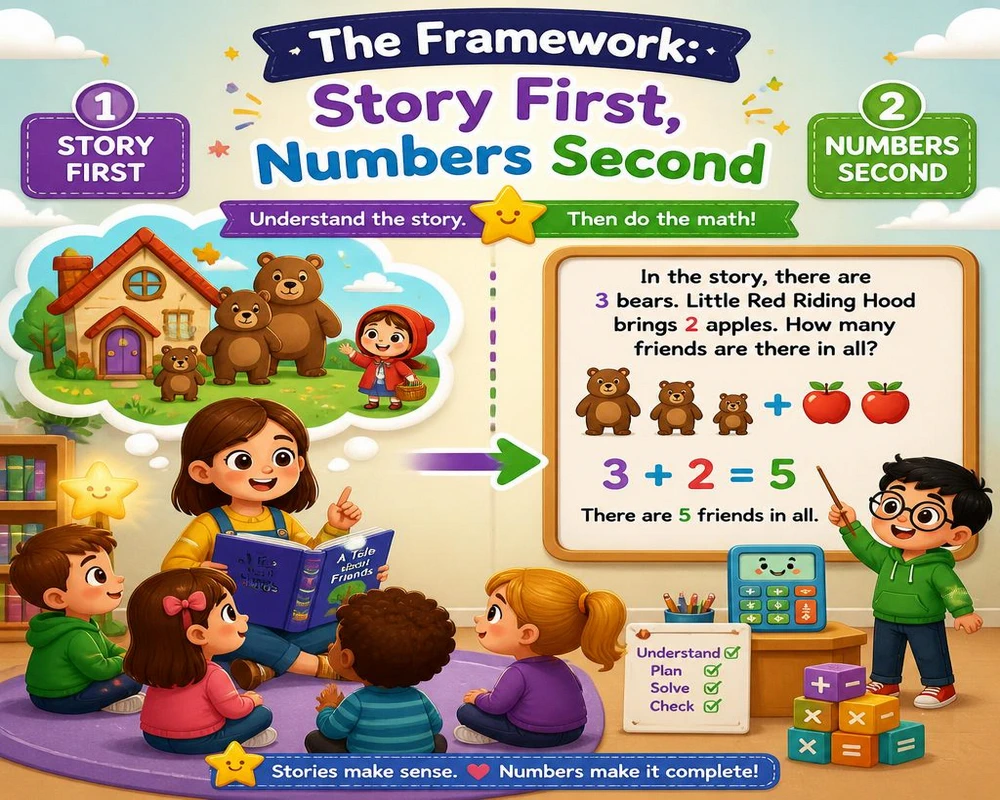
Step 1: Retell the Story Without Any Numbers
Before touching a single digit, have your child explain what’s happening in their own words. “A bakery makes cookies and sells some, and we need to find out how many are left” is a complete, useful retelling — and it requires zero calculation to produce.
Step 2: Identify What’s Actually Being Asked
Circle or underline the specific question at the end. This sounds obvious, but a huge share of wrong answers come from solving a different question than the one actually asked.
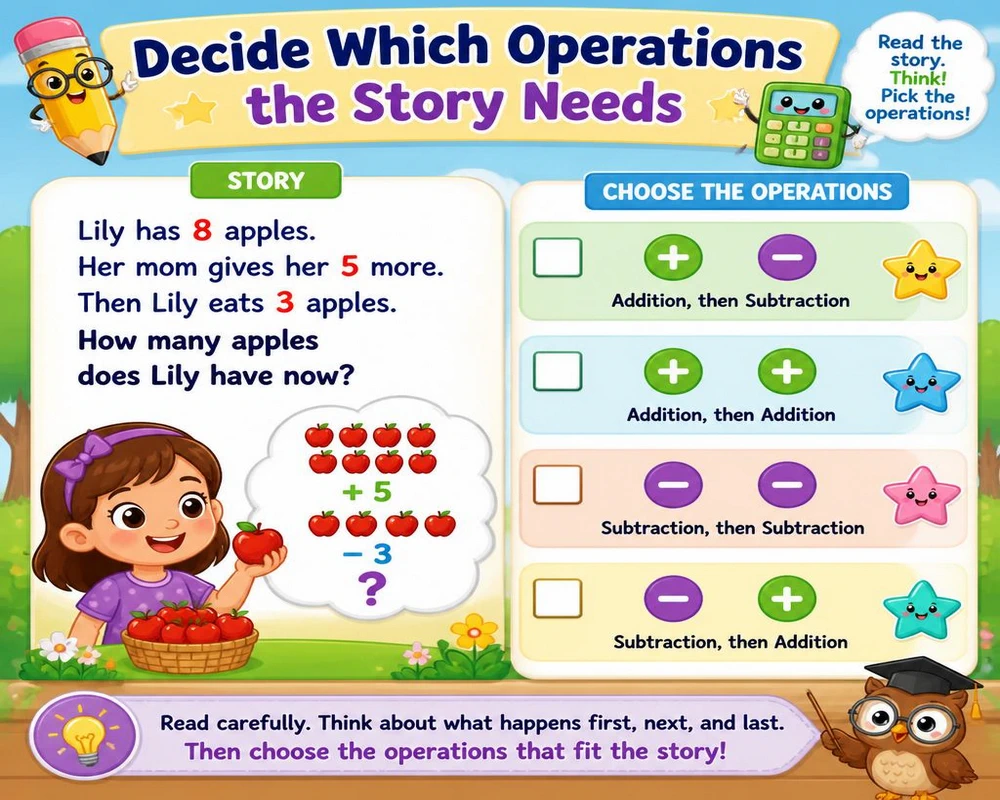
Step 3: Decide Which Operations the Story Needs
Now, and only now, bring the numbers back in. Ask: does this story involve combining amounts, taking away, sharing into groups, or comparing? Sometimes it’s more than one.
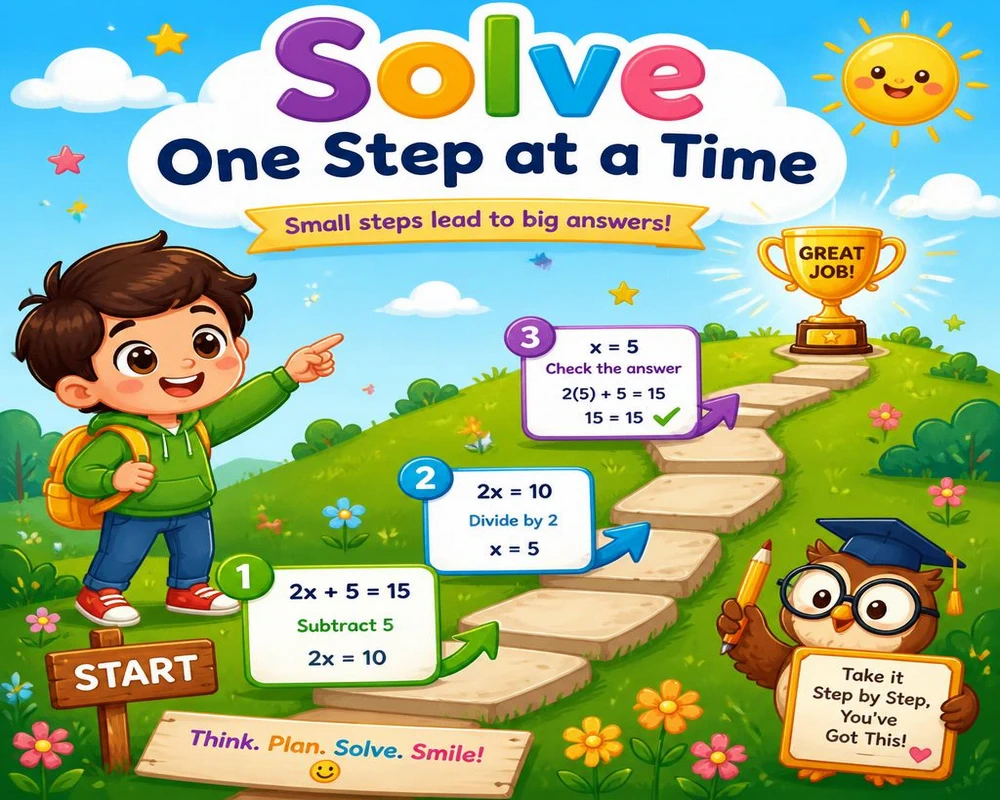
Step 4: Solve One Step at a Time
For multi-step problems, treat each step as its own small problem, using the answer from step one as an input for step two.
Step 5: Check Against the Original Story
Return to the plain-language retelling from Step 1. Does the final number make sense for that story? A bakery with 4,000 leftover cookies should raise an immediate flag.
Watching the Framework in Action
Problem: A school orders 6 boxes of markers, with 24 markers in each box. They give 38 markers to Grade 3 classrooms. How many markers are left for Grade 4?
Step 1 (retell): “The school gets a bunch of markers, gives some away, and we need what’s left.”
Step 2 (question): How many markers are left for Grade 4?
Step 3 (operations): Combining equal groups (multiplication) first, then taking away (subtraction).
Step 4 (solve): 6 × 24 = 144. Then 144 − 38 = 106.
Step 5 (check): 106 markers left, from an original 144, after giving away 38 — that’s reasonable and matches the story.
Practice Questions Using the Framework
Working through these Grade 4 word problems with the full five-step framework, rather than jumping straight to calculation, builds the habit that makes future problems easier.
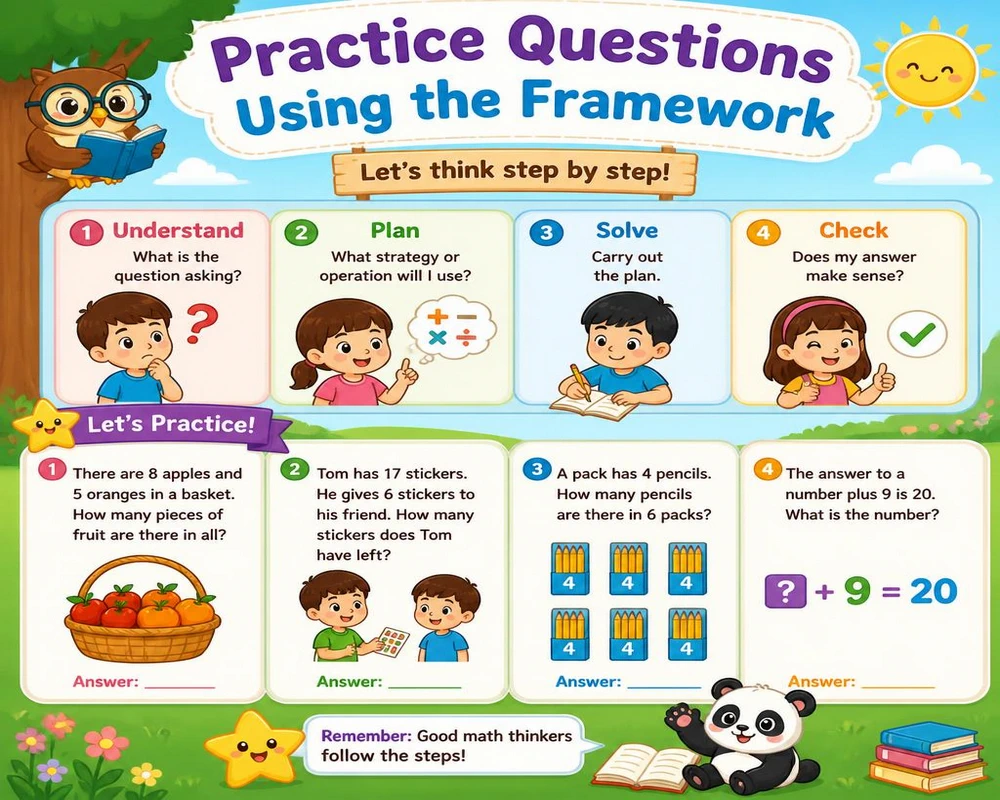
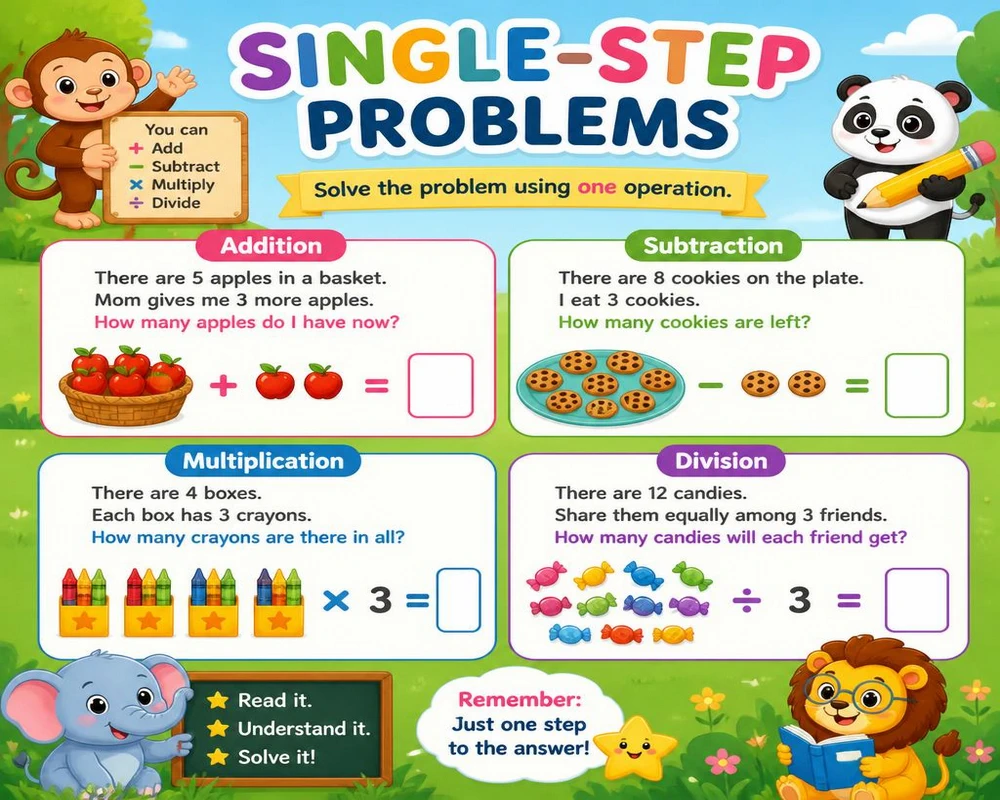
Single-Step Problems
- A garden has 7 rows with 9 flowers in each row. How many flowers are there?
- A container holds 96 marbles, shared equally among 8 bags. How many marbles per bag?
Answers: 1) 63 flowers 2) 12 marbles
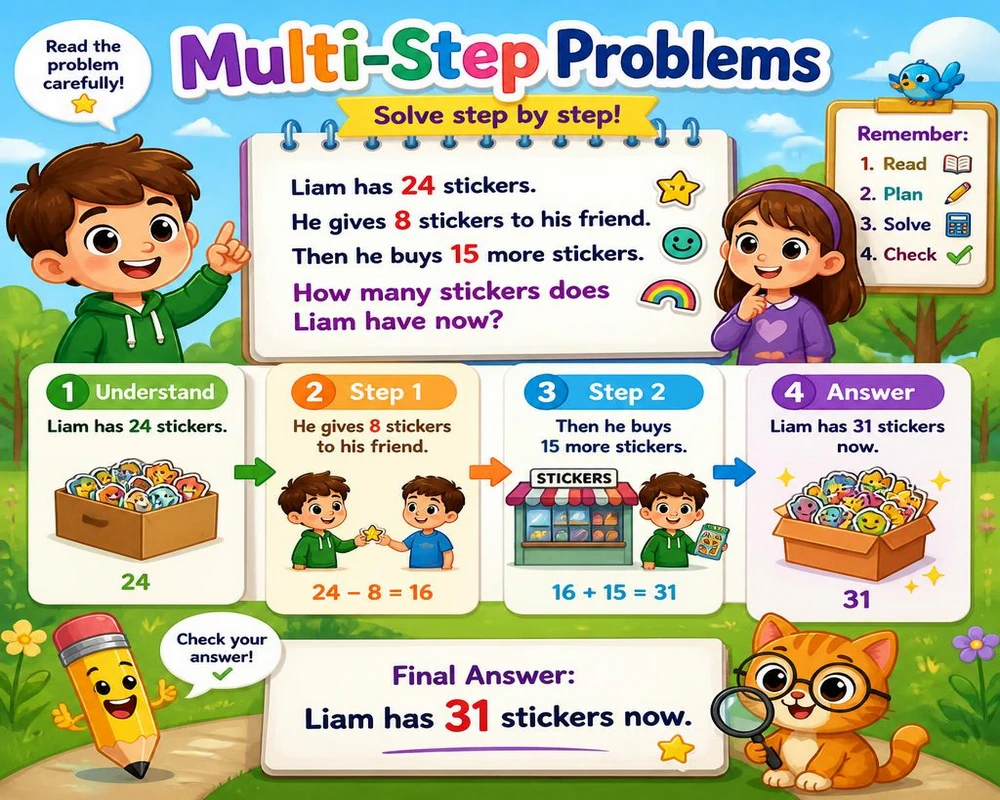
Multi-Step Problems
- A store has 5 boxes of 18 pencils each. They sell 47 pencils. How many pencils are left?
- Priya saves $6 every week for 8 weeks, then spends $23 on a gift. How much money does she have left?
- A theatre has 12 rows of 15 seats. If 3 rows are completely empty, how many seats are filled?
Answers: 1) 43 pencils 2) $25 3) 135 seats
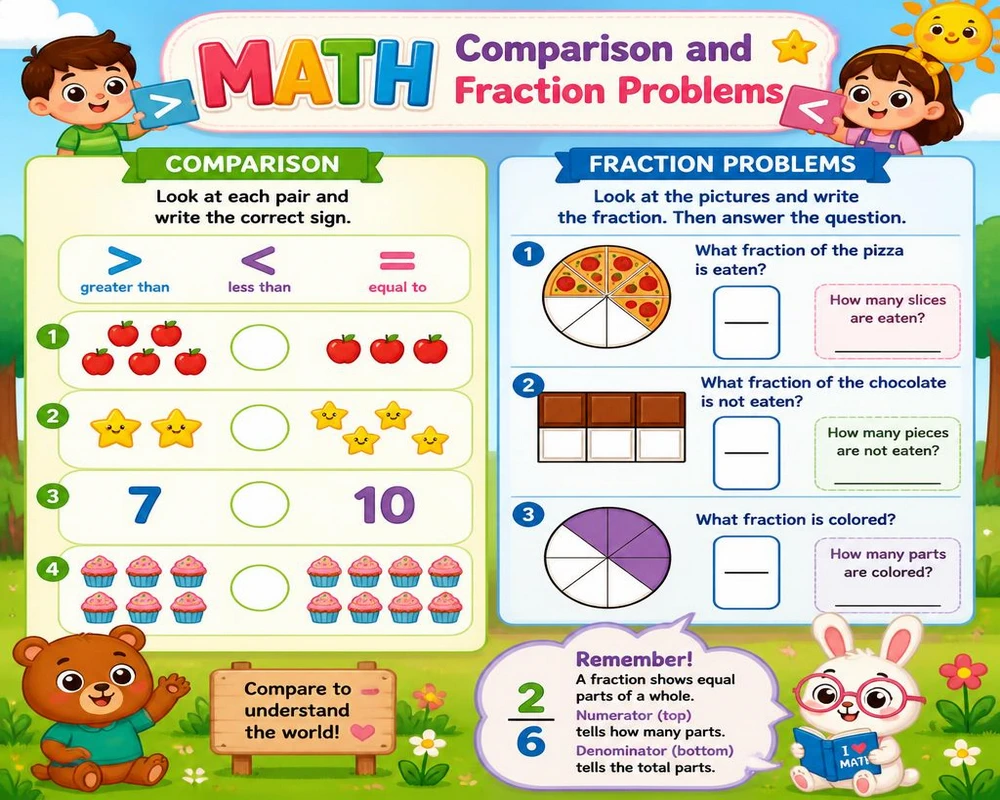
Comparison and Fraction Problems
- Malik has 84 hockey cards. His friend has 57. How many more cards does Malik have?
- A pizza has 12 slices. If 3/4 of it is eaten, how many slices remain?
Answers: 1) 27 more cards 2) 3 slices
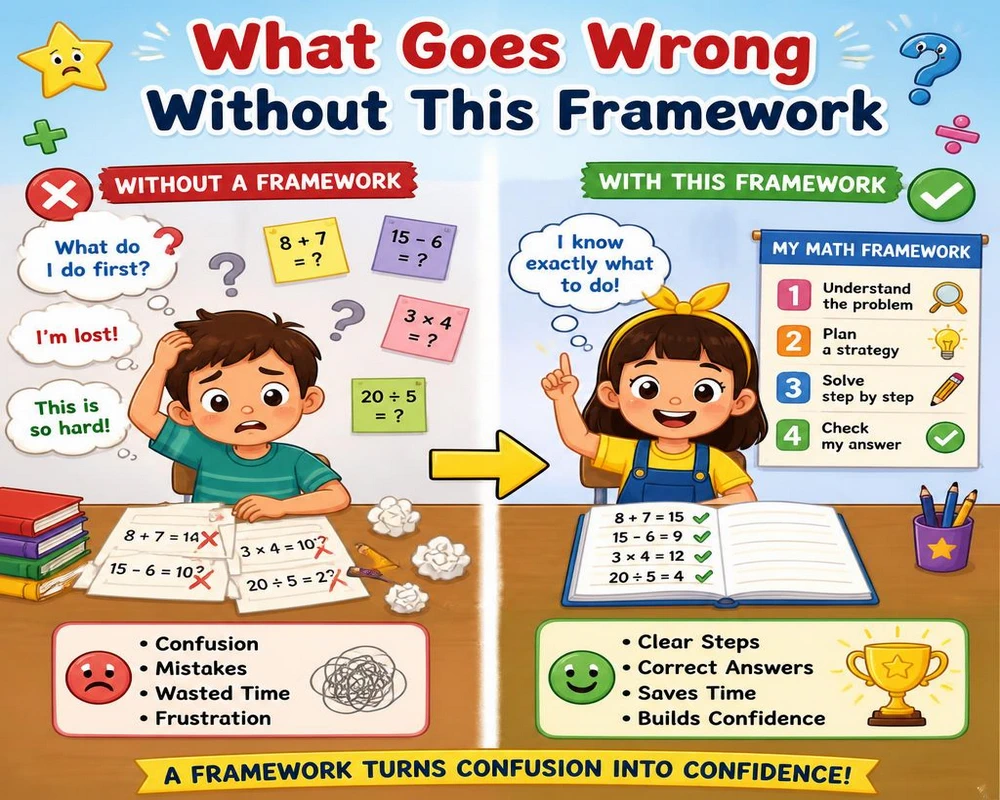
What Goes Wrong Without This Framework
Most errors on Grade 4 word problems trace back to skipping the retelling step, not to any genuine gap in calculation ability.
Skip the “retell without numbers” step, and a very specific pattern emerges: students see two numbers in a story and combine them with whatever operation feels most familiar, usually addition or multiplication, whether or not the story actually calls for it. This isn’t carelessness. It’s the predictable result of jumping straight to calculation before understanding what’s actually happening in the problem.
The second most common failure happens in multi-step problems specifically — a student solves the first step correctly, then stops, treating that first answer as the final one. Step 5 (checking against the original story) catches this reliably, since an answer that only addresses half the question rarely matches the full retelling from Step 1.
Making This a Habit, Not a One-Time Lesson
Treat every set of Grade 4 word problems as an opportunity to practice the full framework, even on stories that seem simple enough to solve without it.
The framework above only becomes useful once it’s automatic, which means resisting the urge to skip straight to numbers even on problems that seem simple. Practicing it on easy problems first, where the payoff feels almost unnecessary, builds the habit before harder problems demand it.
Short, consistent practice — two or three word problems worked through with all five steps, several times a week — builds this habit far more reliably than an occasional worksheet of twenty problems solved quickly and without the framework.
Grade 4 word problems stop feeling overwhelming the moment a child has a reliable process to fall back on, rather than facing each new story from scratch.
Frequently Asked Questions
1. Why does my child understand the math but not the word problems?
This almost always means the translation step — turning a story into the right operations — hasn’t been practiced directly. The math skills exist; the process for applying them to a story doesn’t yet.
2. How is this framework different from just “reading carefully”?
It gives a specific, repeatable sequence of steps rather than a vague instruction. “Read carefully” doesn’t tell a child what to actually do differently; retelling the story without numbers does.
3. What if my child gets the operations right but makes a calculation error?
That’s a separate issue from problem-solving itself, and it’s a good sign — the reasoning process worked, and the fix is simply more practice with the specific calculation involved.
4. How many steps do Grade 4 word problems typically have?
Most involve one or two steps, though Ontario’s curriculum does expect students to handle problems requiring more than one operation by year’s end.
5. Should I let my child use a calculator while learning this framework?
It’s best to keep the framework and the calculation separate at first, since the goal is building the reasoning process, not testing arithmetic speed.
6. How can I tell if my child actually understood a word problem, or just got lucky with the answer?
Ask them to retell the story in their own words after solving it. A child who can’t explain what happened likely arrived at the answer through guessing rather than genuine reasoning.
7. How does this connect to Grade 5?
Grade 5 word problems build on this same multi-step reasoning, adding decimals, ratios, and more complex fraction work into the mix, so a solid process now pays off directly next year.
Word problems draw on everything else covered in Grade 4, including multiplication, division, fractions, and geometry. Our Grade 4 math practice hub covers every topic in one place.
Reading comprehension plays a bigger role in word problems than most parents expect. EduGains, Ontario’s dedicated math resource hub, offers free strategies for building the reading-to-math connection these problems require.