
Grade 1 Word Problems Practice: 6 Fun Story Types
Grade 1 word problems practice tends to reveal something a straight number sentence never does: a child who can solve “5 + 3” instantly might completely freeze when the same problem shows up wrapped in a story about sharing stickers. Having spent years supporting Ontario’s Primary Division classrooms, I’ve watched this happen constantly, and it rarely means a child doesn’t understand addition. It usually means they haven’t yet learned to translate a story into math — a completely separate skill that needs its own practice.
This guide breaks down what Ontario’s Grade 1 curriculum expects around word problems, why the reading part matters as much as the math part, and how to build real confidence with six simple activity types.
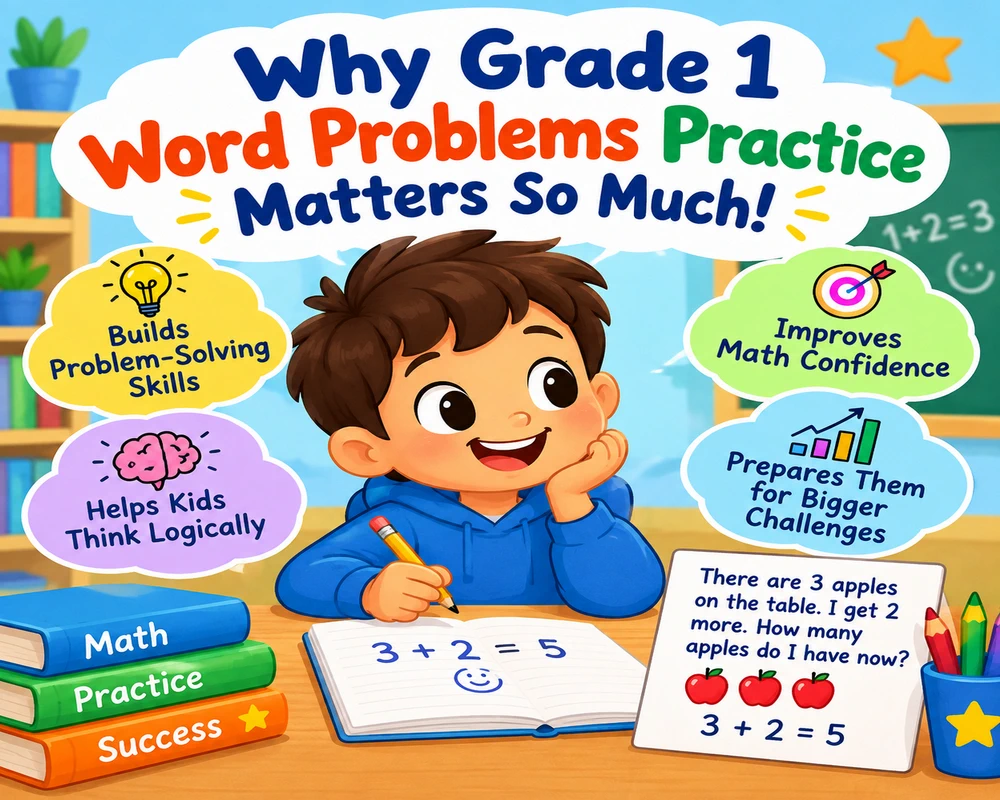
Why Grade 1 Word Problems Practice Matters So Much
Ontario’s math curriculum treats problem-solving as one of its core process expectations, running through every strand rather than sitting off to the side as its own topic. Word problems are where that shows up most clearly — a child has to read (or listen to) a situation, figure out what’s actually being asked, choose the right operation, and then solve it. That’s four separate steps hiding inside what looks like a single question.
This matters because Grade 1 word problems practice isn’t really testing math skill in isolation. It’s testing whether a child can connect real-life language (“altogether,” “left over,” “more than”) to the operations they already know. Without that connection, even strong number sense doesn’t automatically transfer to real situations.
What the Ontario Curriculum Expects in Grade 1
By the end of Grade 1, students are generally expected to:
- Solve simple addition and subtraction problems presented in a real-world context
- Use objects, drawings, or number lines to model a word problem before solving it
- Identify key information in a short story problem (the numbers and what’s being asked)
- Explain their thinking, even informally, about how they reached an answer
- Recognize common word-problem language, like “in total,” “how many are left,” or “how many more”
Notice that formal written solutions aren’t expected yet. Grade 1 word problems practice is really about connecting language to operations, using drawings and objects as often as needed.
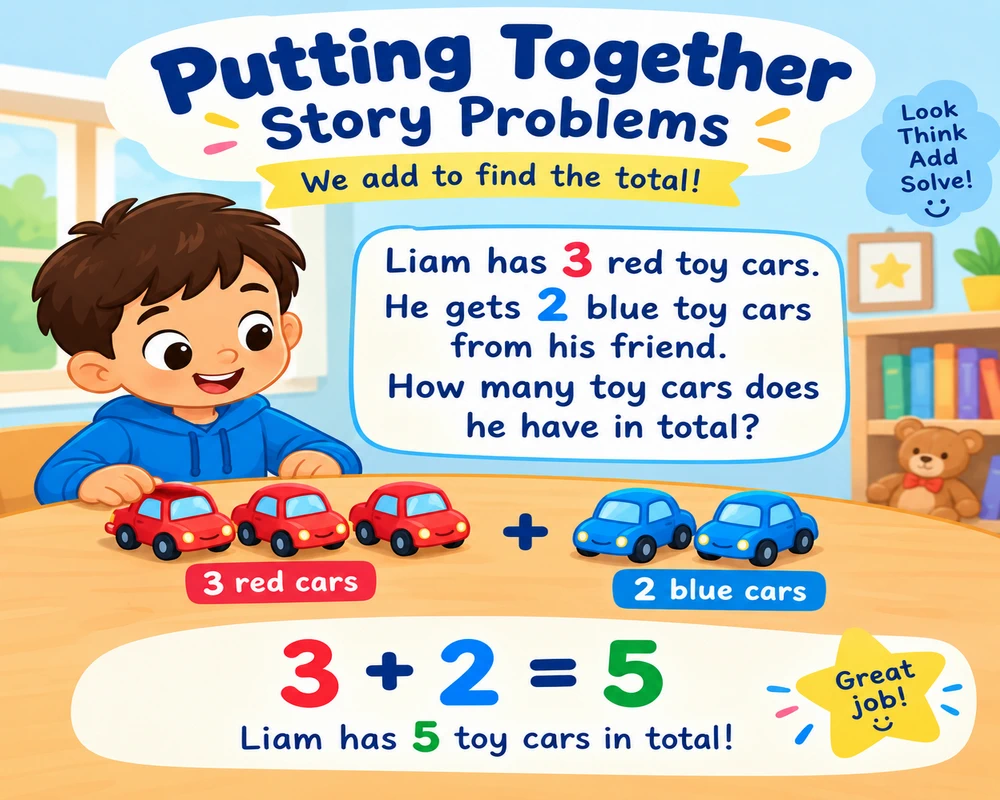
Story Type 1: “Putting Together” Problems
These are the most natural starting point, since they map directly onto addition.
- Malik has 4 red crayons and 3 blue crayons. How many crayons does he have altogether?
- Priya picked 5 apples in the morning and 2 more in the afternoon. How many apples did she pick in total?
Answers: 1) 7 crayons 2) 7 apples
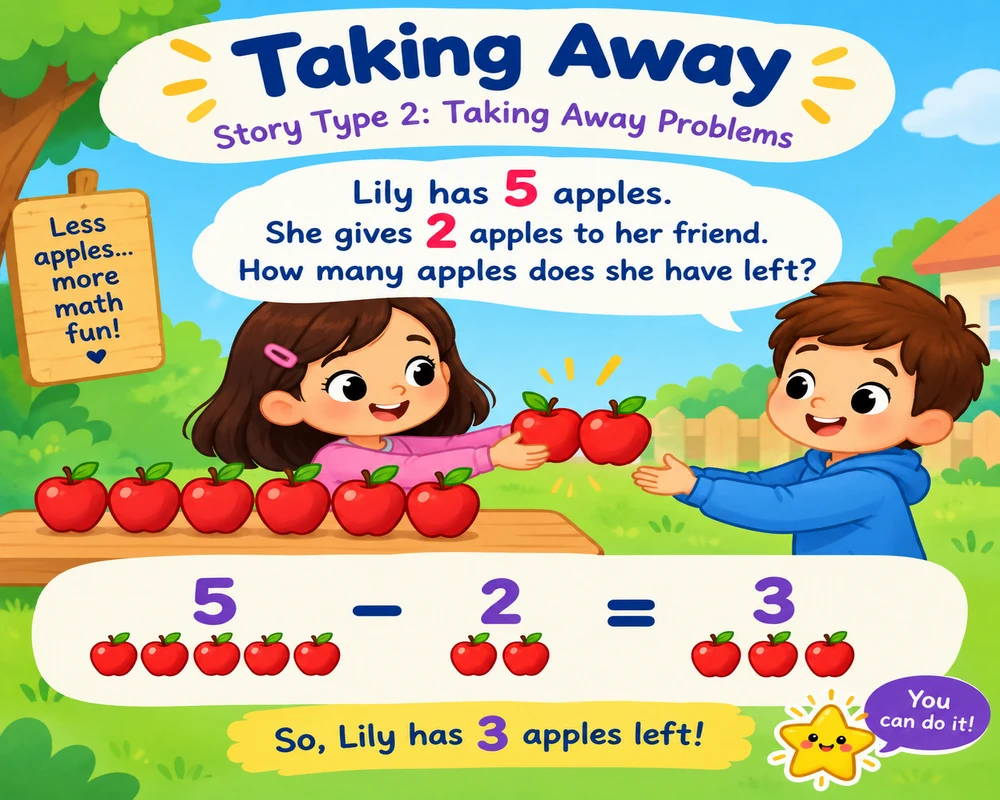
Story Type 2: “Taking Away” Problems
These map onto subtraction and usually feel intuitive once a child recognizes the pattern.
- Sam had 8 stickers. He gave 3 to his friend. How many stickers does Sam have left?
- There were 10 birds in a tree. 4 flew away. How many birds are left?
Answers: 1) 5 stickers 2) 6 birds
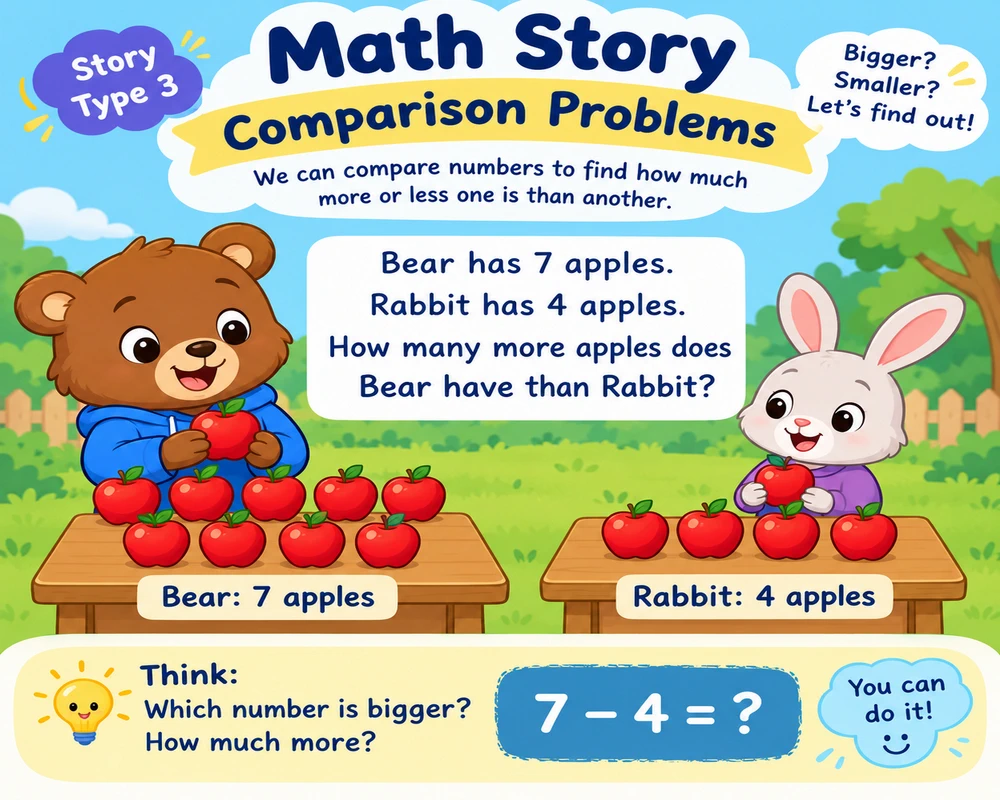
Story Type 3: “Comparison” Problems
Comparison problems are trickier because the operation isn’t always obvious from the wording alone.
- Jordan has 6 toy cars. His sister has 4 toy cars. How many more cars does Jordan have?
- There are 9 apples and 5 oranges. How many fewer oranges are there than apples?
Answers: 1) 2 more cars 2) 4 fewer oranges
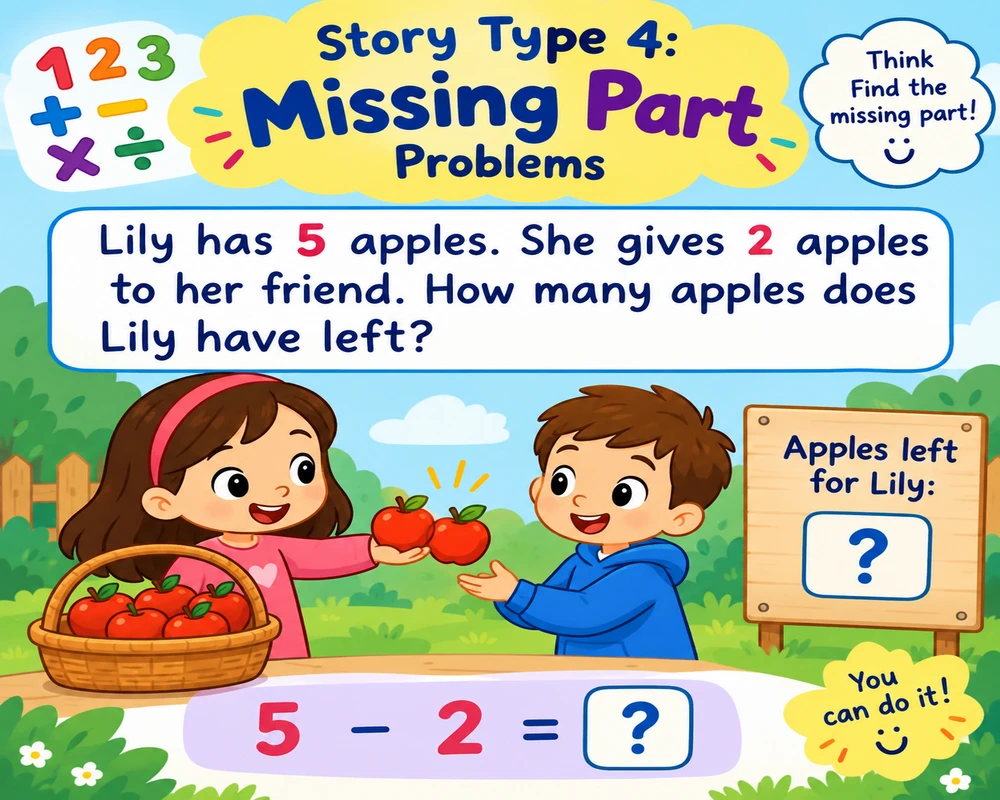
Story Type 4: “Missing Part” Problems
These ask a child to work backward, which builds early flexible thinking about the relationship between addition and subtraction.
- Aisha had some marbles. After finding 3 more, she had 8 marbles. How many did she start with?
- There were some cookies on a plate. After eating 2, there were 5 left. How many cookies were on the plate at first?
Answers: 1) 5 marbles 2) 7 cookies
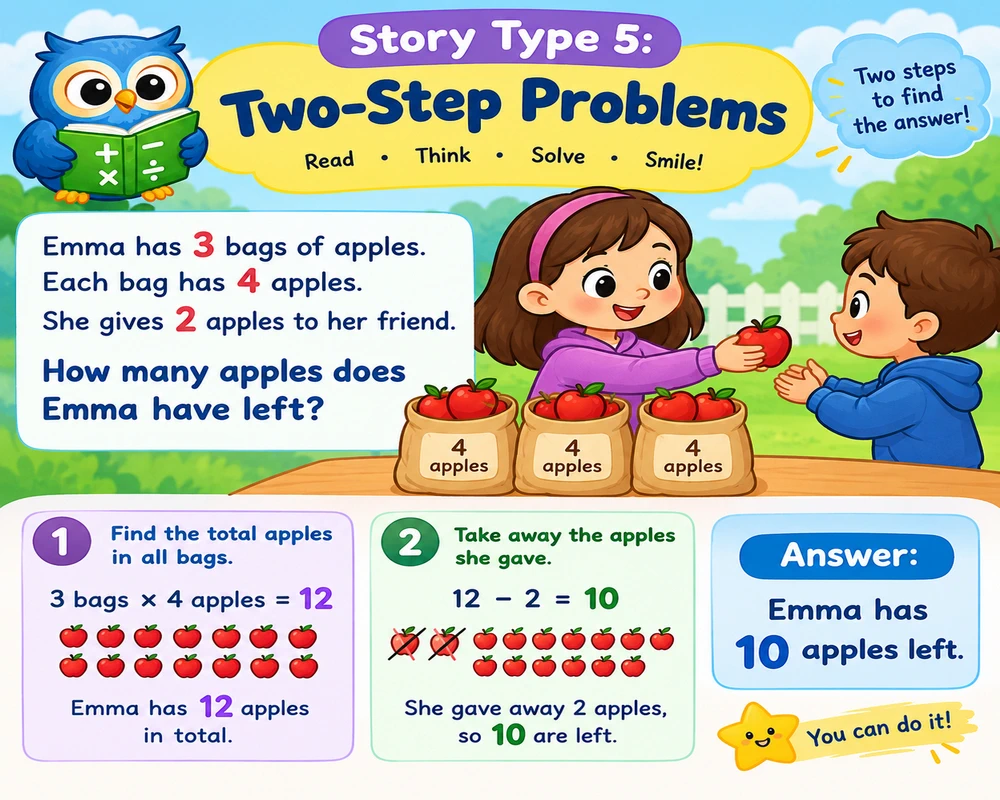
Story Type 5: “Two-Step” Problems
Once single-step problems feel comfortable, two-step stories gently raise the challenge without overwhelming a Grade 1 student.
- Leo had 3 stickers. His mom gave him 4 more, and then he gave 2 to his friend. How many stickers does Leo have now?
- There were 5 ducks at the pond. 3 more ducks arrived, and then 2 flew away. How many ducks are at the pond now?
Answers: 1) 5 stickers 2) 6 ducks
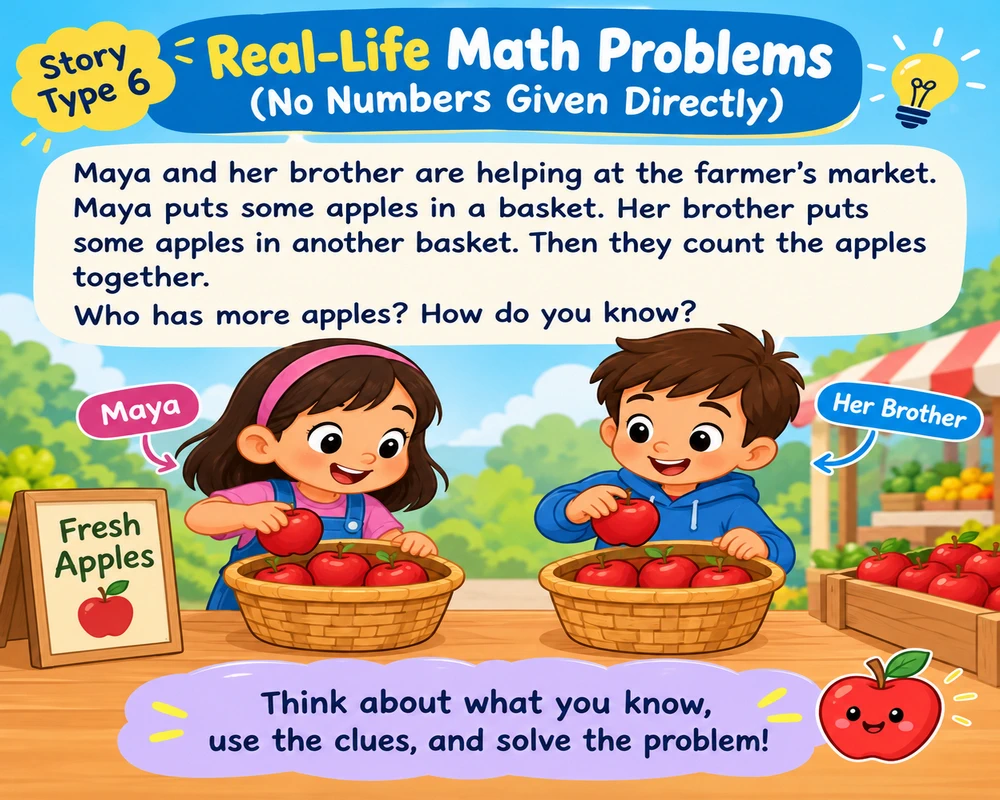
Story Type 6: “Real-Life” Problems Without Numbers Given Directly
These ask a child to notice information hidden inside a sentence, building genuine reading-for-math skills.
- A box holds a dozen eggs, but 2 are used for breakfast. (Hint: a dozen means 12.) How many eggs are left?
- A week has 7 days. If 3 days have already passed, how many days are left in the week?
Answers: 1) 10 eggs 2) 4 days
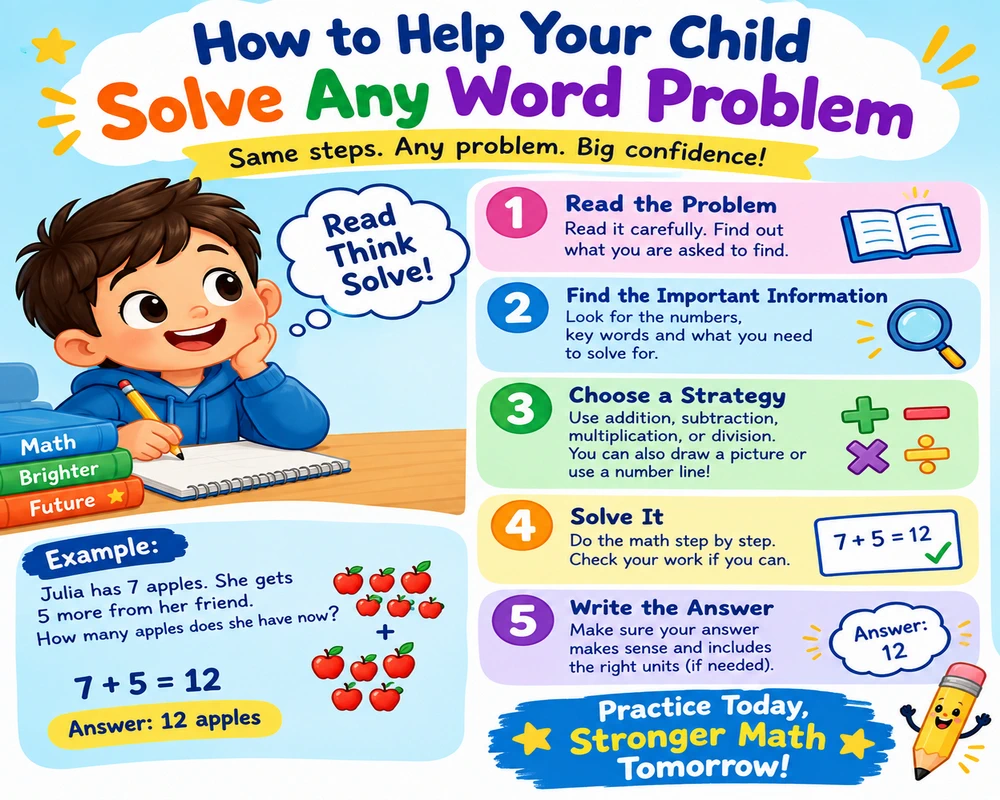
How to Help Your Child Solve Any Word Problem
Read It Twice, Slowly
Encourage your child to read (or listen to) the problem a second time before doing anything else. The first pass is for understanding the story; the second pass is for spotting the numbers and the actual question.
Draw It Out
Grade 1 word problems practice works best when kids draw a quick picture or use small objects to model the story. A rushed mental calculation skips exactly the step where real understanding happens.
Circle the Question
Have your child physically point to or underline the actual question at the end of the problem. Many early mistakes happen simply because a child solved a different question than the one being asked.
Say the Answer in a Full Sentence
Instead of just writing “7,” encourage a full response like “Malik has 7 crayons altogether.” This small habit reinforces that the number connects back to a real, meaningful answer.
This kind of hands-on Grade 1 word problems practice turns an abstract skill into something your child can genuinely master through repetition, not memorization.
Common Mistakes in Grade 1 Word Problems
Grabbing the First Two Numbers and Adding
A very common shortcut: a child sees two numbers in a story and adds them automatically, without checking whether the problem actually calls for addition. Comparison and missing-part problems especially expose this habit.
Getting Distracted by Story Details
Sometimes a child fixates on an interesting but irrelevant detail (the colour of the crayons, for example) rather than the actual numbers and question. Gently redirecting back to “what does the question ask?” helps refocus attention.
Struggling With Unfamiliar Vocabulary
Words like “altogether,” “fewer,” or “left” can trip up a child even when the math itself is simple. Building a small, informal vocabulary list of common word-problem phrases can genuinely help.
Practical Tips for Practicing at Home
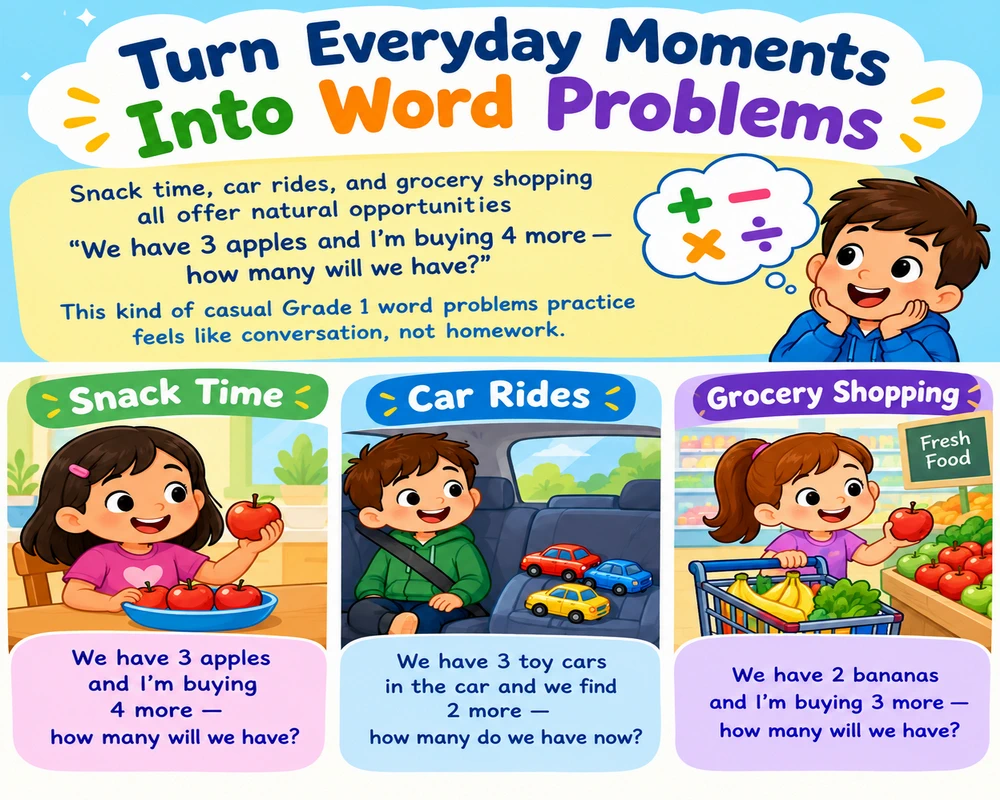
Turn Everyday Moments Into Word Problems
Snack time, car rides, and grocery shopping all offer natural opportunities: “We have 3 apples and I’m buying 4 more — how many will we have?” This kind of casual Grade 1 word problems practice feels like conversation, not homework.
Let Your Child Write Their Own
Once a child feels comfortable solving word problems, flip the exercise: ask them to invent their own story problem for you to solve. This reveals a lot about how well they understand the underlying structure.
Keep Practice Short and Varied
Mixing two or three word problems from different story types into a short session, rather than ten problems of the same type, builds more flexible, transferable thinking.
Reading comprehension plays a bigger role in word problems than most parents expect. Ontario’s own EduGains offers free strategies for building the exact kind of reading-to-math connection that word problems require, developed specifically for Ontario classrooms.
Conclusion: Turning Stories Into Math With Confidence
Word problems tie together everything else your child is learning in Grade 1 — counting, addition, subtraction, and more. For the complete picture, our Grade 1 math practice hub brings every topic together in one place.
Grade 1 word problems practice asks young learners to do something genuinely sophisticated — translate everyday language into math, then solve it. That’s a real skill, separate from pure number fluency, and it deserves its own dedicated practice rather than being treated as an afterthought. With a mix of story types, drawing, and everyday real-life examples, most students build real confidence within just a few weeks.
Try turning one small moment from your day into a word problem tonight — snack time, toy sharing, or a car ride all work well. A few minutes of playful practice like this builds understanding no worksheet alone can match.
Consistent Grade 1 word problems practice, even just a few minutes a day, builds the reading-to-math connection your child will rely on for years.
Frequently Asked Questions
1. What types of word problems should a Grade 1 student practice?
A good mix includes putting-together, taking-away, comparison, missing-part, and simple two-step problems, since each type builds a slightly different kind of reasoning.
2. Why does my child solve number sentences but freeze on word problems?
This is extremely common and usually reflects a gap in translating language to math, not a gap in actual number skills. Practicing the “read, draw, solve” process helps close that gap.
3. Should my child write full sentences when answering?
It’s not required at this age, but encouraging a spoken full-sentence answer (“There are 7 crayons altogether”) reinforces that the number connects to something real.
4. What if my child adds two numbers without checking if that’s the right operation?
This is a common shortcut. Practicing comparison and missing-part problems specifically helps break the habit of automatically adding whatever numbers appear.
5. How can I make word problems more engaging at home?
Use real situations your child cares about — snacks, toys, or family activities — rather than generic textbook examples, and let them invent their own problems occasionally.
6. How many word problems should we practice each session?
Two or three varied problems tend to build more flexible thinking than ten repetitive ones of the same type.
7. How does this connect to later grades?
Word problem skills build directly into multi-step problem solving in Grade 2 and beyond, where operations and story complexity both increase.