
EQAO Grade 3 Math Practice — 50 Free Questions Aligned with Ontario Curriculum
For a lot of Ontario families, the EQAO Grade 3 assessment is the first time “standardized test” enters the household vocabulary — and it usually arrives with a fair bit of nervous energy on both sides of the kitchen table. EQAO Grade 3 math practice doesn’t need to be a source of dread, though. As someone who has spent years supporting Ontario’s Primary Division classrooms and coaching students through their very first provincial assessment, I’ve seen how the right kind of preparation — calm, consistent, and grounded in genuine understanding rather than panic-drilling — turns this milestone into a confidence builder instead of a source of anxiety.
This guide walks through exactly what the Grade 3 EQAO math assessment covers, how it’s structured, and includes 50 practice questions spanning every strand tested, so you and your child can prepare with a clear sense of what’s actually ahead.
What Is the EQAO Grade 3 Math Assessment?
EQAO, or the Education Quality and Accountability Office, administers Ontario’s provincial testing program across several grade levels, and Grade 3 marks a student’s very first encounter with it. This assessment falls under the Primary Division and covers both language and mathematics, though this guide focuses specifically on the math component.
Grade 3 is a meaningful milestone precisely because it’s a first exposure — to the format, the vocabulary of standardized testing, and to sitting through a structured assessment period. Getting comfortable with what to expect matters just as much as the math itself, and that’s exactly why EQAO Grade 3 preparation should start well before the actual test dates arrive.
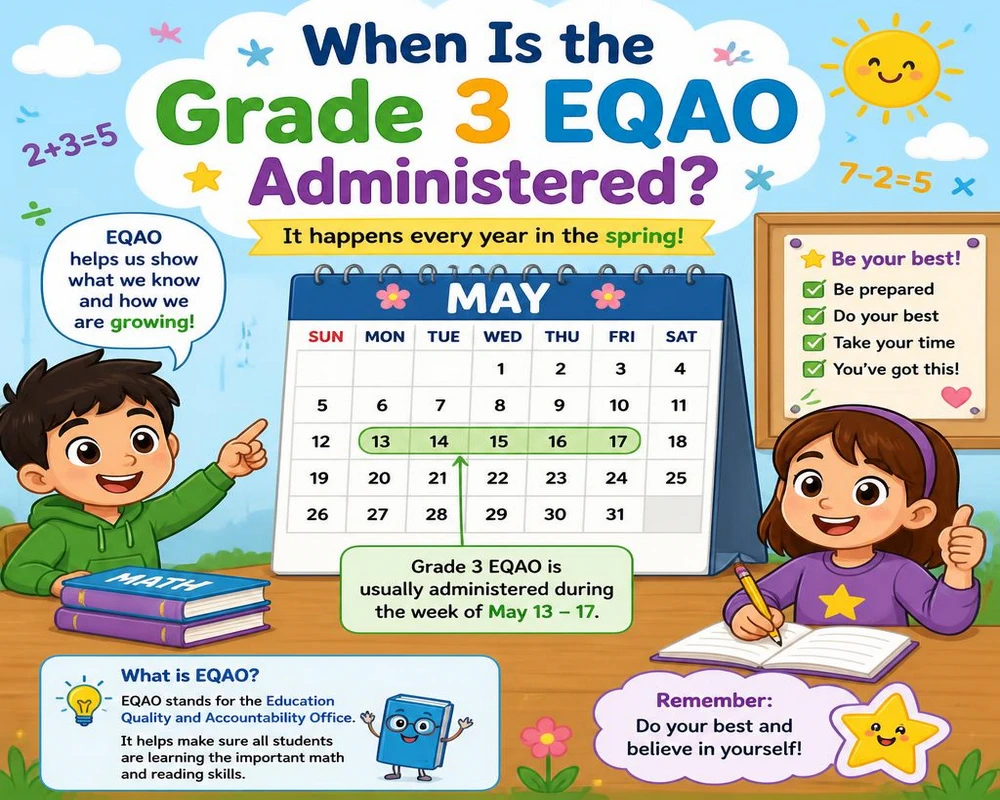
When Is the Grade 3 EQAO Administered?
Like the Junior Division assessment, the Grade 3 Primary Division test is administered within a provincial window in the spring, typically running from early May through late June, with individual schools selecting specific dates within that window. Your child’s teacher will share exact dates once the school finalizes its schedule, since boards coordinate device and lab availability across multiple grades sitting the test around the same time.
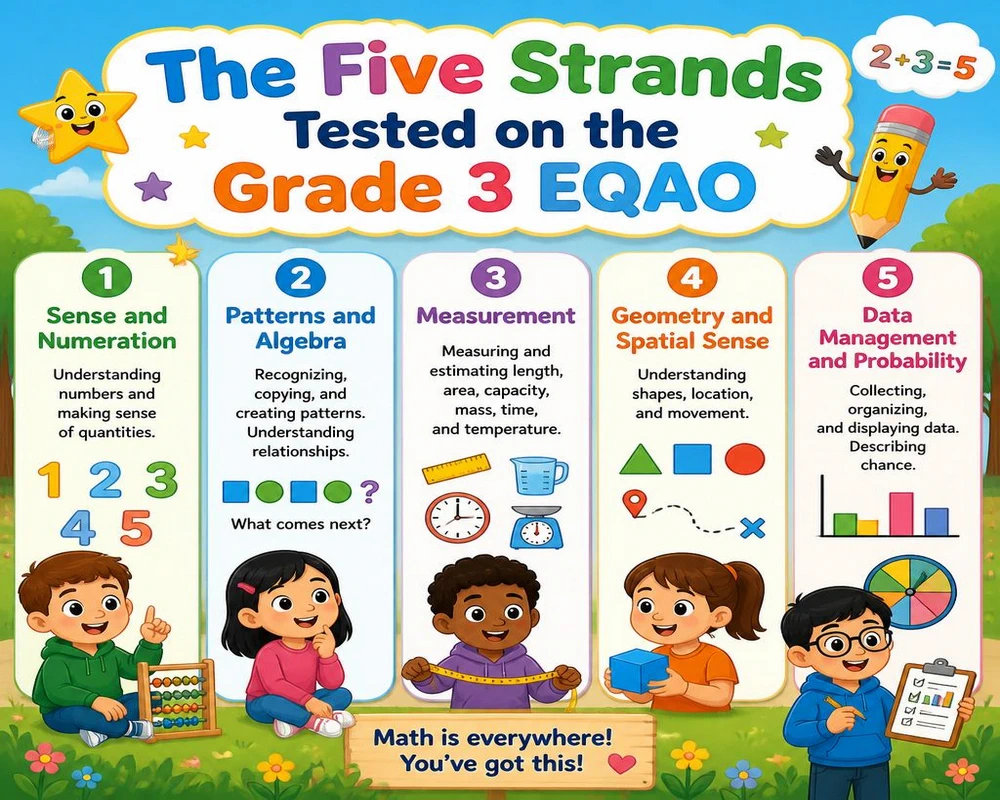
The Five Strands Tested on the Grade 3 EQAO
The Grade 3 math test Ontario students take is built around the same five-strand structure found across Ontario’s 2020 math curriculum, scaled to Grade 3 expectations. Understanding each strand helps target your practice time more effectively rather than practicing everything at random.
Number
This is the largest strand by far, covering addition and subtraction within 1,000, an introduction to multiplication and division, place value, and simple fractions.
Algebra and Coding
Grade 3 introduces basic coding concepts alongside traditional pattern work — recognizing and extending patterns, understanding equality, and early variable concepts appropriate for this age group.
Data
Students read and interpret bar graphs and pictographs, collect and organize simple data sets, and answer questions based on the information shown.
Spatial Sense
This covers 2D and 3D shape properties, basic measurement (length, mass, capacity, and time), and an early introduction to angles.
Financial Literacy
Grade 3 students work with money concepts like making change, comparing prices, and simple budgeting scenarios appropriate for eight- and nine-year-olds.
Beyond the practice questions here, plenty of free Ontario-specific study tools exist to build confidence before test day. TVO Learn, Ontario’s own educational platform, offers curriculum-aligned resources for Grades 1 through 8 that pair well with EQAO preparation and are free for families across the province.
50 EQAO Grade 3 Math Practice Questions
Below are practice questions organized by strand so you can target specific weak spots. These reflect the style and difficulty of real assessment content, though they aren’t official EQAO questions — the actual secure test bank isn’t publicly released.
Number Strand (Questions 1–15)
- 245 + 138 = ___
- 512 − 267 = ___
- What is the value of the 4 in 462?
- Round 378 to the nearest hundred.
- 3 x 6 = ___
- 24 ÷ 4 = ___
- 6 x 7 = ___
- What fraction of this group is shaded if 2 out of 5 parts are colored in?
- Order these numbers from smallest to largest: 456, 645, 546, 564
- 150 + 275 = ___
- 600 − 345 = ___
- Write 307 in expanded form.
- 9 x 4 = ___
- 56 ÷ 8 = ___
- Is 47 an odd or even number?
Answers: 1) 383 2) 245 3) 60 (four tens) 4) 400 5) 18 6) 6 7) 42 8) 2/5 9) 456, 546, 564, 645 10) 425 11) 255 12) 300 + 0 + 7 13) 36 14) 7 15) Odd
Algebra and Coding Strand (Questions 16–25)
- Continue the pattern: 4, 8, 12, 16, ___
- If a triangle equals 5, and a square equals 8, what does a triangle plus a square equal?
- Describe the pattern rule for: 2, 5, 8, 11, ___
- Fill in the missing number: 7 + ___ = 15
- If one robot step moves a character forward 2 spaces, how many spaces after 4 steps?
- What comes next in the shape pattern: circle, square, circle, square, ___
- Fill in the blank: 20 − ___ = 12
- Extend the pattern: 100, 90, 80, ___
- If x + 6 = 10, what is x?
- Describe in words the rule for the pattern 3, 6, 9, 12.
Answers: 16) 20 17) 13 18) Add 3 each time; next number is 14 19) 8 20) 8 spaces 21) Circle 22) 8 23) 70 24) 4 25) Add 3 to the previous number
Data Strand (Questions 26–35)
Use this table to answer questions 26 through 30:
| Fruit | Number of Votes |
|---|---|
| Apple | 8 |
| Banana | 5 |
| Grape | 10 |
| Orange | 7 |
- Which fruit received the most votes?
- How many more votes did grapes receive than bananas?
- What is the total number of votes across all fruits?
- Which two fruits combined equal exactly 15 votes?
- If 3 more students vote for banana, how many votes would banana have?
- A pictograph shows each symbol representing 2 students. If there are 5 symbols next to “soccer,” how many students chose soccer?
- What type of graph is best for comparing categories side by side?
- If a bar graph shows 12 students like reading and 8 like drawing, how many more students like reading?
- List two things a graph title tells you about the data.
- Why is it important to label the axes of a graph?
Answers: 26) Grape 27) 5 28) 30 29) Apple and Orange 30) 8 31) 10 students 32) A bar graph 33) 4 34) What is being measured and what the categories represent 35) So the reader knows what the numbers on the graph represent
Spatial Sense Strand (Questions 36–45)
- How many sides does a pentagon have?
- Name a 3D shape with exactly 6 square faces.
- Is a clock’s hand pointing straight up and then to the 3 an example of a right angle?
- Convert 3 meters into centimeters.
- Which is heavier: 500 grams or 1 kilogram?
- How many minutes are there in half an hour?
- Name two properties of a rectangle.
- A shape has 4 equal sides and 4 right angles. What is it called?
- Estimate: is a school bus more likely to be measured in meters or kilometers?
- If it’s 2:15 now, what time will it be in 45 minutes?
Answers: 36) 5 37) Cube 38) Yes 39) 300 centimeters 40) 1 kilogram 41) 30 minutes 42) Opposite sides are equal, and all angles are right angles 43) Square 44) Meters 45) 3:00
Financial Literacy Strand (Questions 46–50)
- If an item costs $3.50 and you pay with a $5 bill, how much change do you receive?
- You have 2 loonies and 3 quarters. How much money do you have in total?
- A pencil costs 75 cents and an eraser costs 50 cents. How much do both cost together?
- If you save $2 every week, how much will you have saved after 6 weeks?
- Which is the better deal: a toy for $8 or the same toy on sale for $6?
Answers: 46) $1.50 47) $2.75 48) $1.25 49) $12 50) The toy on sale for $6
How the Grade 3 EQAO Is Structured
Question Formats
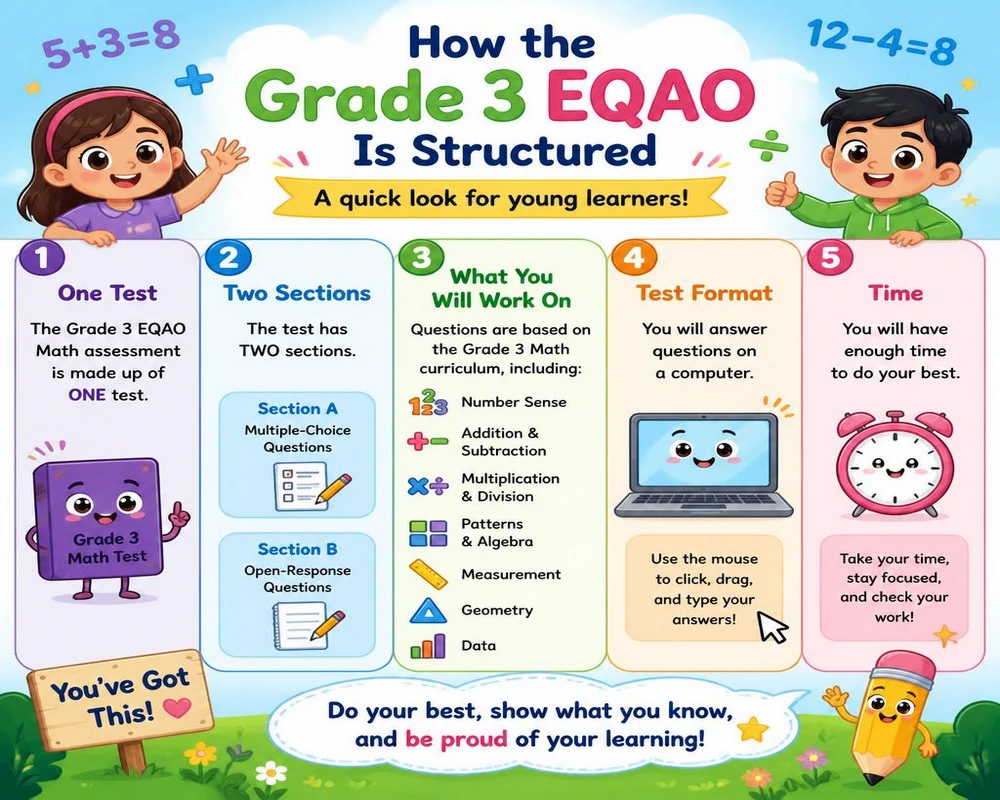
The Grade 3 EQAO math test Ontario students complete uses a mix of multiple-choice questions and open-response questions that ask students to show their work or explain their thinking in a sentence or two. Since the assessment is fully digital, students also interact with drag-and-drop and drop-down question types, so it’s worth having your child practice on a screen, not only on paper, in the weeks leading up to test day.
Built-In Support Tools
The digital platform includes accessibility tools such as text-to-speech, zoom, highlighting, and a line reader, along with math-specific supports. Letting your child explore these tools ahead of time — through EQAO’s official sample tests — means they won’t be a distraction or a mystery on the actual test day.
Building an Effective EQAO Grade 3 Preparation Plan
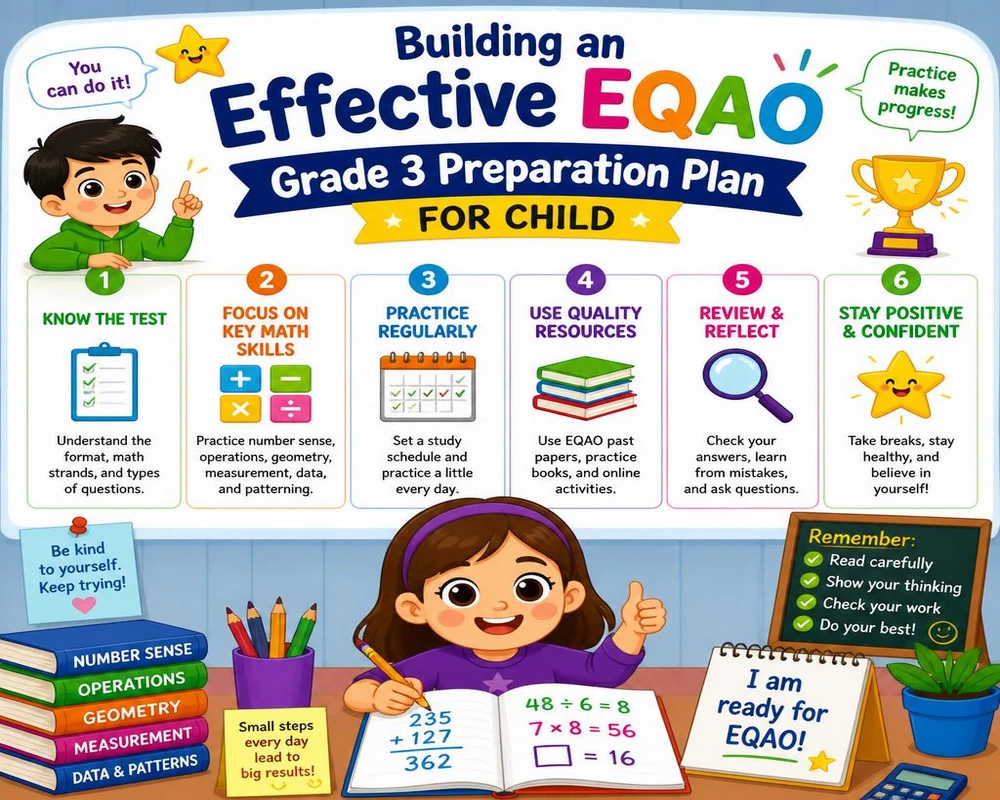
Start With a Low-Pressure Diagnostic
Rather than diving straight into worksheets, run a short, five-question quiz per strand to see where your child feels confident and where they hesitate. This tells you far more in fifteen minutes than an hour of unfocused practice would.
Practice a Little, Often
Short, frequent sessions consistently outperform long, infrequent cram sessions for young learners. Fifteen to twenty minutes of EQAO Grade 3 preparation, three or four times a week over a couple of months, tends to build both skill and stamina without burning a child out.
Normalize the Format Early
A lot of first-time test anxiety comes from unfamiliarity rather than the math itself. Let your child explore EQAO’s official sample questions on a device well before the real test, so the format feels routine rather than intimidating.
Talk Through Thinking, Not Just Answers
Open-response questions specifically reward students who can explain their reasoning. Practice having your child say their thinking out loud, then jot it down in a sentence, even for questions they answer easily.
Pros and Cons of EQAO Testing at the Grade 3 Level
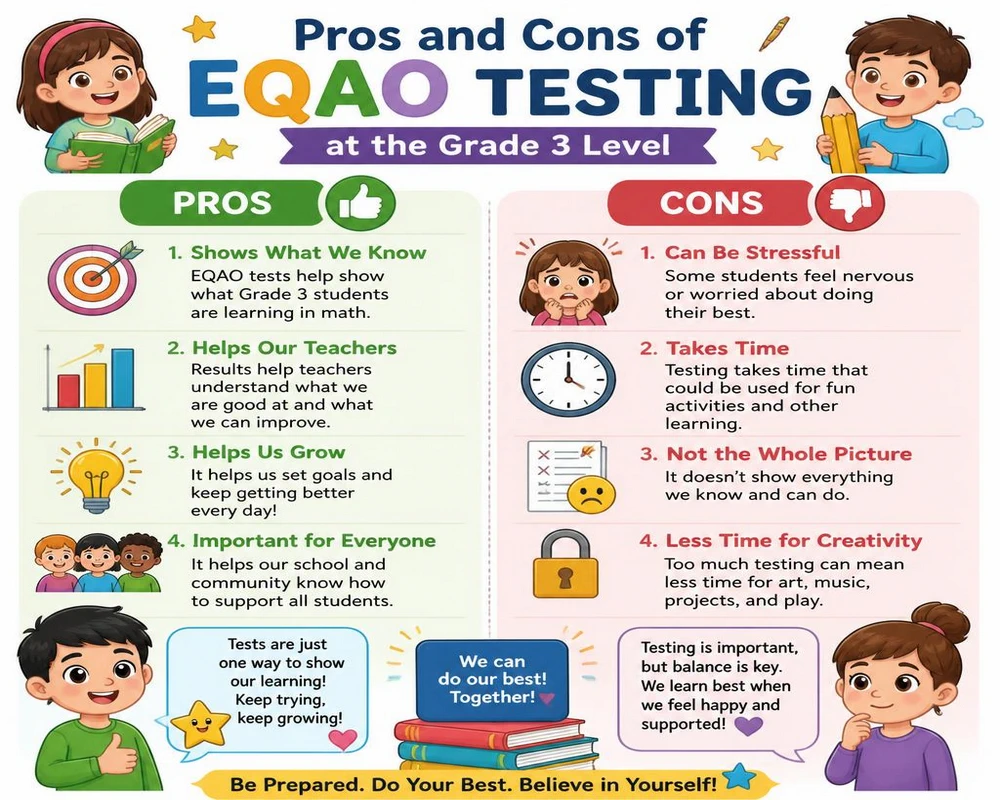
| Pros | Cons |
|---|---|
| Establishes an early external benchmark | Can feel intimidating as a “first” standardized test |
| Familiarizes students with digital assessment tools | Younger students may need extra support managing test-day nerves |
| Highlights curriculum strengths and gaps early | A single test day doesn’t reflect a full year of growth |
| Results help guide instructional planning at the school level | Results don’t appear on report cards, which can confuse families about their purpose |
Common Mistakes Students Make on the Grade 3 EQAO
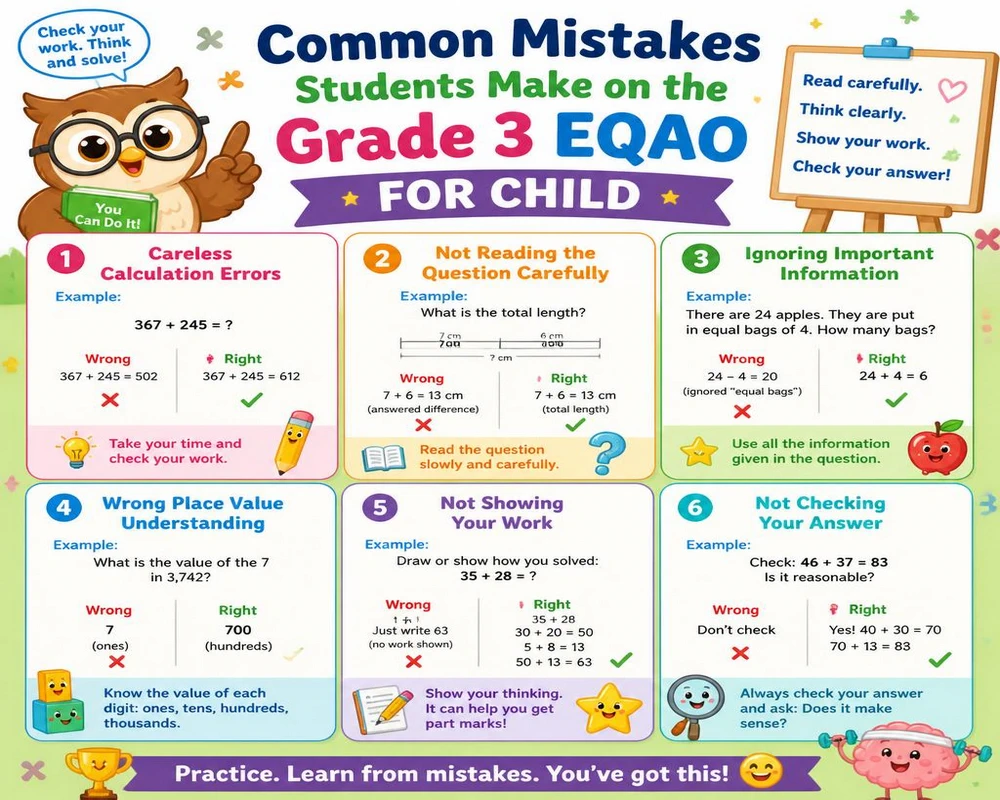
- Rushing through word problems without identifying the key numbers first
- Forgetting to check whether a question asks for an exact answer or an estimate
- Leaving open-response questions blank instead of showing partial reasoning
- Mixing up units in measurement questions, like centimeters versus meters
- Not reviewing answers if time remains at the end of a session
Conclusion: Turning a First Test Into a Confidence Milestone
These 50 questions give a solid snapshot of what the EQAO covers, but Grade 3 math stretches well beyond test prep alone. For steady, year-round practice across every topic, our Grade 3 math practice hub covers the full curriculum at a comfortable, low-pressure pace.
EQAO Grade 3 math practice works best when it’s approached as a gentle introduction to standardized testing, not a high-pressure hurdle. The goal isn’t perfection — it’s familiarity, comfort with the format, and a chance to reinforce a year’s worth of learning in a low-stakes way. Work through a few strands from the 50 questions above together this week, talk through the reasoning behind each answer, and keep the tone light. That’s exactly the kind of preparation that helps a nine-year-old walk into their very first provincial assessment feeling ready rather than rattled.
Pick one strand tonight — maybe Number or Data — and try five questions together as a warm-up. Small, steady practice now builds the kind of quiet confidence that carries a child well beyond this one test.
Frequently Asked Questions
1. What math topics are covered on the Grade 3 EQAO? The assessment covers five strands: Number, Algebra and Coding, Data, Spatial Sense, and Financial Literacy, all aligned with the Ontario 2020 math curriculum at a Grade 3 level.
2. Is the Grade 3 EQAO assessment done on paper or digitally? The Primary Division assessment, including Grade 3, is administered in a fully digital format, so practicing on a screen ahead of time is genuinely helpful.
3. When does the Grade 3 EQAO typically take place? It’s administered within a provincial window in the spring, generally from early May through late June, with each school choosing specific dates within that window.
4. How can I help my child who feels anxious about their first standardized test? Focus on familiarizing them with the digital format ahead of time using official sample questions, keep practice sessions short and low-pressure, and remind them the test is one checkpoint, not a pass-or-fail exam.
5. Do EQAO Grade 3 results affect my child’s report card? No, EQAO results are reported separately from report card grades and are used to show how students are progressing relative to provincial expectations.
6. How many practice questions should my child complete each week? There’s no fixed number, but aiming for short, focused sessions covering ten to fifteen questions across two or three strands each week tends to work well without causing fatigue.
7. What’s the best way to practice open-response questions? Have your child explain their reasoning out loud first, then practice writing that explanation down in a sentence or two, since open-response questions specifically reward clear reasoning.
8. Are there official EQAO Grade 3 practice materials available? Yes, EQAO provides official sample questions and previously released items on its website, which offer the most accurate preview of the real test’s format and difficulty level.