EQAO Grade 6 Math Practice — Free Questions & Study Guide 2026
📅 August 8, 2026·✍️ Teacher·⏱ 11 min read
If your child has come home saying “we did an EQAO practice test today,” you’re not alone in wondering what that actually means for their spring. EQAO Grade 6 math practice has become one of the most searched topics among Ontario parents every winter, and for good reason — this is the last province-wide math checkpoint students face before heading into intermediate and secondary school. As someone who has spent years working alongside Ontario classrooms and tutoring students through the Junior Division assessment, I’ve watched firsthand how the right kind of preparation turns a stressful, unfamiliar test into something students can approach with genuine confidence.
This guide walks through exactly what the Grade 6 EQAO math assessment covers in 2026, how it’s structured, and — most importantly — how to practice in a way that actually builds understanding rather than just test-taking anxiety.
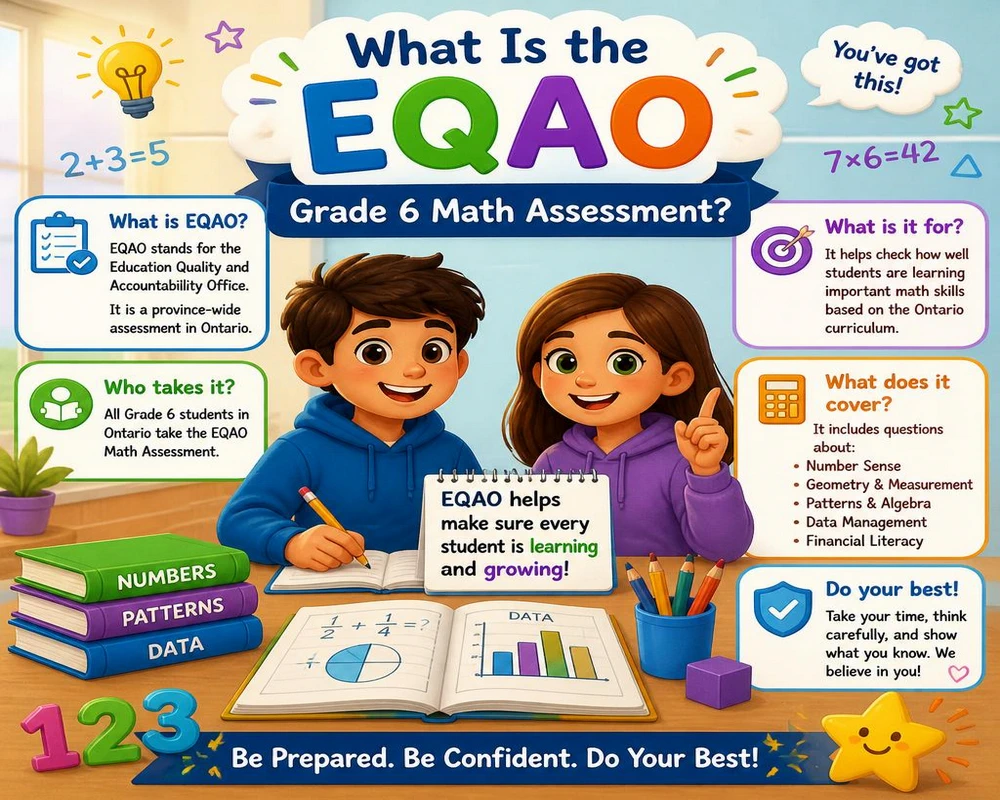
What Is the EQAO Grade 6 Math Assessment?
EQAO stands for the Education Quality and Accountability Office, and it’s the body responsible for Ontario’s provincial testing program. The Grade 6 assessment is part of the Junior Division testing cycle and covers both math and language, though this guide focuses specifically on the math component. The Grade 6 assessment has been administered in its current computer-based format since 2022, which is a meaningful shift for families who remember the old paper-and-pencil booklets.
The EQAO Grade 6 math assessment tests the Ontario 2020 curriculum across five strands, drawing on content through the end of Grade 6, and the questions are cumulative — meaning they pull from concepts taught in Grades 4 and 5 as well. That last point trips a lot of families up. If your child struggled with fractions back in Grade 4, that gap doesn’t just disappear; it tends to resurface on the EQAO unless it’s been addressed directly.
What Is the EQAO Grade 6 Math Assessment?
EQAO stands for the Education Quality and Accountability Office, and it’s the body responsible for Ontario’s provincial testing program. If you want to dig into the official sample questions or check exact testing windows for your school board, the EQAO official website is the most reliable place to look — everything here is meant to complement that, not replace it.
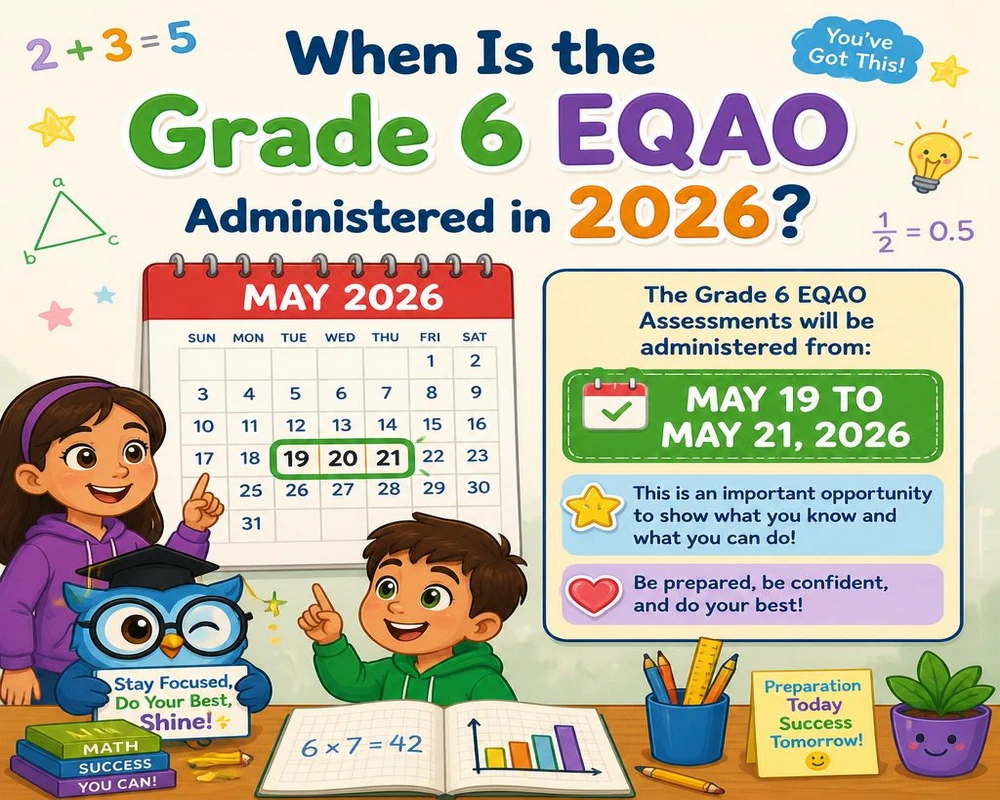
When Is the Grade 6 EQAO Administered in 2026?
The Grade 6 EQAO Junior Division assessment is administered within a provincial window in May and June, with individual schools choosing their own dates inside that window</cite>. Your child’s teacher or school office will have the exact dates, since boards stagger their schedules to manage computer lab and device availability.
One scheduling detail worth knowing: EQAO assessments are no longer permitted to be scheduled on June 1st, out of recognition for Ontario Day, and schools are encouraged to run the assessment earlier in the window rather than in the final two days. It’s a small administrative change, but it can affect when your child’s specific test day lands.
When Is the Grade 6 EQAO Administered in 2026?
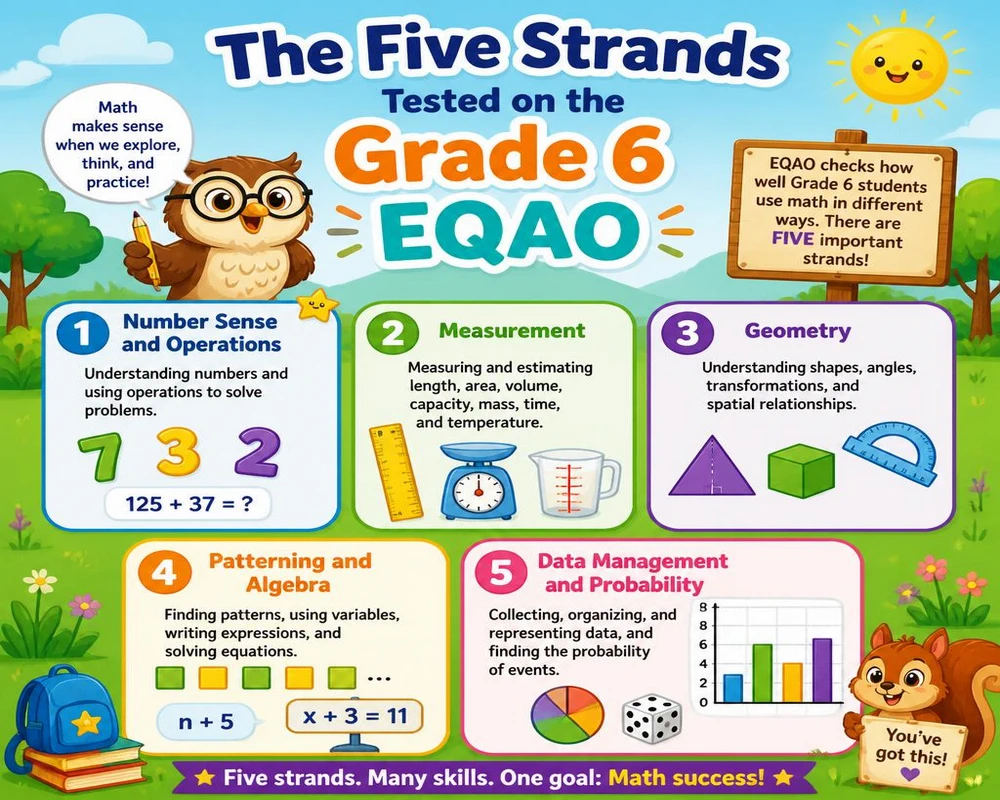
The Five Strands Tested on the Grade 6 EQAO
Understanding the structure of the test is half the battle. The Grade 6 EQAO tests five strands of the Ontario 2020 math curriculum: Number, Algebra, Data, Spatial Sense, and Financial Literacy. Let’s break down what each one actually looks like in practice.
Number
This strand covers whole numbers, fractions, decimals, percentages, and the four basic operations. Expect Grade 6 math test Ontario questions involving multi-digit multiplication and division, equivalent fractions, and converting between fractions, decimals, and percents.
Algebra
Algebra in Grade 6 doesn’t mean solving for x with negative exponents — it’s about patterns, variables in simple equations, and understanding equality. A typical question might ask a student to find the missing number in an equation or extend a growing pattern.
Data
This includes reading and interpreting graphs, calculating averages (mean), and making predictions based on data sets. Students are often asked to analyze a bar graph or line graph and answer a series of questions about what it shows.
Spatial Sense
Geometry and measurement live here — area, perimeter, volume, angles, and properties of 2D and 3D shapes. This strand tends to benefit enormously from hands-on practice with actual shapes and grid paper rather than pure memorization.
Financial Literacy
Added as its own strand in the 2020 curriculum update, Financial Literacy questions might involve calculating simple interest, comparing prices, or working through a basic budgeting scenario — practical math with real-world application.
The Five Strands Tested on the Grade 6 EQAO
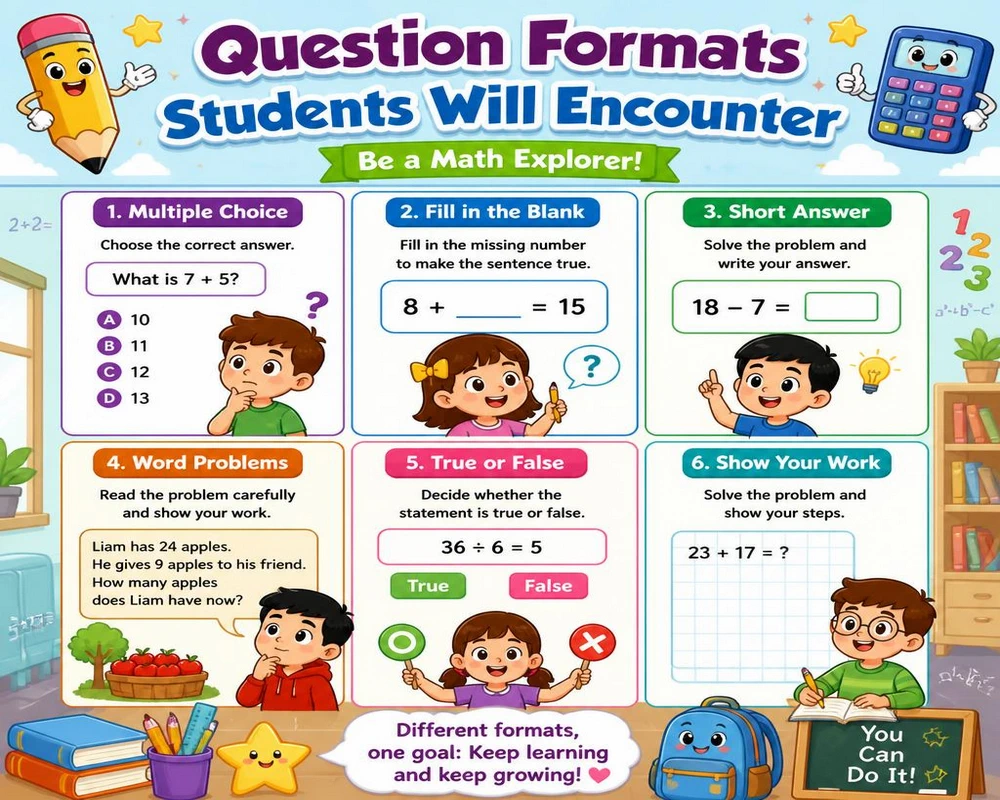
Question Formats Students Will Encounter
One of the biggest sources of test anxiety isn’t the math itself — it’s not knowing what the test screen will actually look like. In Grade 6, students answer questions using different formats, including multiple-choice, drag-and-drop, drop-down menu questions, and short written responses. Practicing exclusively with paper worksheets, then, only prepares a student for part of what they’ll see on test day.
The assessment also gives students access to helpful tools inside the online platform, such as text-to-speech, zoom, high contrast display, a line reader, highlighting tools, and math support tools. It’s worth having your child explore these features ahead of time using EQAO’s official sample questions, so the tools themselves aren’t a distraction on test day.
Question Formats Students Will Encounter
A New Option for French Immersion Families
Starting in the 2025-2026 school year, EQAO expanded the option for students in French-Immersion programs to complete the mathematics component of the assessment in French to include the Junior Division. If your child is in a French Immersion program, this means the math questions will automatically be provided in the language option selected by your school board.
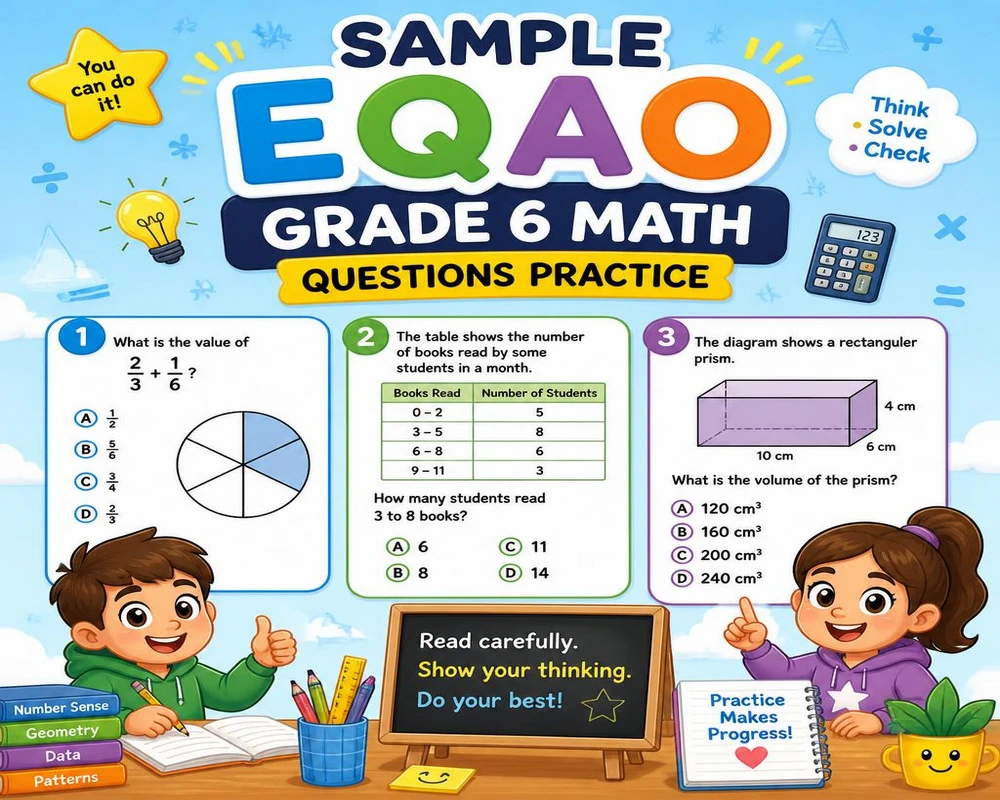
Sample EQAO Grade 6 Math Questions Practice
Below are practice questions modeled after the style and difficulty level of the real assessment. These aren’t official EQAO questions — the actual test bank is secure — but they reflect the same reasoning skills and strand coverage.
Number Strand Practice
Write 3/4 as a decimal and as a percent.
A recipe calls for 2 1/2 cups of flour. If you triple the recipe, how much flour is needed?
Round 47,382 to the nearest thousand.
Order these fractions from least to greatest: 2/3, 5/6, 1/2, 3/4
Algebra Strand Practice
If 6 + n = 14, what is the value of n?
Describe the pattern rule for the sequence: 3, 7, 11, 15, ___
A store charges $4 per notebook plus a flat $2 shipping fee. Write an expression for the total cost of buying n notebooks.
Data Strand Practice
Day
Books Sold
Monday
12
Tuesday
18
Wednesday
15
Thursday
21
Using the table above, calculate the mean (average) number of books sold across the four days.
Spatial Sense Strand Practice
A rectangle has a length of 9 cm and a width of 4 cm. What is its area?
Calculate the volume of a cube with side lengths of 5 cm.
What is the sum of the interior angles of a triangle?
Financial Literacy Strand Practice
A jacket costs $60 and is on sale for 25% off. What is the sale price?
If you save $8 per week, how many weeks will it take to save $120?
“If your child needs more structured support, our Grade 6 math practice lessons cover integers, probability, and financial literacy in one place.”
Sample EQAO Grade 6 Math Questions Practice
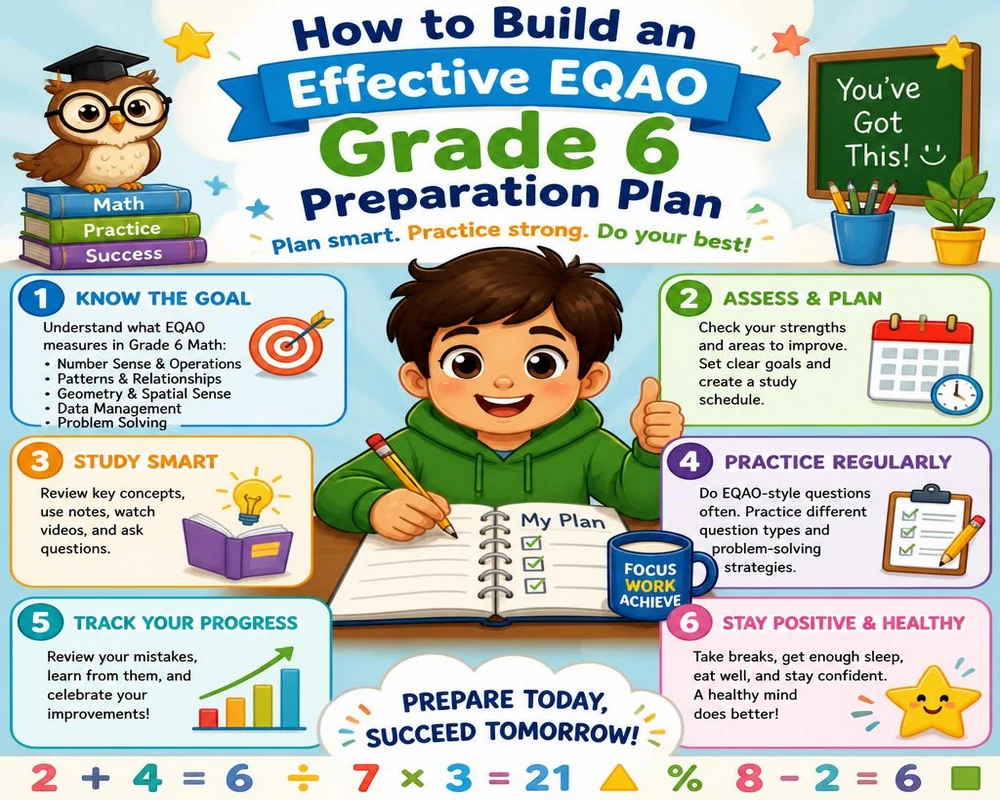
How to Build an Effective EQAO Grade 6 Preparation Plan
Start With a Diagnostic, Not a Drill
Before assigning a stack of practice sheets, figure out where the actual gaps are. A quick strand-by-strand quiz — even just five questions per strand — tells you far more than an hour of random practice. I’ve seen too many well-meaning parents spend weeks on fractions when the real weak spot was spatial reasoning.
Practice in Short, Focused Bursts
Cramming doesn’t work for eleven-year-olds any better than it does for adults. Twenty to thirty minutes of focused EQAO Grade 6 preparation, three or four times a week over two months, tends to produce far better results than a frantic week of long sessions right before the test.
Mix Digital and Hands-On Practice
Since the real test is fully digital, make sure at least some of your child’s practice happens on a screen, using drag-and-drop or multiple-choice formats. But don’t abandon hands-on tools entirely — physical manipulatives and drawn diagrams still build the conceptual understanding that digital drills alone can’t replicate.
Talk Through the Reasoning
EQAO doesn’t just want the right answer; open-response questions specifically ask students to show their thinking. Practice having your child explain their reasoning out loud, then write it down in a sentence or two. This single habit tends to boost open-response scores more than any other strategy I’ve used with students.
How to Build an Effective EQAO Grade 6 Preparation Plan
Understanding EQAO Achievement Levels
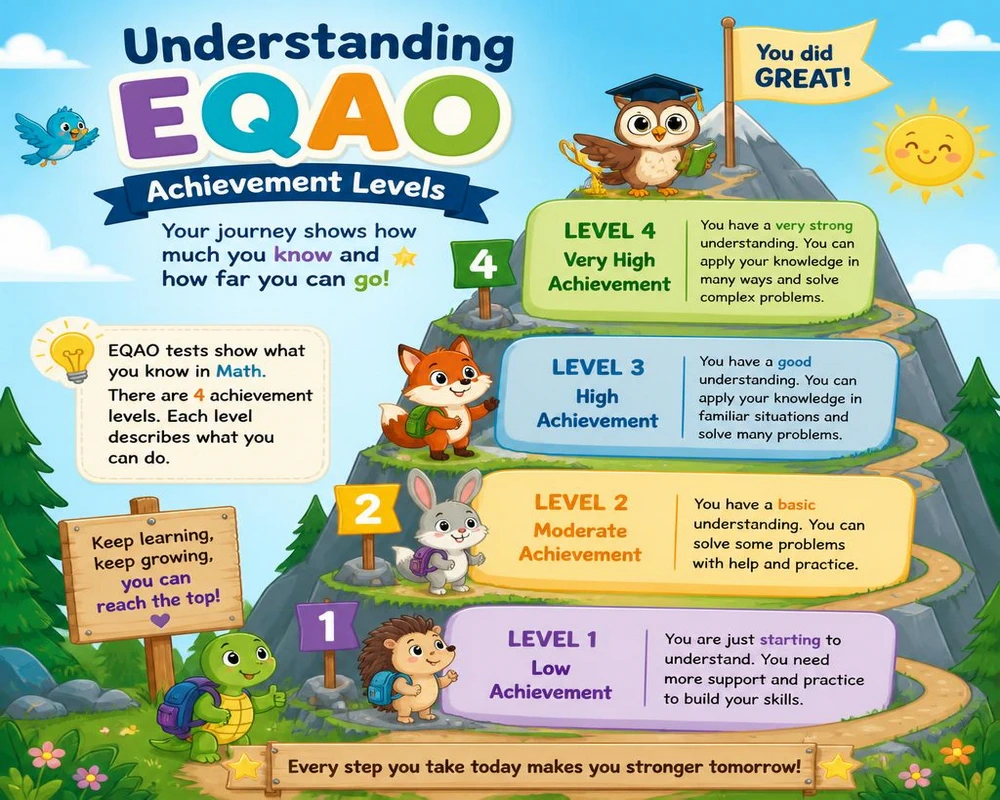
EQAO reports results at four levels: Level 1, which falls below the provincial standard; Level 2, approaching the standard; Level 3, at the provincial standard; and Level 4, above the standard. Level 3 is the target, and a student achieving Level 3 or 4 is considered to be meeting or exceeding Ontario curriculum expectations for Grade 6.
It’s worth putting this in perspective for your child: this isn’t a pass/fail test in the traditional sense, and for Grade 6, EQAO results do not appear on report cards — they’re used to show how well a student is meeting expected learning levels. Recent provincial data has drawn public attention to math achievement trends across Ontario, with education officials citing the results as a signal for where system-wide instructional support is still needed. That context is useful for parents, but it shouldn’t translate into pressure on an individual eleven-year-old sitting down to write the test.
Understanding EQAO Achievement Levels
Pros and Cons of EQAO Testing for Families
Pros
Cons
Gives a clear external benchmark of skills
Can create test anxiety if over-emphasized
Identifies curriculum gaps early
One test day doesn’t capture a full year of learning
Familiarizes students with standardized formats
Digital format requires its own practice and comfort
Results guide school-level instructional planning
Results aren’t tied to report card grades, which can confuse families about their purpose
Common Mistakes Students Make on the Grade 6 EQAO
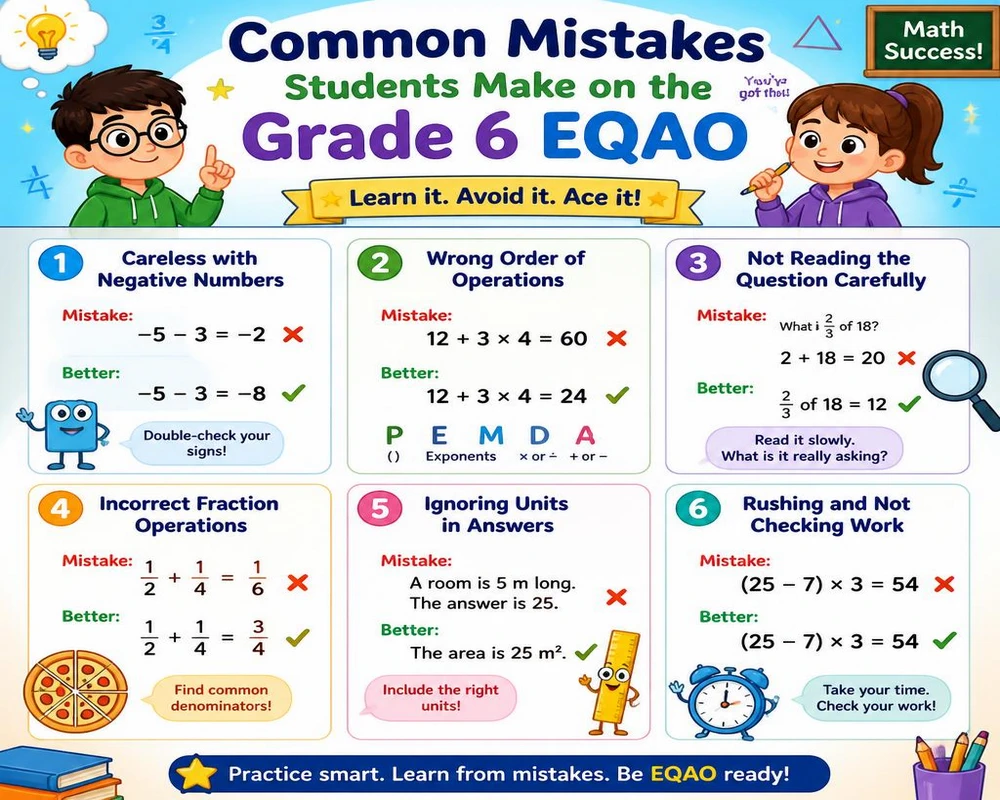
Rushing through word problems without underlining or noting the key numbers first
Skipping the formula sheet — EQAO provides an updated formula sheet for students completing the mathematics component of the Junior-division assessment, but many students forget it’s available
Leaving open-response questions blank when unsure, rather than showing partial reasoning for partial credit
Not checking units on measurement and financial literacy questions
Second-guessing correct first answers without a clear mathematical reason to change them
Common Mistakes Students Make on the Grade 6 EQAO
Conclusion: Turn Practice Into Confidence, Not Pressure
EQAO Grade 6 math practice works best when it’s treated as an opportunity to reinforce a year’s worth of learning, not a hurdle to fear. The strongest preparation blends strand-by-strand review, comfort with the digital test format, and plenty of low-stakes practice that lets your child make — and learn from — mistakes well before test day arrives. Start early, keep sessions short and consistent, and remind your child that this test is one measurement among many, not a verdict on their ability.
Ready to put this into action? Pick one strand this week — maybe Number or Spatial Sense — and work through five practice questions together tonight. Small, steady steps are exactly what turn EQAO prep from a source of stress into a genuine confidence builder.
Turn Practice Into Confidence, Not Pressure
Frequently Asked Questions
1. What topics are covered on the Grade 6 EQAO math assessment? The assessment covers five strands from the Ontario 2020 curriculum: Number, Algebra, Data, Spatial Sense, and Financial Literacy, drawing on content cumulative from Grades 4 through 6.
2. Is the EQAO Grade 6 test done on paper or on a computer? It’s fully digital. The Grade 6 assessment has been administered in its current computer-based format since 2022, using formats like multiple-choice, drag-and-drop, and short written responses.
3. When is the Grade 6 EQAO written in 2026? The Junior Division assessment is administered within a provincial window in May and June, though each school selects its own specific dates within that window.
4. Does the EQAO Grade 6 result affect my child’s report card grade? No. For Grade 6, EQAO results do not appear as report card grades; they’re used separately to show how a student is meeting provincial learning expectations.
5. What is considered a good score on the EQAO Grade 6 math test? Level 3 is the provincial standard and the general target. Students scoring Level 3 or Level 4 are considered to be meeting or exceeding curriculum expectations for their grade.
6. Can French Immersion students write the math assessment in French? Yes. Starting in the 2025-2026 school year, French Immersion students in the Junior Division can complete the mathematics component in French, based on the option their school board selects.
7. How can I help my child prepare without causing stress? Focus on short, consistent practice sessions rather than long cram sessions, mix in hands-on activities alongside digital practice, and frame the test as one checkpoint rather than a high-stakes exam.
8. Are there official practice questions available from EQAO? Yes, EQAO releases official sample questions and previously used released questions through its website, which are the most accurate way to preview the actual test format and difficulty level.
👩🏫
Teacher
Math educator and curriculum specialist helping Canadian families make the most of elementary math education.