
Grade 1 Addition and Subtraction Practice — Ontario Curriculum Questions
If you’ve ever watched your six-year-old count on their fingers, lose track at seven, and then declare “I hate math,” you already know that the leap into formal addition and subtraction can feel bigger than it looks on paper. Grade 1 addition and subtraction practice isn’t just about memorizing number facts — it’s about building the number sense that will carry your child through every math class for the next twelve years. As a former classroom teacher and curriculum consultant who has spent over a decade helping Ontario families navigate the early math curriculum, I’ve seen firsthand how the right kind of practice, delivered the right way, transforms anxious counters into confident problem-solvers.
This article breaks down exactly what Grade 1 students in Ontario are expected to know, why it matters, and how you can support that learning at home with real, curriculum-aligned questions and strategies — no gimmicks, no fluff, just what actually works.
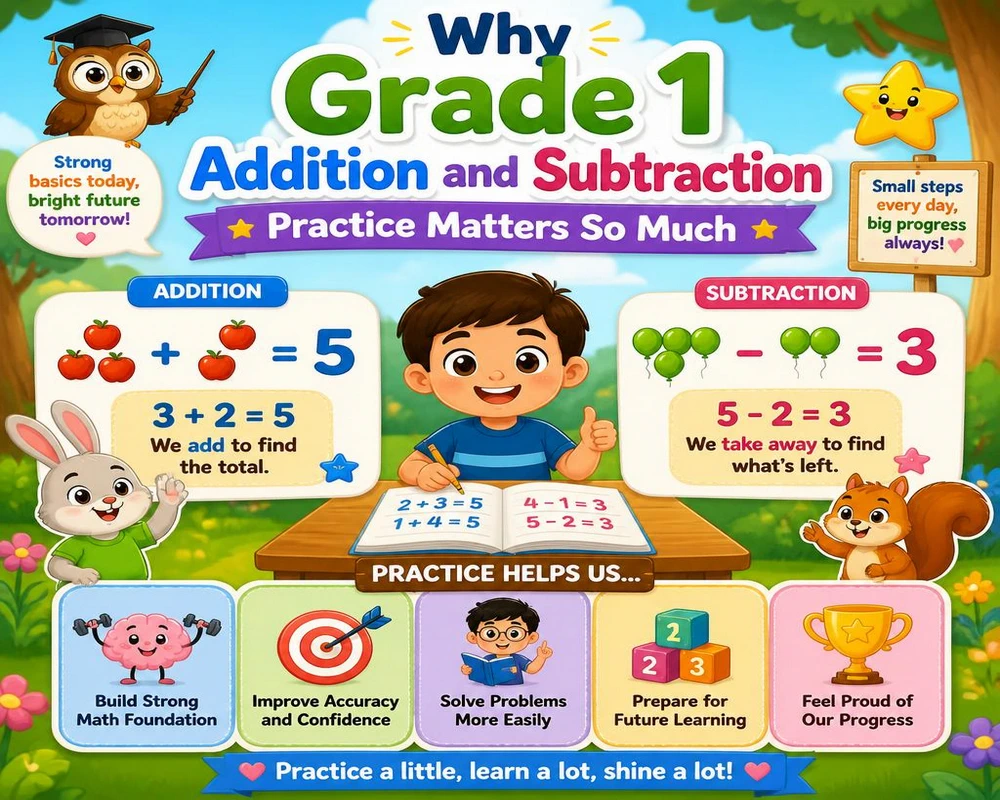
Why Grade 1 Addition and Subtraction Practice Matters So Much
The Ontario 2020 Mathematics Curriculum places heavy emphasis on number sense in the primary grades, and for good reason. Research published by the Ontario Ministry of Education and echoed in recent studies from the Canadian Council on Learning shows that a child’s grasp of early number operations is one of the strongest predictors of later math achievement — stronger, in fact, than IQ scores at age six. A 2024 review from the C.D. Howe Institute noted that Canadian students who fall behind in foundational numeracy in Grades 1 and 2 rarely catch up without targeted intervention.
That’s the stakes. But here’s the encouraging part: Grade 1 addition and subtraction practice doesn’t need to feel like a chore or a test. Done well, it looks a lot like play — counting snack crackers, splitting up toy cars, or figuring out how many more steps to the mailbox.
What the Ontario Curriculum Actually Expects in Grade 1
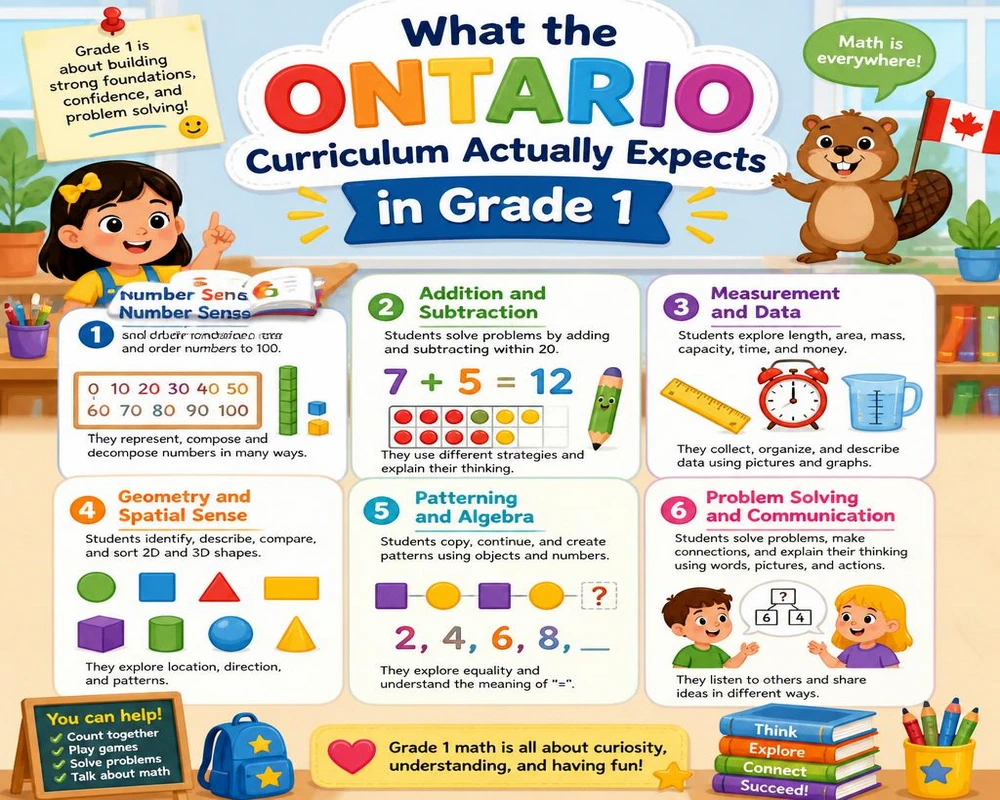
Under the Ontario curriculum, Grade 1 students are expected to:
- Add and subtract numbers up to 20, using concrete materials and drawings
- Understand addition as “putting together” and subtraction as “taking away” or “finding the difference”
- Recognize and use the relationship between addition and subtraction (fact families)
- Solve simple word problems involving addition and subtraction
- Use mental math strategies, such as counting on and counting back
- Represent number sentences using symbols like + and =
Notice what’s missing from that list: timed worksheets and rote memorization drills. The curriculum is explicit about wanting students to understand what addition and subtraction mean before they’re asked to perform them quickly. That’s a subtle but important shift from how many of us were taught math in the 1990s.
Core Strategies for Grade 1 Addition Practice
Before diving into sample questions, it helps to understand the strategies Ontario teachers use in the classroom. If you reinforce these same strategies at home, your child’s practice will feel consistent rather than confusing.
Counting On
This is usually the first strategy introduced. Instead of counting both numbers from one, a child starts at the larger number and counts up. For 5 + 3, they’d say “5… 6, 7, 8” rather than starting from zero.
Making Ten
Because our number system is base-10, teachers spend a lot of time helping students see how numbers relate to 10. For example, 8 + 5 can be solved by taking 2 from the 5 to make 8 into 10, leaving 10 + 3 = 13. This strategy feels abstract at first, but with visual ten-frames, most Grade 1 students pick it up within a few weeks.
Using Manipulatives
Physical objects — counters, snap cubes, dried beans, even Cheerios — are not a crutch. They’re a bridge to abstract thinking. The Ontario curriculum explicitly recommends concrete materials as a first step in every operation.
Doubles and Near-Doubles
Facts like 4 + 4 = 8 tend to stick in a child’s memory quickly. Teachers use these “doubles” as anchors, so a near-double like 4 + 5 becomes “4 + 4, plus one more.”
Addition and subtraction stick best when they show up outside the classroom too — during snack time, chores, or a quick game before bed. Ontario’s own at Home resource hub offers additional grade-specific activities parents can use to reinforce exactly these skills between school days.
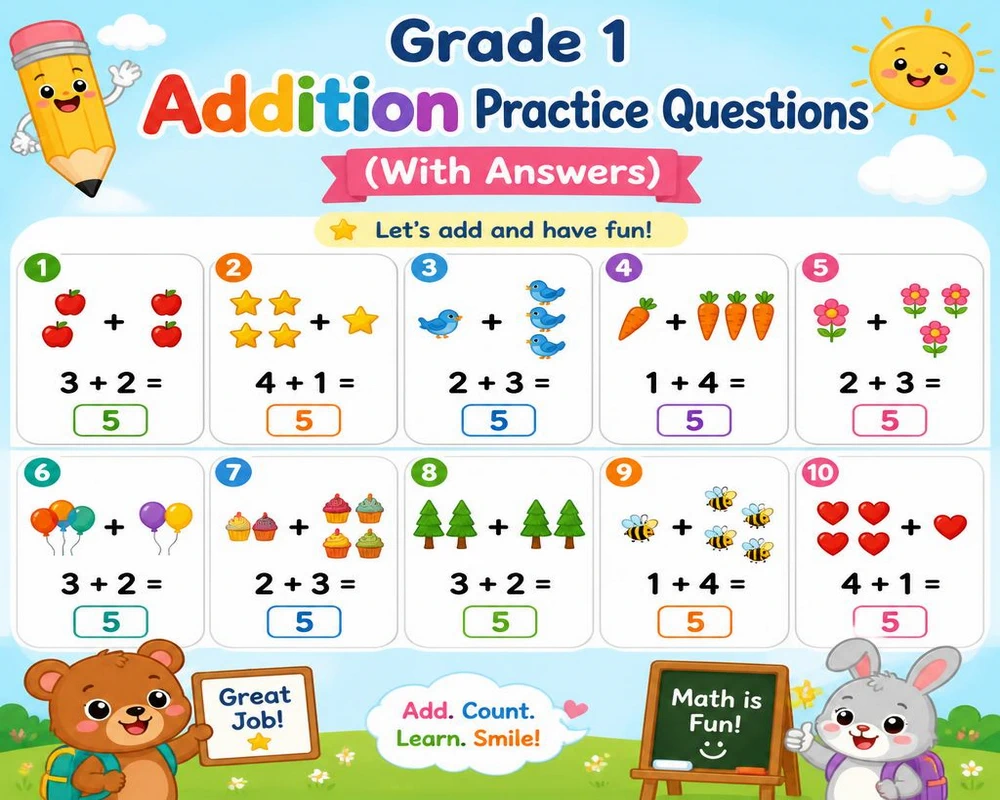
Grade 1 Addition Practice Questions (With Answers)
Below is a set of addition practice Grade 1 Ontario questions organized from easiest to most challenging. Work through a few at a time — five to eight questions in one sitting is plenty for a six- or seven-year-old.
| Question | Answer |
|---|---|
| 2 + 3 = ___ | 5 |
| 4 + 4 = ___ | 8 |
| 6 + 2 = ___ | 8 |
| 5 + 5 = ___ | 10 |
| 7 + 3 = ___ | 10 |
| 8 + 4 = ___ | 12 |
| 9 + 6 = ___ | 15 |
| 10 + 7 = ___ | 17 |
Word Problems for Addition
Word problems are where a lot of kids stumble, not because the math is hard, but because they haven’t learned to picture the story yet. Try reading these aloud and asking your child to draw the problem before solving it.
- Mia has 4 stickers. Her friend gives her 3 more. How many stickers does Mia have now?
- There are 6 ducks in the pond. 5 more ducks join them. How many ducks are there in total?
- Sam counted 8 red apples and 6 green apples in a basket. How many apples are there altogether?
These types of math questions Grade 1 addition problems build the same skill kids will use later for multi-step word problems in Grades 3 and 4, so it’s worth the extra few minutes of drawing and talking it through.
Grade 1 Subtraction Practice Questions (With Answers)
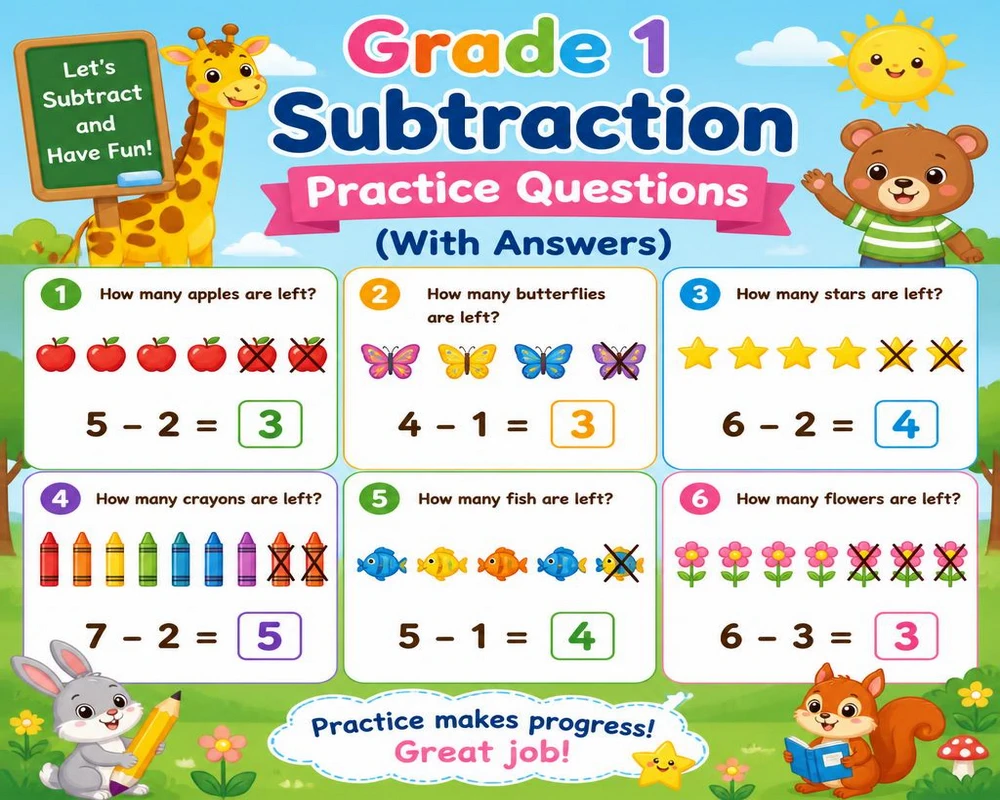
Subtraction Grade 1 Canada students often find trickier than addition, mostly because “taking away” requires holding two ideas in mind at once — the whole amount and the amount removed. Ten-frames and number lines are especially useful here.
| Question | Answer |
|---|---|
| 5 − 2 = ___ | 3 |
| 8 − 3 = ___ | 5 |
| 10 − 4 = ___ | 6 |
| 9 − 5 = ___ | 4 |
| 12 − 6 = ___ | 6 |
| 15 − 7 = ___ | 8 |
| 18 − 9 = ___ | 9 |
| 20 − 11 = ___ | 9 |
Word Problems for Subtraction
- Jack had 10 crayons. He gave 4 to his sister. How many crayons does Jack have left?
- There were 9 birds on a branch. 3 flew away. How many birds are left?
- Priya baked 14 cookies. Her family ate 6 of them. How many cookies remain?
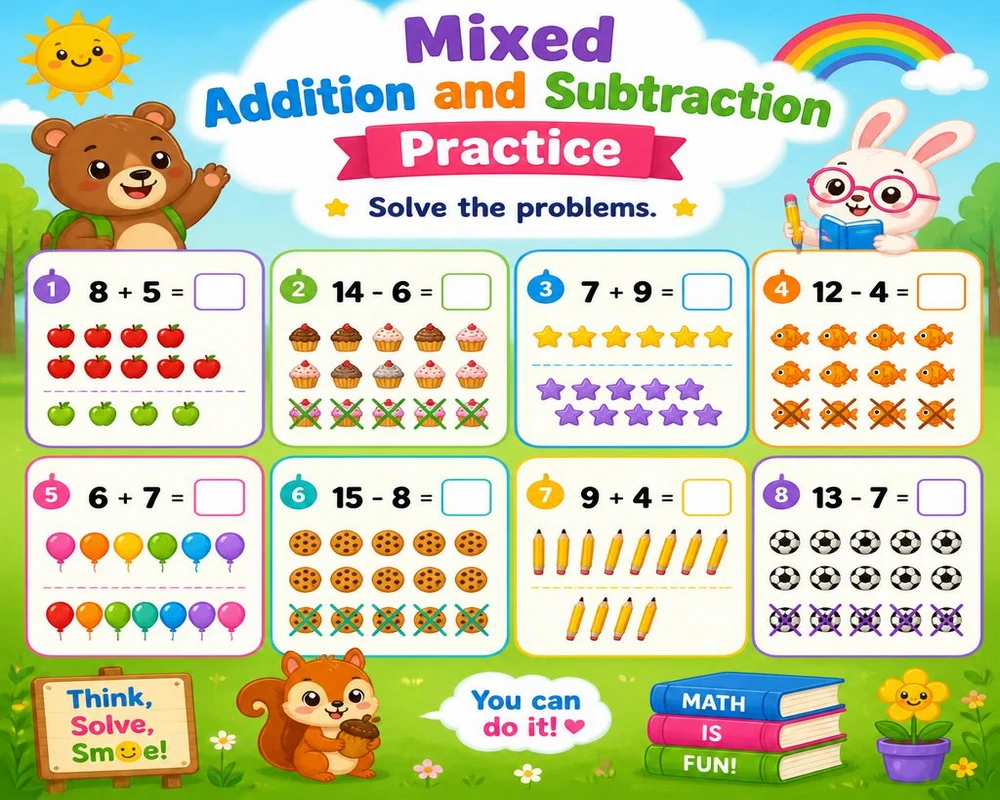
Mixed Addition and Subtraction Practice
Once your child feels solid with each operation separately, mixing them together strengthens flexible thinking — an essential skill for the fact-family concept the Ontario curriculum highlights.
- 7 + 6 = ___
- 13 − 5 = ___
- 9 + 9 = ___
- 16 − 8 = ___
- 4 + 8 = ___
- 11 − 3 = ___
Fact Family Practice
Fact families help kids see that addition and subtraction are two sides of the same coin. Given the numbers 3, 4, and 7, a student should be able to write:
- 3 + 4 = 7
- 4 + 3 = 7
- 7 − 4 = 3
- 7 − 3 = 4
Try this with a few number trios at home: 5, 6, 11 or 8, 2, 10. It’s a five-minute activity that pays off enormously when your child hits Grade 2 and starts working with larger numbers.
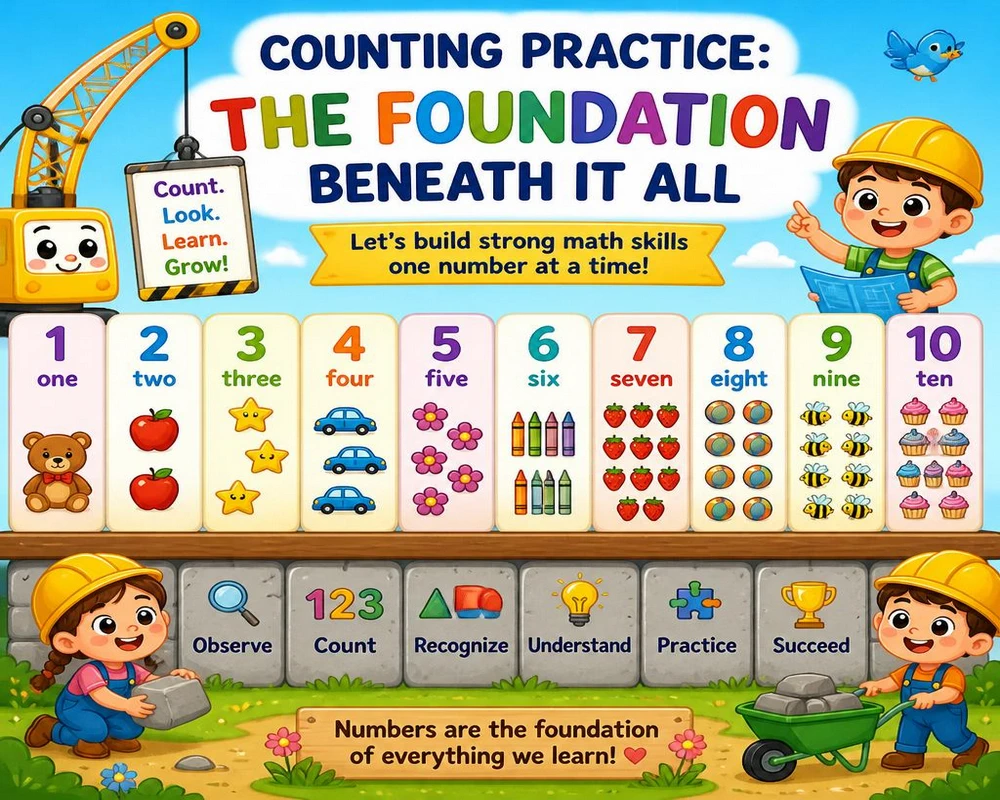
Counting Practice Grade 1: The Foundation Beneath It All
It’s tempting to skip straight to addition and subtraction worksheets, but counting practice Grade 1 skills — skip counting, counting backward, counting on from a random number — are what make everything else possible. If your child can’t confidently count from 13 to 20, addition problems in that range will always feel like a struggle rather than a skill.
Here are a few quick counting warm-ups to do before any addition or subtraction session:
- Count forward from 7 to 20.
- Count backward from 15 to 1.
- Skip count by 2s to 20.
- Start at 9 and count on 5 more numbers out loud.
Spending two minutes on these before diving into “real” math homework primes the brain and, in my experience working with primary classrooms, cuts down on the frustration that shows up mid-worksheet.
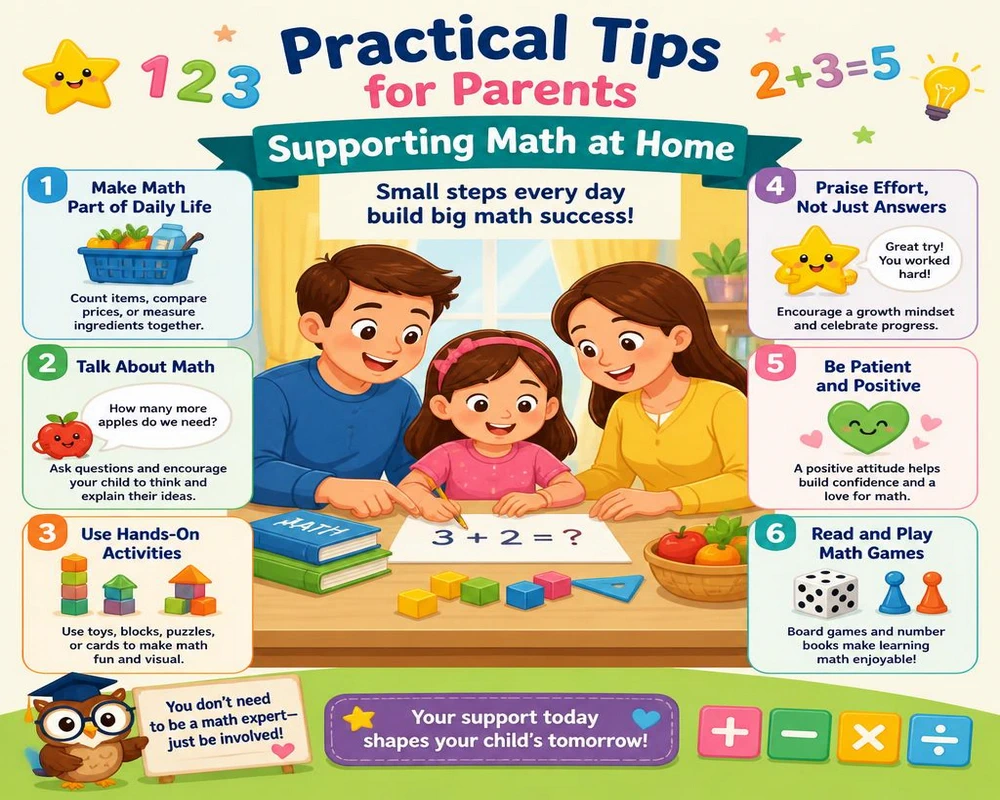
Practical Tips for Parents Supporting Math at Home
Keep Sessions Short and Frequent
A 2025 report from the Ontario Association for Mathematics Education found that short, consistent practice — 10 to 15 minutes, four or five times a week — produced better retention in primary students than longer, less frequent sessions. Six-year-olds simply don’t have the stamina for 45-minute math blocks, and forcing it tends to build resentment rather than skill.
Use Everyday Moments
You don’t need a workbook to practice. Setting the table (“we need 4 forks, we have 2, how many more?”), sharing snacks, or counting stairs all count as real math practice — and honestly, kids often engage more with these than with a printed page.
Celebrate Strategy, Not Just Speed
It’s tempting to praise quick answers, but the Ontario curriculum values how a child gets to an answer just as much as whether it’s correct. Ask “how did you figure that out?” and celebrate a well-reasoned strategy even if it takes a little longer than instant recall.
Pros and Cons of Worksheet-Based Practice
| Pros | Cons |
|---|---|
| Easy to track progress over time | Can feel repetitive without variety |
| Reinforces written number sentences | Doesn’t build hands-on number sense alone |
| Convenient for quick daily practice | Risk of rushing without understanding |
The takeaway isn’t to avoid worksheets entirely — they’re a useful tool — but to pair them with hands-on activities and conversation so your child understands the “why” behind the numbers, not just the “what.”
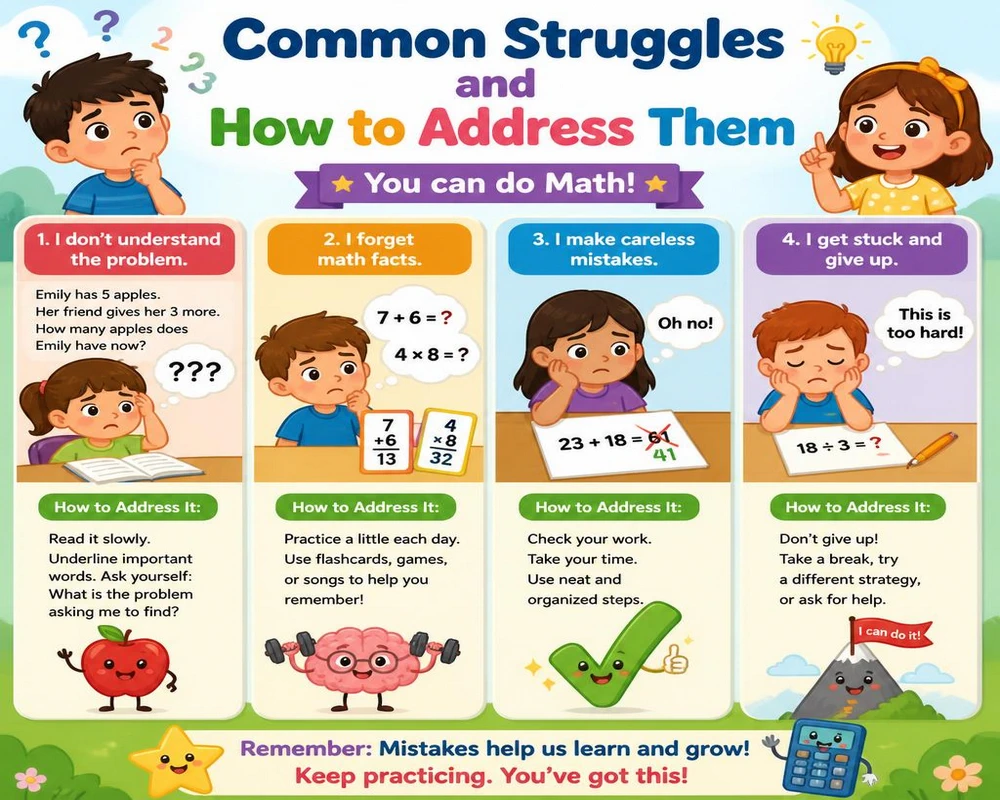
Common Struggles and How to Address Them
Reversing Numbers or Symbols
Many Grade 1 students mix up + and − symbols, or write numbers backward. This is developmentally normal and usually resolves with continued practice and gentle correction — not something to worry over.
Losing Track While Counting
If your child consistently miscounts past 10, go back to counting practice before pushing further into addition and subtraction. It’s a foundational gap, not a sign they can’t do math.
Anxiety Around “Getting It Wrong”
Math anxiety can start as early as Grade 1. Keep the tone light, frame mistakes as useful information, and avoid comparing your child’s pace to siblings or classmates. A 2024 study out of York University found that parental math anxiety, when expressed even subtly during homework help, can transfer to children and affect their confidence — so it’s worth checking your own tone, too.
Conclusion: Small Steps Build Big Confidence
Addition and subtraction form the backbone of Grade 1 math, but they’re just the starting point for a full year that also covers shapes, patterns, and measurement. For the complete picture, our Grade 1 math practice hub brings every topic together in one place.
Grade 1 addition and subtraction practice is really about laying a foundation — not racing to the finish line. Every counted cracker, every drawn-out word problem, and every fact family your child masters this year becomes a building block for the math they’ll do for the rest of their schooling. Be patient, keep it playful, and lean on the strategies your child is already learning in the classroom so home practice feels like reinforcement, not a second curriculum.
If you’re looking for more structured support, consider printing out a few of the practice questions above each week, or turning them into a simple game night activity. Consistency, not intensity, is what builds lasting number sense — start with just ten minutes today, and watch the confidence grow.
Frequently Asked Questions
1. What addition and subtraction skills should a Grade 1 student have by the end of the year in Ontario? By the end of Grade 1, most Ontario students should be able to add and subtract numbers up to 20 using concrete materials, drawings, or mental strategies, and should be able to solve simple related word problems.
2. How many math facts should a Grade 1 child know by heart? There’s no strict number mandated by the Ontario curriculum, but many students naturally memorize doubles (like 3+3, 4+4) and small sums to 10 through repeated, playful practice over the school year.
3. Is it normal for my child to still use fingers to count in Grade 1? Yes, completely normal. Finger counting is a valid strategy at this stage and often fades naturally as a child’s number sense strengthens through practice.
4. How can I help my child with subtraction if they only understand addition? Use fact families to show the connection — if they know 6 + 3 = 9, help them see that 9 − 3 = 6 uses the same numbers in reverse. Ten-frames and physical objects also make subtraction more concrete.
5. How much time should Grade 1 students spend on math practice at home each day? Around 10 to 15 minutes of focused practice, four to five times a week, tends to work well for most six- and seven-year-olds without causing burnout.
6. What’s the difference between Ontario’s Grade 1 math expectations and other provinces? While the core concepts (addition, subtraction, counting to 20) are broadly similar across Canada, Ontario’s 2020 curriculum places particular emphasis on math process expectations, like problem-solving and reasoning, alongside content knowledge.
7. My child gets the right answer but can’t explain how they solved it. Should I be concerned? Not necessarily, but it’s worth gently encouraging explanation, since the Ontario curriculum values reasoning skills. Try asking open-ended questions like “show me how you did that” rather than “why.”
8. Are printable worksheets enough, or do I need extra resources? Worksheets are a helpful tool for tracking progress, but pairing them with hands-on counting activities, verbal word problems, and everyday math moments gives a more well-rounded practice experience.