
Grade 6 Integers Practice: Positive & Negative Numbers
Many Grade 6 students feel confused the first time they meet negative numbers. Temperature drops below zero, bank balances go into the red, or elevators travel below ground level—all of these situations suddenly need a new kind of number. Solid Grade 6 integers practice turns that confusion into confidence. This guide walks you through the exact skills Ontario expects, shows clear examples, and gives practical ways to practice so students truly understand positive and negative numbers.
Whether you are a student, parent, or teacher, the right Grade 6 integers practice builds a foundation that supports later work with algebra, coordinate grids, and real-world problem solving. Let’s break it down step by step.
What the Ontario Curriculum Expects for Grade 6 Integers
In Ontario, Grade 6 students are introduced to integers as the set of whole numbers and their opposites. They learn to represent, compare, order, and perform simple operations with positive and negative numbers. The curriculum also connects integers to real-life contexts such as temperature, elevation, and financial situations.
Effective Grade 6 integers practice therefore goes beyond memorizing rules. Students need to visualize numbers on a number line, understand the meaning of zero, and explain their thinking. Recent classroom observations across Ontario in 2025 continue to show that students who regularly engage in meaningful Grade 6 integers practice develop stronger number sense and make fewer sign errors later in middle school.
Core Ideas Every Student Needs for Grade 6 Integers Practice
Positive Numbers, Negative Numbers, and Zero
Positive numbers sit to the right of zero on the number line and represent values greater than zero. Negative numbers sit to the left and represent values less than zero. Zero itself is neither positive nor negative—it is the origin point.
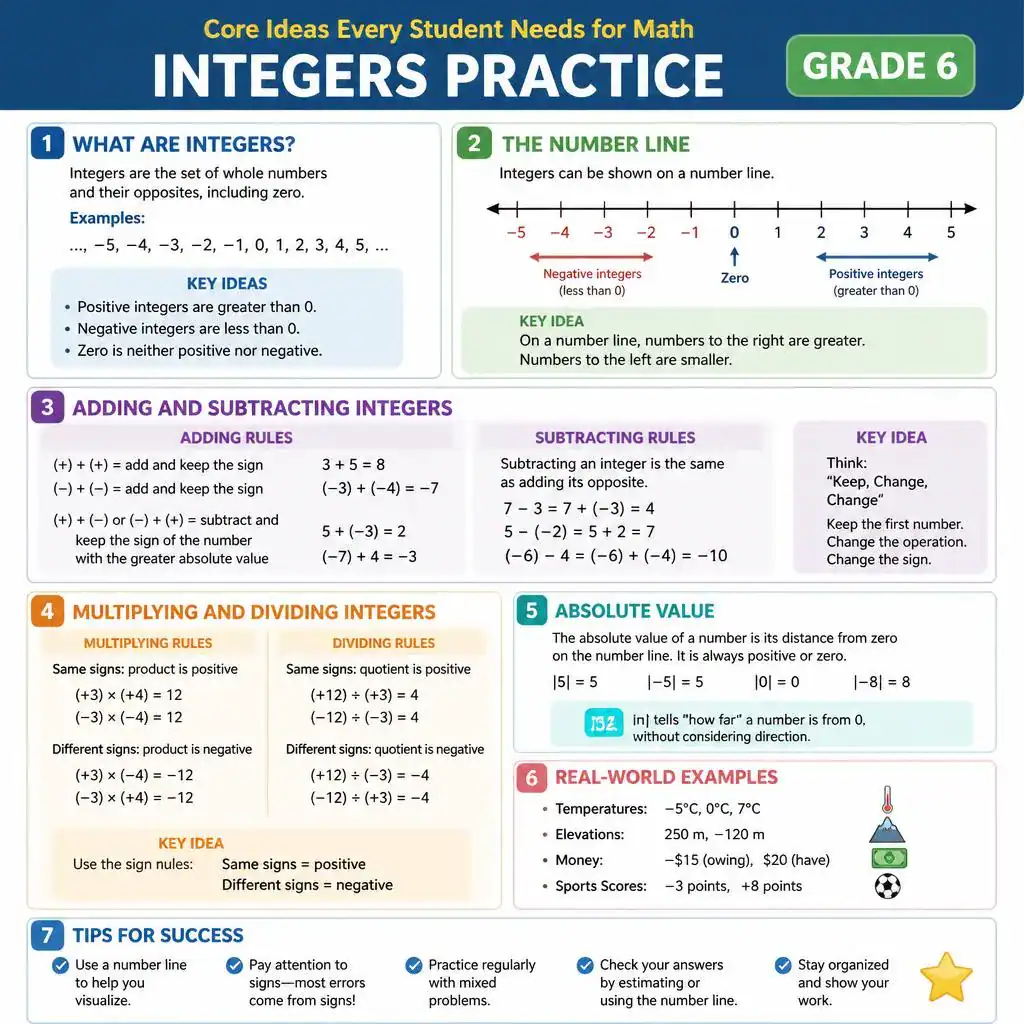
A simple way to remember: if you walk five steps forward from a starting point you reach +5. If you walk five steps backward you reach –5. Both distances are the same size, yet they point in opposite directions. This idea of opposite direction is central to successful Grade 6 integers practice.
Absolute Value
Absolute value tells us the distance from zero without considering direction. The absolute value of both +7 and –7 is 7. Students often meet absolute value when comparing temperatures or measuring how far a number sits from zero. Including absolute-value questions in Grade 6 integers practice helps students separate size from sign.
Comparing and Ordering Integers
On a number line, numbers increase as you move right and decrease as you move left. Therefore –3 is greater than –8, even though 8 looks “bigger” than 3. Many students need repeated Grade 6 integers practice with number lines before this idea feels natural.
Practical Strategies for Effective Grade 6 Integers Practice
The best Grade 6 integers practice mixes visual models, real-life stories, and short written problems. Here are approaches that consistently work in Ontario classrooms.
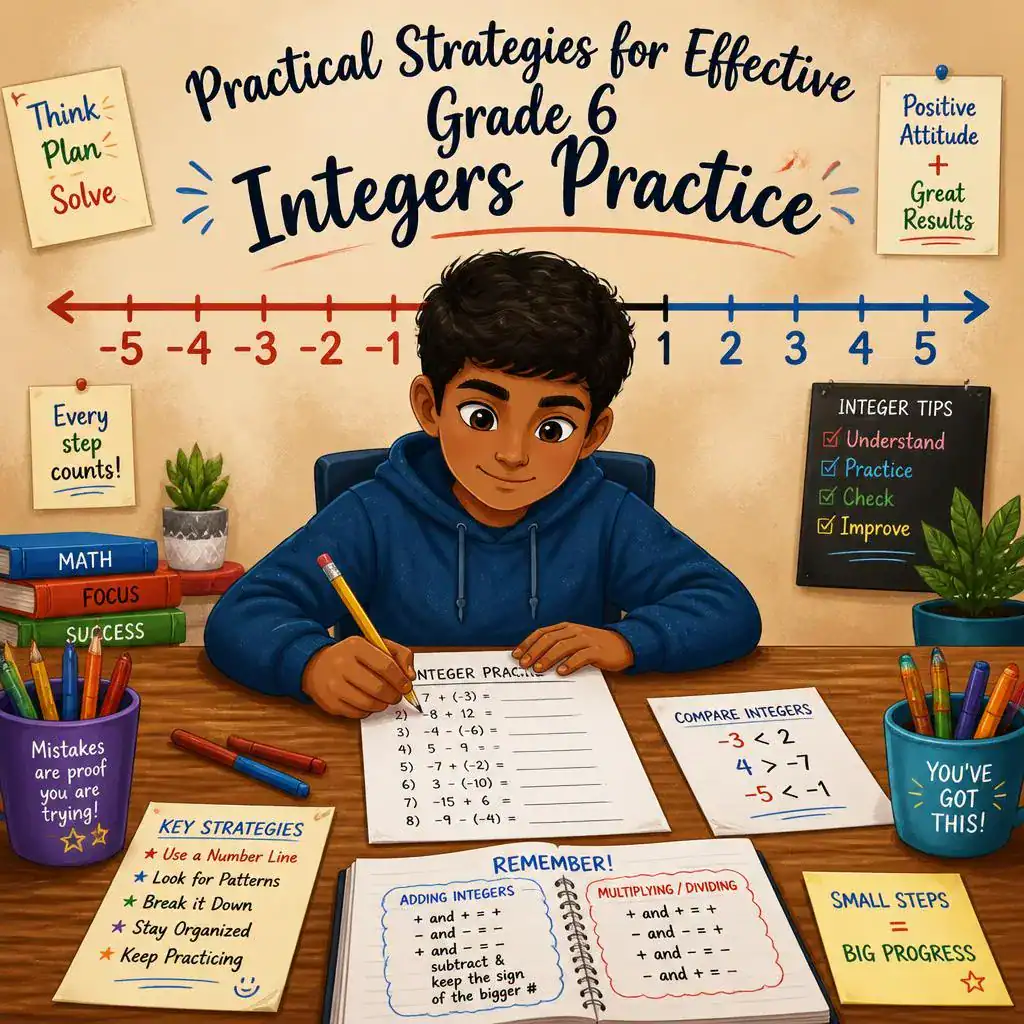
Use the Number Line Every Day
Draw a number line on paper, a whiteboard, or even the sidewalk with chalk. Ask students to place numbers, find opposites, or jump a certain number of units left or right. Physical movement strengthens memory. Teachers who incorporate daily number-line work report faster progress during Grade 6 integers practice.
Connect to Real Situations
- Temperature: “It was –4 °C in the morning and rose 9 degrees. What is the new temperature?”
- Elevation: “A submarine is at –120 m. It rises 45 m. Where is it now?”
- Money: “You have $15 and spend $22. What is your balance?”
These contexts make abstract symbols meaningful and keep Grade 6 integers practice engaging.
Teach Addition and Subtraction with Models
Two reliable models help students add and subtract integers:
- Number-line jumps – Start at the first number and move right for positive and left for negative.
- Chip or counter model – Use two colors to represent positive and negative. Pairs of opposite chips cancel to zero.
Once students can show the operation with a model, they are ready for symbolic work. Mixing models into regular Grade 6 integers practice prevents students from relying only on memorized rules that they later forget.
Sample Grade 6 Integer Problems with Solutions
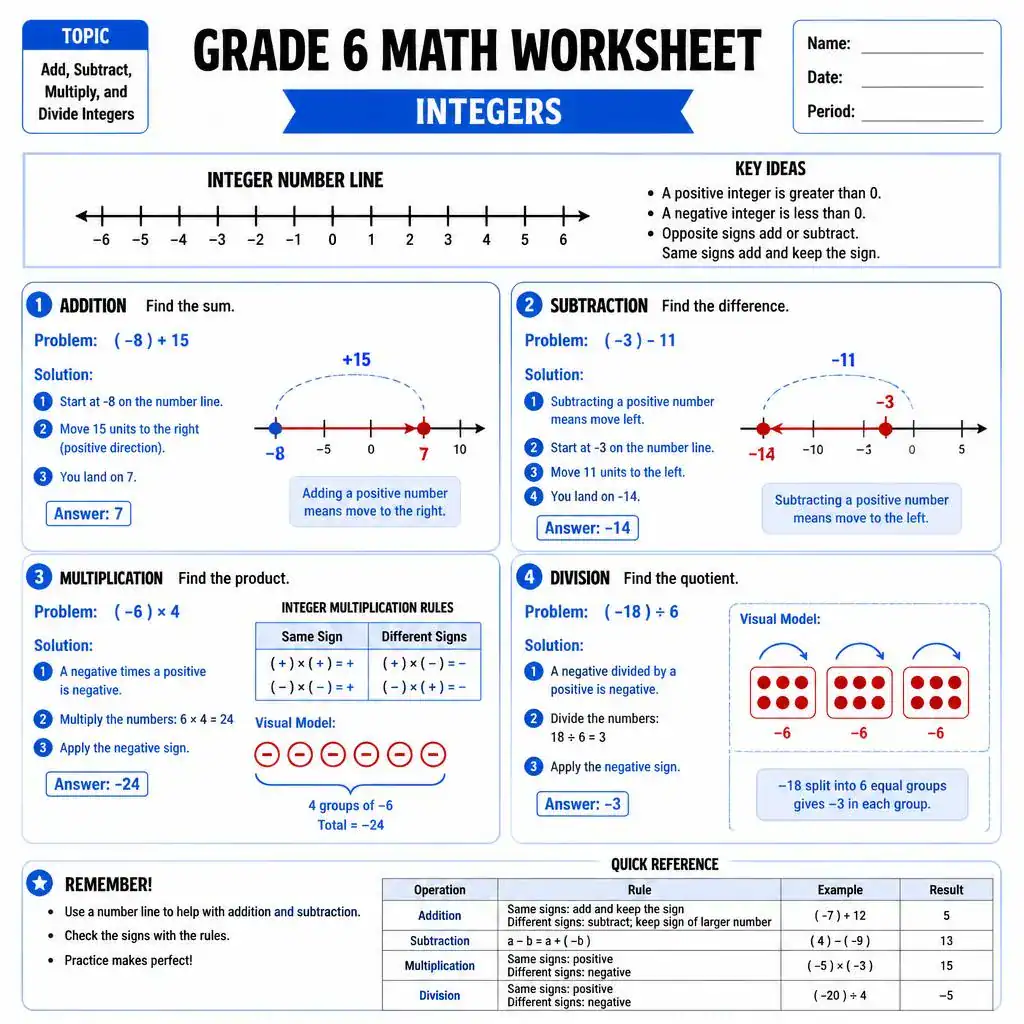
Below are typical integers questions Grade 6 Ontario students encounter, followed by clear reasoning.
Comparing and Ordering
Problem: Order from least to greatest: –5, 3, –1, 0, –8
Solution: Place them on a mental number line. Moving left to right: –8, –5, –1, 0, 3.
Addition
Problem: (–7) + 12
Solution: Start at –7 and move 12 units right. You land on 5. Alternatively, 12 is larger than 7 and positive, so the answer is positive 5.
Subtraction
Problem: 4 – (–9)
Solution: Subtracting a negative is the same as adding the opposite. 4 + 9 = 13. On a number line you start at 4 and move 9 units right.
Regular exposure to problems like these forms the heart of solid Grade 6 integers practice. Encourage students to explain each step in words as well as symbols.
Common Mistakes and How to Fix Them
Even motivated students make predictable errors. Addressing them early improves the quality of Grade 6 integers practice.
- Thinking “larger digit means larger number” – Students may say –9 is greater than –2 because 9 > 2. Number-line practice quickly corrects this.
- Sign errors when subtracting – Many forget that subtracting a negative becomes addition. Modeling with counters or number lines reduces these mistakes.
- Ignoring zero – Students sometimes skip zero when ordering integers. Explicitly placing zero on every number line helps.
When errors appear, return to a concrete model before moving back to abstract numbers. This cycle of model → symbol → model is one of the most effective patterns in Grade 6 integers practice.
Real-Life Applications That Deepen Understanding
Integers appear constantly outside the classroom. Linking practice to these situations increases motivation.
Weather reports, sports scores (especially golf or games with penalties), elevator floors, and bank statements all use positive and negative numbers. Ask students to keep a short “integers journal” for one week, recording every time they notice a negative number in daily life. Sharing these observations at the start of a lesson makes Grade 6 integers practice feel relevant rather than abstract.
Financial literacy connections are especially strong in the Ontario curriculum. Discussing simple profit and loss, or the meaning of a negative bank balance, gives authentic reasons to master the skills.
Tips for Parents Supporting Grade 6 Integers Practice at Home
Parents do not need to become math teachers. A few supportive habits make a noticeable difference.
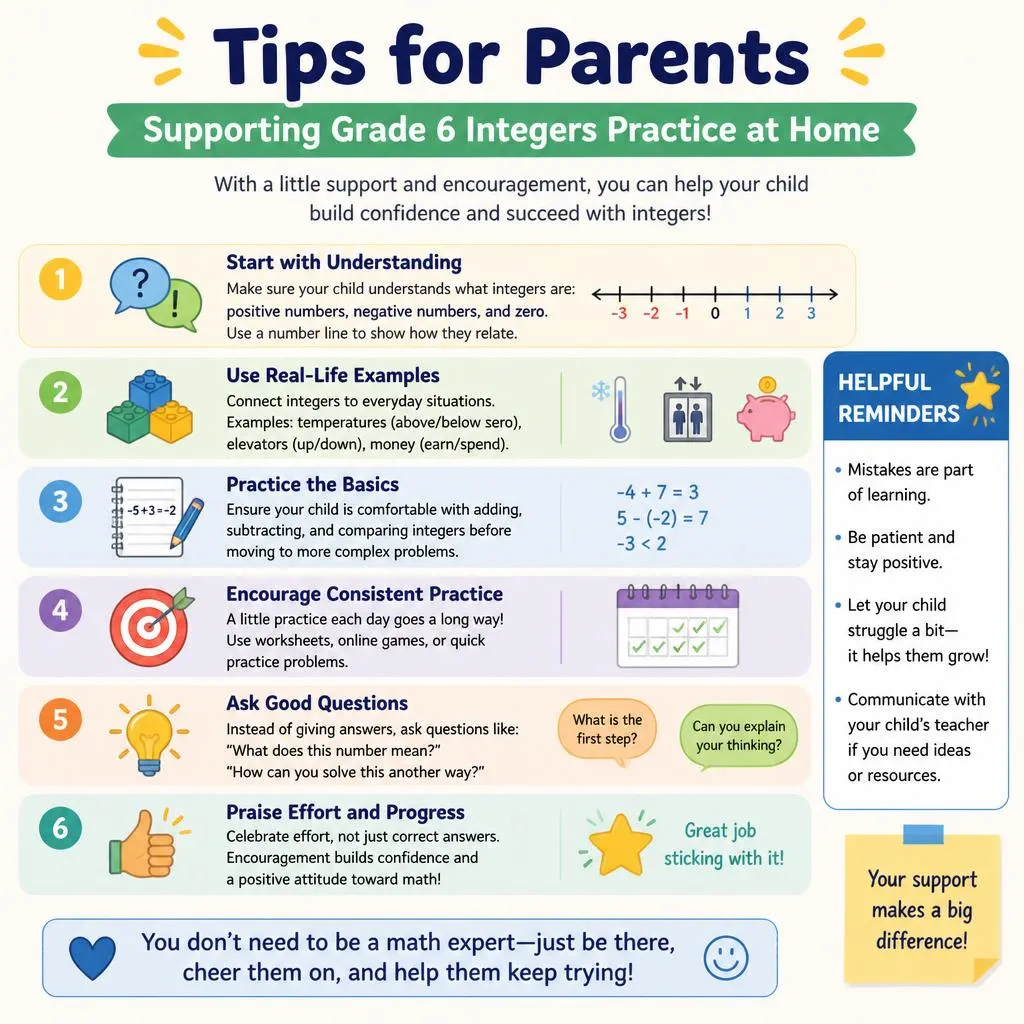
- Ask your child to explain a problem out loud. Teaching someone else reveals gaps quickly.
- Use kitchen or household situations: “The freezer is at –18 °C. If the temperature rises 5 degrees, what is it now?”
- Keep practice sessions short—10 to 15 minutes of focused work is usually better than a long frustrated session.
- Celebrate clear thinking, not only correct answers.
When parents stay curious and calm, children are more willing to take risks during Grade 6 integers practice.
Tips for Teachers Designing Grade 6 Integers Practice
Variety keeps engagement high. Rotate among number-line work, counter models, story problems, quick games, and short written sets. Exit tickets with one or two carefully chosen questions give useful daily feedback.
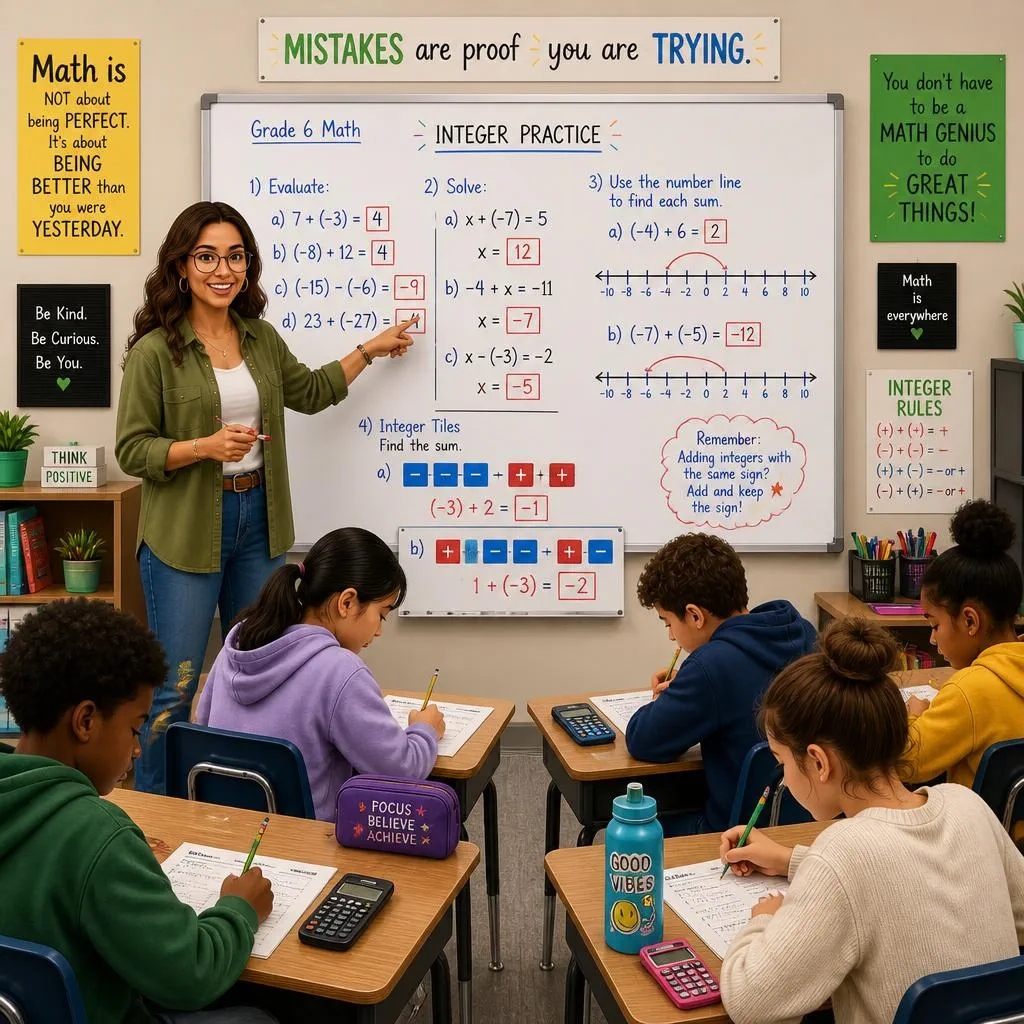
Peer discussion is powerful. Have students solve a problem independently, then compare strategies with a partner before sharing with the class. Hearing multiple correct approaches deepens understanding and makes Grade 6 integers practice more collaborative.
Assessment should check both procedural skill and conceptual understanding. Asking “Why is –3 greater than –7?” reveals more than a page of calculations alone.
Building Fluency Without Losing Meaning
Fluency matters, yet it should rest on understanding. Once students can explain why the rules work, short timed practice or games can build speed. Avoid pure drill too early; it often produces fragile knowledge that collapses when problems look slightly different.
A balanced approach—models, stories, discussion, and then targeted practice—produces the strongest results in Grade 6 integers practice. Students who follow this path move into Grade 7 and 8 with far fewer misconceptions about signed numbers.
“If your child needs more structured support, our Grade 6 math practice lessons cover integers, probability, and financial literacy in one place.”
Mastering integers is a turning point in elementary mathematics. With clear models, real-life connections, and steady Grade 6 integers practice, students learn that positive and negative numbers are simply tools for describing direction and quantity. The Ontario curriculum gives a clear roadmap; thoughtful practice turns that roadmap into lasting skill.
Start with the number line, add real contexts, address common errors early, and keep the tone encouraging. Whether you are a student practicing tonight’s homework, a parent helping at the kitchen table, or a teacher planning next week’s lessons, consistent and meaningful Grade 6 integers practice will make a measurable difference. Choose one strategy from this guide and try it today. Confidence with integers grows one clear understanding at a time.
FAQ: Grade 6 Integers Practice
1. What are integers in Grade 6?
Integers are the set of whole numbers and their opposites: … –3, –2, –1, 0, 1, 2, 3 … Grade 6 students learn to represent, compare, order, and perform simple operations with them.
2. Why do some students struggle with negative numbers?
Many children have only experienced counting upward from zero. The idea that numbers can go “below” zero and that a larger digit can represent a smaller value takes time and repeated visual practice to become comfortable.
3. How can I help my child with Grade 6 integers practice at home?
Use a number line, connect problems to temperature or money, and ask your child to explain their thinking. Keep sessions short and positive.
4. What is the easiest way to subtract a negative number?
Subtracting a negative is the same as adding the opposite. For example, 5 – (–3) becomes 5 + 3 = 8. Modeling this on a number line helps the idea stick.
5. Are calculators allowed for Grade 6 integers practice?
In the early stages it is better to work without a calculator so students develop mental models. Once understanding is solid, calculators can be used for checking or more complex multi-step problems.
6. How does Grade 6 integers practice prepare students for later grades?
Integers appear in algebra, coordinate geometry, scientific notation, and many real-world applications. A strong Grade 6 foundation reduces future frustration.
7. What are good online or offline resources for extra practice?
Number-line apps, printable integer games, and curriculum-aligned workbooks can help. Always balance digital practice with hands-on models and discussion.
8. How often should students practice integers?
Short, frequent practice—three to four times a week for 10–15 minutes—usually produces better results than one long weekly session. Consistency builds both skill and confidence.