
Grade 1 Number Sense Practice — Counting to 50 Ontario Curriculum
Learning to count confidently is one of the biggest milestones for Grade 1 students. Strong Grade 1 number sense practice helps children understand numbers, recognize patterns, solve simple problems, and build the mathematical confidence they need throughout elementary school.
In Ontario, number sense is much more than simply reciting numbers. Children are expected to understand what numbers represent, compare quantities, recognize patterns, estimate amounts, and apply counting skills in real-life situations. Whether they’re counting toys, reading house numbers, or keeping score during a game, number sense appears everywhere in daily life.
This guide explains exactly what Ontario Grade 1 students should know about counting to 50, why these skills matter, and how parents can make learning fun at home using practical, research-backed activities.
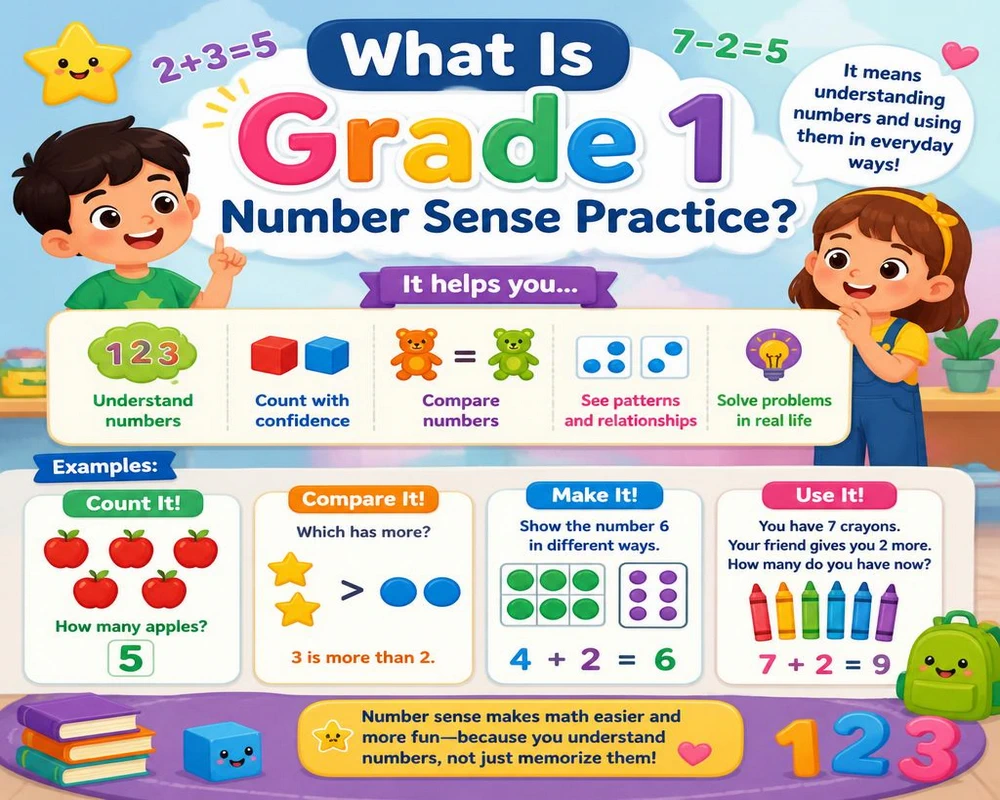
What Is Grade 1 Number Sense Practice?
Quick Answer: Grade 1 number sense practice helps children understand how numbers work—not just how to say them. Students learn to count, recognize numbers, compare quantities, estimate, and solve simple mathematical problems using real objects and visual models.
Number sense is often described as the foundation of all future mathematics. A child who develops strong number sense doesn’t simply memorize facts—they understand relationships between numbers.
For example, when a child knows that:
- 21 comes after 20,
- 35 is larger than 28,
- 49 is one less than 50,
- counting continues forever,
they are developing true mathematical understanding.
According to the Ontario Mathematics Curriculum (2020), Grade 1 students continue building their understanding of whole numbers while learning to think flexibly about quantities, patterns, and relationships.
Instead of asking,
“Can your child count to 50?”
teachers also ask,
“Does your child understand what those numbers mean?”
That difference is what makes number sense so important.
Number Sense vs. Memorizing Numbers
Many children can recite:
1, 2, 3, 4, 5…
without actually understanding numbers.
Consider these examples.
Child A
Can count to 50 perfectly.
When asked,
“What comes after 32?”
they hesitate.
Child B
Can count to 50.
Can also answer:
- Which number is bigger?
- Which number comes next?
- Which number comes before?
- How many objects are there?
- Is 45 closer to 40 or 50?
Child B has developed stronger number sense.
The goal of Grade 1 number sense practice is to help every child become like Child B.
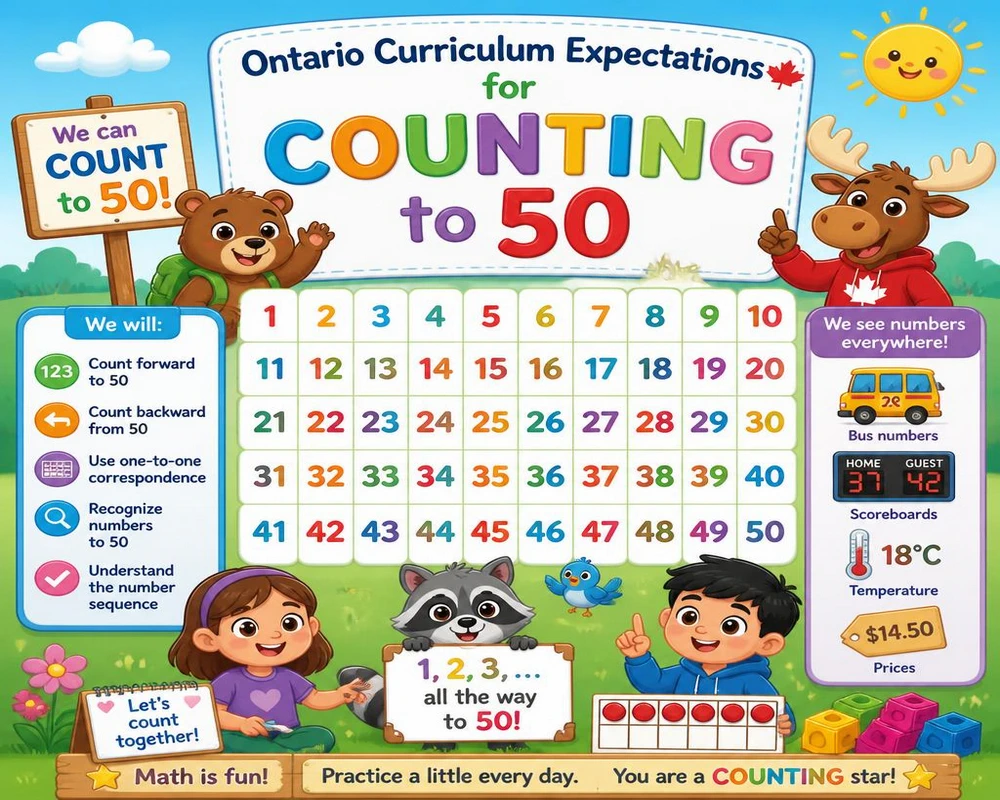
Ontario Curriculum Expectations for Counting to 50
Quick Answer: By the end of Grade 1, Ontario students should confidently count, recognize, compare, and represent numbers while applying number sense in everyday situations.
Ontario’s mathematics curriculum emphasizes understanding over memorization.
Students are expected to develop confidence using numbers through exploration, discussion, games, and problem solving.
Key learning expectations include:
| Skill | Example |
|---|---|
| Count forward | 1 → 50 |
| Count backward | 50 → 1 (with support early in Grade 1) |
| Read numbers | 1–50 |
| Write numbers | 1–50 |
| Compare numbers | 34 > 21 |
| Order numbers | 12, 18, 25, 31 |
| Represent numbers | Using blocks, counters, drawings |
| Estimate quantities | “About 30 cubes” |
| Count objects accurately | Up to 50 objects |
These skills prepare students for addition, subtraction, place value, measurement, and data management later in Grade 1 and beyond.
Why Ontario Focuses on Understanding
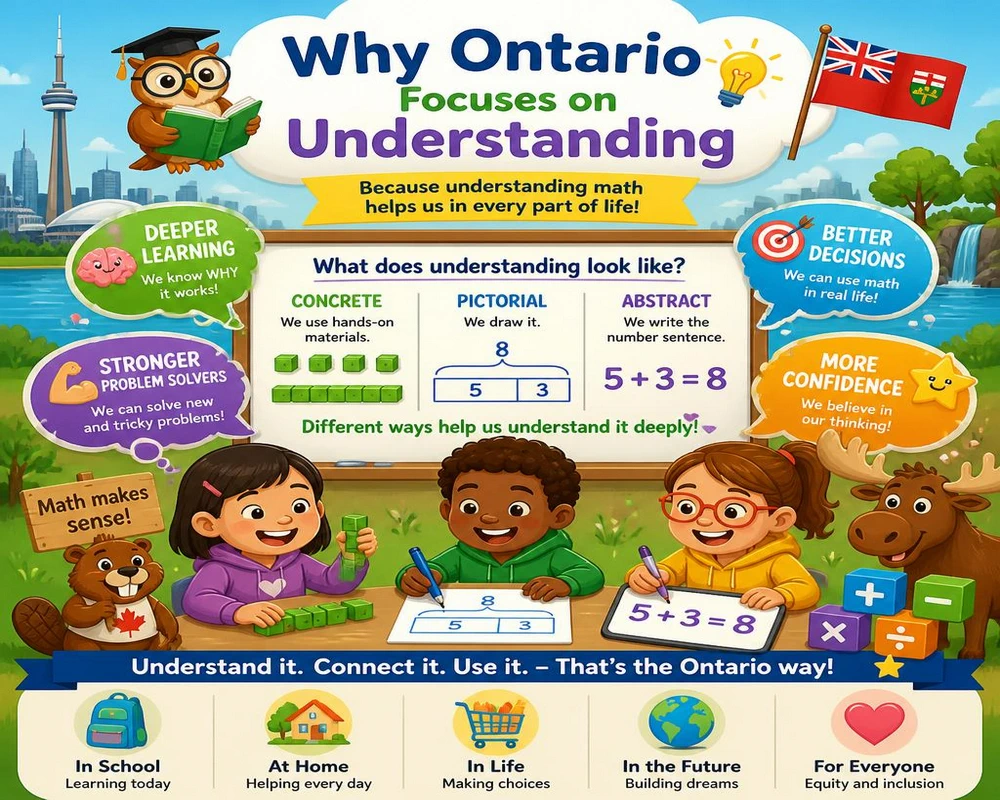
Educational research consistently shows that children learn mathematics more effectively when they understand concepts rather than memorize procedures.
For example:
Instead of simply memorizing:
28 comes before 29
students explore:
- Why?
- What happens if we add one?
- What happens if we subtract one?
- How many tens?
- How many ones?
This conceptual approach builds flexible mathematical thinking.
Why Counting to 50 Is So Important
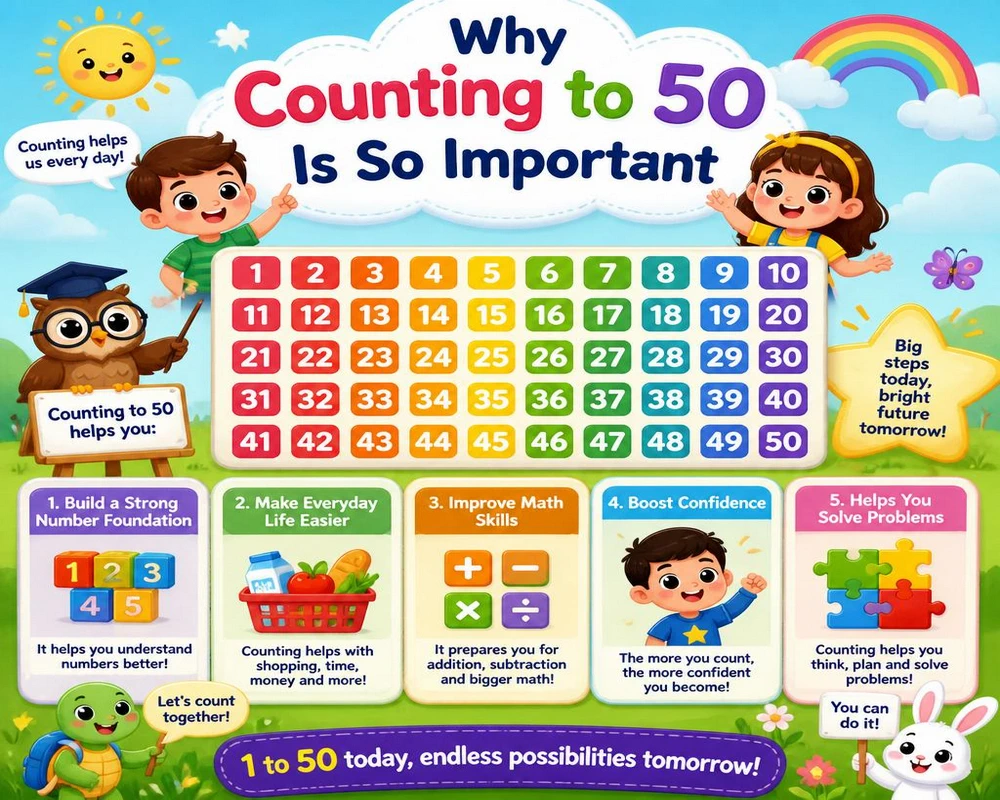
Quick Answer: Counting to 50 strengthens memory, reasoning, pattern recognition, place value understanding, and prepares children for addition and subtraction.
Many parents wonder,
“Why spend so much time counting?”
The answer is simple.
Counting is the language of mathematics.
Every future math skill depends on it.
Children who count confidently usually find it easier to learn:
- Addition
- Subtraction
- Multiplication
- Fractions
- Money
- Measurement
- Time
- Problem solving
- Algebra later in school
Without strong counting skills, these later concepts become much harder.
Real-Life Examples
Children naturally use counting every day.
For example:
Grocery Store
Count apples.
Playground
Count steps.
LEGO Building
Count bricks.
Calendar
Count days until a birthday.
Reading Books
Count pages.
Sports
Keep score.
Baking
Count cookies.
Each activity strengthens mathematical thinking without feeling like homework.
Cognitive Benefits
Regular counting practice improves:
- Working memory
- Attention
- Pattern recognition
- Logical reasoning
- Confidence
- Visual processing
- Executive functioning
- Problem-solving ability
These skills benefit not only mathematics but also reading and science.
Essential Grade 1 Number Sense Skills
Quick Answer: Counting is only one part of number sense. Grade 1 students also develop number recognition, sequencing, comparing, estimating, and understanding quantities.
Let’s explore the essential skills one by one.
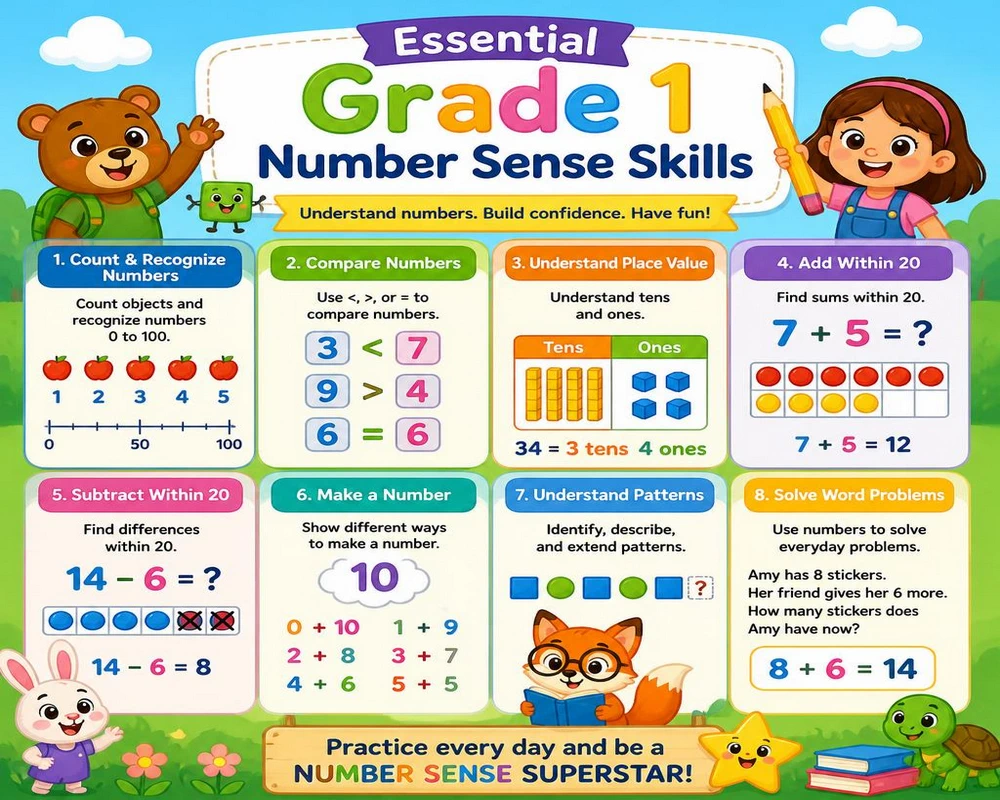
1. Counting Forward
Students should count confidently from:
- 1–20
- 1–30
- 1–40
- 1–50
Eventually they should also begin counting from any number.
Example:
Start at 17.
Continue:
18…
19…
20…
21…
rather than always beginning at one.
This demonstrates flexible thinking.
2. Counting Backward
Backward counting is more difficult because children cannot rely on familiar memorized sequences.
Examples include:
50…
49…
48…
47…
or
28…
27…
26…
25…
Backward counting prepares students for subtraction.
3. Number Recognition
Children should instantly recognize written numbers.
Examples:
- 16
- 24
- 39
- 41
- 50
Recognition should become automatic rather than requiring counting.
4. One-to-One Correspondence
One-to-one correspondence means every object receives exactly one counting word.
Example:
🍎 🍎 🍎 🍎 🍎
The child touches each apple once while saying:
One…
Two…
Three…
Four…
Five.
Skipping objects or counting one object twice indicates this skill is still developing.
5. Cardinality
Cardinality is one of the most important mathematical ideas in Grade 1.
After counting:
1…
2…
3…
4…
5…
the child understands:
“There are FIVE apples.”
The last number counted tells how many objects there are altogether.
Children who lack this understanding often recount the objects after finishing.
6. Comparing Numbers
Students compare quantities using:
- greater than
- less than
- equal to
Example:
Which is greater?
37 or 29?
A child with strong number sense answers quickly:
37
They also explain why.
7. Ordering Numbers
Students should arrange numbers correctly.
Example:
18
12
25
31
Correct order:
12
18
25
31
This strengthens understanding of numerical relationships.
Counting Forward to 50
Quick Answer: Children learn counting best through movement, games, songs, visual models, and meaningful daily practice—not through repetitive drills alone.
Experts recommend practicing counting in different ways.
Instead of repeating:
1…
2…
3…
every day,
mix activities to keep learning engaging.
Fun Counting Activities
- Count jumps.
- Count toy cars.
- Count stairs.
- Count crayons.
- Count puzzle pieces.
- Count snack crackers.
- Count stuffed animals.
- Count leaves outside.
The more varied the experiences, the deeper the understanding becomes.
Skip Counting Foundations
Although formal skip counting develops further in later grades, Grade 1 students benefit from introductory experiences such as:
- Counting by 2s using pairs of socks
- Counting by 5s using fingers
- Counting by 10s using groups of blocks
These activities help children recognize patterns and prepare them for multiplication concepts in future grades.
How Can Children Learn to Count Backward from 50?
Quick Answer: Counting backward from 50 strengthens number relationships and prepares children for subtraction. The best way to teach this skill is through short, engaging activities rather than memorization drills.
Many Grade 1 students can count forward confidently but hesitate when asked to count backward. This is completely normal because backward counting requires children to mentally reverse the familiar number sequence.
Instead of practicing only from 50 to 1, encourage your child to start from different numbers.
Examples:
- 50, 49, 48…
- 36, 35, 34…
- 21, 20, 19…
- 12, 11, 10…
This flexibility develops stronger mathematical thinking.
Fun Backward Counting Games
🚀 Rocket Countdown
Pretend you’re launching a rocket.
Countdown:
10…
9…
8…
7…
…
Blast off!
Once children master 10, gradually increase to 20, then 30, and finally 50.
🪜 Step Down the Stairs
As children walk downstairs, count backward one number per step.
Example:
25…
24…
23…
22…
This combines movement with learning, which improves memory.
🎈 Balloon Pop Game
Write numbers 1–50 on balloons (paper or digital).
Children pop balloons in reverse order.
This reinforces number sequencing while making practice exciting.
Key Takeaways
✔ Backward counting supports subtraction.
✔ Practice from different starting numbers.
✔ Use movement and games instead of worksheets alone.
✔ Short daily practice is more effective than long sessions.
How Do Children Recognize Numbers to 50?
Quick Answer: Number recognition means instantly identifying written numbers without counting. Automatic recognition builds confidence and speeds up future math learning.
Some children can count perfectly but still struggle to recognize written numbers like 27, 34, or 46.
That’s because counting and recognizing numbers are different skills.
For example:
A child may recite:
1…2…3…4…
yet hesitate when shown the numeral 38.
Ontario classrooms encourage students to recognize numbers using multiple representations.
Children learn numbers through:
- Number cards
- Number charts
- Ten frames
- Base-ten blocks
- Dice
- Counters
- Digital math games
Number Hunt Activity
Hide number cards around the room.
Ask your child:
“Can you find number 18?”
“What number did you discover?”
This transforms learning into a game.
Build Numbers with Objects
Instead of only writing numbers, represent them visually.
Example:
Number 24
- 24 LEGO bricks
- 24 buttons
- 24 beads
Children begin connecting symbols with actual quantities.
Flash Card Challenge
Show a number card for only two seconds.
Ask:
“What number was that?”
Fast recognition improves automatic recall.
Key Takeaways
✔ Number recognition is different from counting.
✔ Use visual models.
✔ Practice with real-life objects.
✔ Encourage quick recognition instead of counting every time.
How Can Children Compare and Order Numbers?
Quick Answer: Comparing and ordering numbers helps children understand quantity rather than simply memorizing number names.
Children should learn to answer questions like:
- Which number is greater?
- Which number is smaller?
- Which comes first?
- Which comes last?
These skills prepare students for addition, subtraction, and place value.
Greater Than and Less Than
Example:
Which is greater?
29 or 35
Answer:
35
Ask children to explain why.
Encouraging explanations develops mathematical reasoning rather than guessing.
Put Numbers in Order
Activity:
Arrange these numbers from least to greatest.
41
18
32
25
Correct answer:
18
25
32
41
Once children master four numbers, increase the challenge to six or eight numbers.
Missing Number Games
Example:
18
19
__
21
22
Children identify the missing number.
More advanced examples:
34
__
36
37
__
39
These activities improve sequencing skills.
Comparison Table
| Skill | Beginner | Developing | Confident |
|---|---|---|---|
| Count to 50 | ✓ | ✓ | ✓ |
| Count backward | ✓ | ✓ | |
| Recognize numbers | ✓ | ✓ | |
| Compare numbers | ✓ | ✓ | |
| Order numbers | ✓ |
Key Takeaways
✔ Comparing develops reasoning.
✔ Ordering strengthens sequencing.
✔ Missing-number activities improve flexibility.
Common Challenges Grade 1 Students Face
Quick Answer: Mistakes are a normal part of learning number sense. Identifying them early helps children build stronger mathematical understanding.
Parents often worry when children make counting mistakes.
Fortunately, most errors are temporary.
Skipping Numbers
Example:
27
28
30
31
The child forgets 29.
Solution
Practice using a number chart and oral counting games.
Repeating Numbers
Example:
18
19
19
20
This usually happens when children lose concentration.
Encourage slower, more careful counting.
Counting Objects Twice
Children may accidentally count one object more than once.
Use one-to-one correspondence.
Teach children to move each object after counting it.
Reversing Numerals
Examples:
12 ↔ 21
16 ↔ 61
These errors are common during early number writing.
Provide opportunities to read and write numbers daily.
Losing Track Above 30
Many Grade 1 students count confidently to 20 but struggle after 30.
This usually reflects limited practice rather than misunderstanding.
Short daily counting sessions help build confidence.
Common Mistakes Table
| Mistake | Why It Happens | Helpful Strategy |
|---|---|---|
| Skipping numbers | Weak sequence memory | Number chart games |
| Counting twice | One-to-one correspondence developing | Move objects after counting |
| Number reversals | Visual confusion | Practice reading and writing numerals |
| Stops after 30 | Limited experience | Daily oral counting |
Key Takeaways
✔ Mistakes are expected.
✔ Focus on understanding, not speed.
✔ Encourage effort and celebrate progress.
Fun Ontario-Aligned Activities for Parents
Quick Answer: The best number sense practice happens during everyday activities. Children learn more when math feels meaningful and enjoyable.
Parents do not need expensive resources to support learning.
Simple household activities are often the most effective.
Count During Grocery Shopping
Ask questions such as:
- How many apples?
- Which shelf has more cereal boxes?
- Can you find number 24 on the price tag?
Shopping naturally reinforces counting and comparison.
Nature Number Walk
During a walk, count:
- Trees
- Birds
- Flowers
- Cars
- Mailboxes
Then compare quantities.
Which did we see more of?
LEGO Number Challenge
Build towers containing:
- 12 bricks
- 18 bricks
- 25 bricks
Ask:
Which tower is tallest?
Which has fewer bricks?
Dice Race
Roll two dice.
Count the dots.
Move that many spaces on a game board.
This builds counting fluency while encouraging family interaction.
Build a Number Line
Create a floor number line from 1–50 using paper cards.
Ask children to:
- Jump to 17
- Hop to 29
- Walk backward from 40
- Find the number between 24 and 26
Large movement strengthens memory through physical engagement.
Parent Checklist
✔ Practice for 10–15 minutes each day.
✔ Keep activities playful.
✔ Praise effort rather than perfection.
✔ Ask children to explain their thinking.
✔ Use everyday opportunities to count.
✔ Read number books together.
✔ Encourage curiosity and confidence.
What Do Experts Recommend for Building Strong Number Sense?
Quick Answer: Research consistently shows that children develop stronger number sense when they actively explore numbers through conversations, games, visual models, and real-life experiences rather than memorization alone.
Educational organizations such as the Ontario Ministry of Education, the National Council of Teachers of Mathematics (NCTM), and research from cognitive science emphasize that mathematical understanding develops gradually through meaningful practice.
Instead of asking children to simply memorize number sequences, experts recommend helping them answer questions like:
- Why is 38 greater than 27?
- How do you know 49 is one less than 50?
- Can you show 32 using blocks?
- What happens if we add one more?
These questions encourage reasoning instead of rote learning.
Encourage Mathematical Conversations
Children strengthen their understanding when they explain their thinking.
Instead of asking only:
Try asking:
- “How did you figure that out?”
- “Can you show me another way?”
- “Why do you think that’s correct?”
Explaining mathematical ideas helps children organize their thinking and builds confidence.
Use Visual Models
Young learners understand numbers more easily when they can see and manipulate them.
Helpful tools include:
- Ten frames
- Number lines
- Counters
- Linking cubes
- Base-ten blocks
- LEGO bricks
- Dominoes
- Playing cards
Visual models bridge the gap between abstract numbers and real quantities.
Practice a Little Every Day
Research suggests that 10–15 minutes of focused daily practice is often more effective than one long weekly session.
A simple routine might include:
- Count forward to 50.
- Count backward from a random number.
- Compare two numbers.
- Solve one missing-number puzzle.
- Count everyday objects.
Consistency matters more than duration.
Key Takeaways
- Focus on understanding, not speed.
- Encourage children to explain their thinking.
- Use visual representations.
- Practice regularly in short sessions.
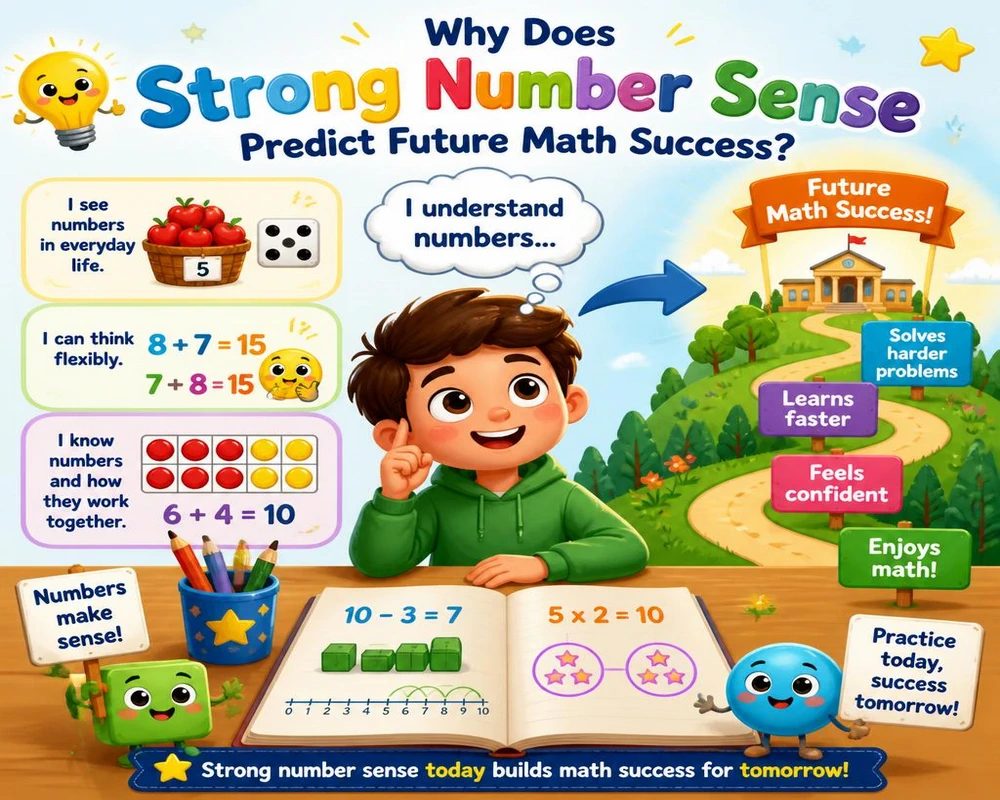
Why Does Strong Number Sense Predict Future Math Success?
Quick Answer: Early number sense is one of the strongest predictors of later achievement in mathematics because it supports problem-solving, reasoning, and flexible thinking.
Children who develop strong number sense in Grade 1 often find later topics easier, including:
- Addition
- Subtraction
- Place value
- Measurement
- Money
- Time
- Fractions
- Multiplication
- Division
- Algebra
Rather than memorizing isolated facts, these students understand how numbers relate to one another.
For example, a child who understands that:
40 + 5 = 45
can more easily understand:
450
4,500
and eventually algebraic thinking.
Number sense is a foundation that continues to support learning throughout elementary school and beyond.
Confidence Matters
Positive early experiences with mathematics influence children’s attitudes toward learning.
When children experience success, they are more likely to:
- Participate in class.
- Try challenging problems.
- Develop resilience.
- Enjoy mathematics.
Parents can nurture this confidence by celebrating effort and progress instead of focusing only on correct answers.
Key Takeaways
- Number sense supports every future math topic.
- Confidence grows through meaningful success.
- Understanding is more valuable than memorization.
How Can Parents Assess Grade 1 Number Sense at Home?
Quick Answer: Informal conversations and simple activities often provide a clearer picture of a child’s understanding than formal tests.
Ask your child questions such as:
- Can you count to 50?
- Can you start counting from 23?
- What comes before 31?
- What comes after 44?
- Which number is greater: 28 or 35?
- Can you count 27 objects accurately?
- Can you find the missing number?
Observe not only whether your child answers correctly but also how they arrive at the answer.
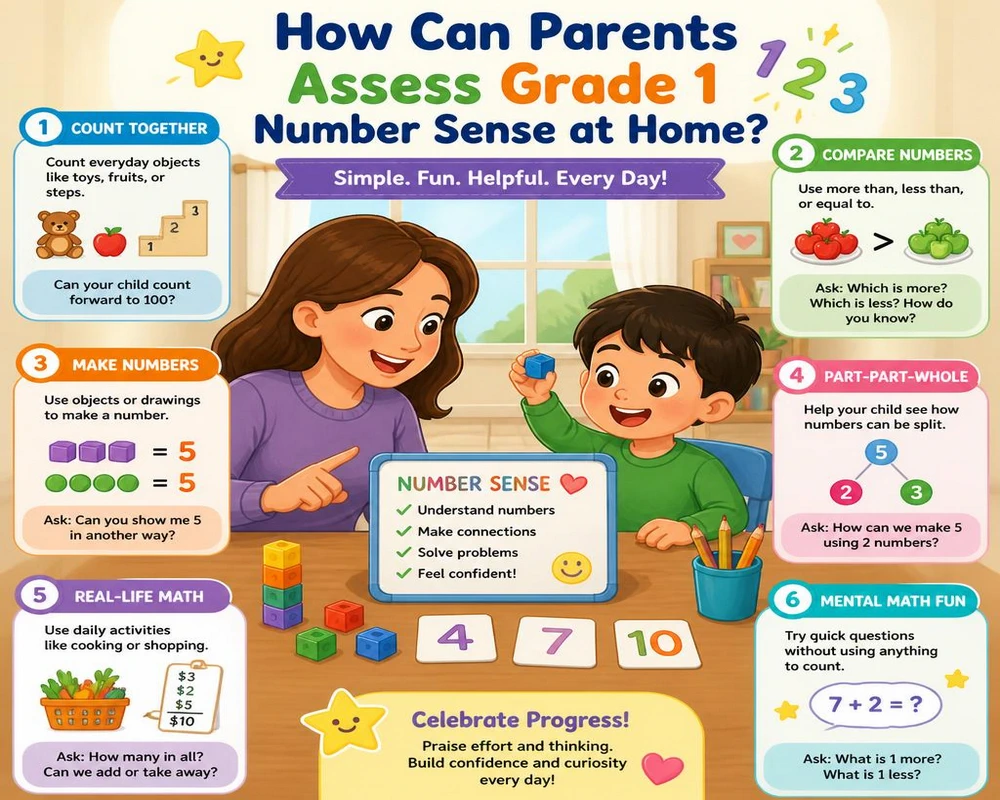
Grade 1 Number Sense Checklist
Your child is progressing well if they can:
✔ Count forward to 50 confidently.
✔ Count backward from different starting numbers.
✔ Recognize written numbers from 1–50.
✔ Write numbers correctly.
✔ Compare numbers.
✔ Order numbers from least to greatest.
✔ Count objects accurately.
✔ Understand that the last number counted represents the total quantity.
✔ Explain simple mathematical thinking.
If several skills still need practice, that’s perfectly normal. Children develop at different rates, and regular, enjoyable practice can make a significant difference.
Ready to help your child become a confident young mathematician? Explore more Ontario curriculum-aligned Grade 1 lessons, printable worksheets, and fun practice activities to support every step of their learning journey
Frequently Asked Questions (FAQ)
1. What should a Grade 1 student know about number sense?
A Grade 1 student should be able to count forward and backward, recognize numbers, compare quantities, order numbers, estimate groups, and understand that numbers represent quantities.
2. Why is counting to 50 important?
Counting to 50 develops foundational skills for addition, subtraction, place value, and future mathematical reasoning while increasing confidence with numbers.
3. How much should my child practice each day?
Approximately 10–15 minutes of focused practice each day is generally sufficient for most Grade 1 students when activities are engaging and varied.
4. My child skips numbers. Should I be worried?
No. Skipping numbers is common during early learning. Consistent practice with number charts, games, and counting activities usually improves sequencing over time.
5. Is it better to use worksheets or games?
Both have value, but games and hands-on activities often promote deeper understanding because children actively engage with mathematical ideas.
6. How can I make counting more enjoyable?
Incorporate counting into everyday life:
- Count toys.
- Count snacks.
- Count stairs.
- Count books.
- Count birds during a walk.
Learning feels natural when connected to real experiences.
7. What is one-to-one correspondence?
One-to-one correspondence means matching one counting word to one object. It is an essential early counting skill that helps children count accurately.
8. When should my child begin counting beyond 50?
Many Grade 1 students naturally progress beyond 50 once they are comfortable with numbers to 50. Continue extending counting gradually while reinforcing understanding rather than speed.
9. How does number sense relate to the Ontario curriculum?
The Ontario Mathematics Curriculum emphasizes conceptual understanding, reasoning, communication, and applying mathematics in meaningful contexts. Number sense is one of the core foundations of Grade 1 mathematics.
10. How can InukMath help my child?
InukMath provides curriculum-aligned practice, engaging activities, printable worksheets, and interactive learning experiences designed to help Grade 1 students build confidence and mastery in number sense while following Ontario learning expectations.
Conclusion
Developing Grade 1 number sense practice is about much more than learning to count. It helps children understand how numbers work, build confidence, and create the foundation for every future mathematics topic.
By combining short daily practice, hands-on activities, meaningful conversations, and real-world experiences, parents can make math both enjoyable and effective. Remember that every child learns at a different pace, and steady progress is more important than perfection.
Whether you’re counting toys at home, comparing numbers during grocery shopping, or exploring patterns on a number line, each activity strengthens your child’s mathematical thinking.
With consistent encouragement and engaging practice, children can develop the confidence and skills they need to succeed throughout Grade 1 and beyond.
Ready to help your child become a confident young mathematician? Explore more Ontario curriculum-aligned lessons, printable worksheets, and fun practice activities to support every step of their learning journey.
Early number sense research consistently points to hands-on, playful practice as the most effective approach for young learners. Organizations like Zero to Three, which focuses specifically on early childhood development, offer additional guidance for parents on building foundational math skills through everyday play.