
Grade 1 Addition Practice: Fun Ways to Master Adding to 20
Introduction
There’s nothing quite like the proud smile on a first-grader’s face when they solve 8 + 7 = 15 without hesitation. This confidence grows through consistent, joyful Grade 1 addition practice that turns numbers into friends rather than challenges.
In the Ontario math curriculum, Grade 1 students develop strategies for adding numbers up to 20 using concrete materials, mental math, and simple word problems. This detailed guide provides parents and educators with proven techniques, engaging activities, dozens of sample Grade 1 addition questions, and expert advice tailored to addition to 20 Grade 1 Ontario.
With over 15 years supporting early learners across Canada, I’ve witnessed how strong foundational addition skills lead to greater success in later grades. You’ll walk away with everything needed to make adding numbers Grade 1 Canada both effective and fun. Let’s get started.
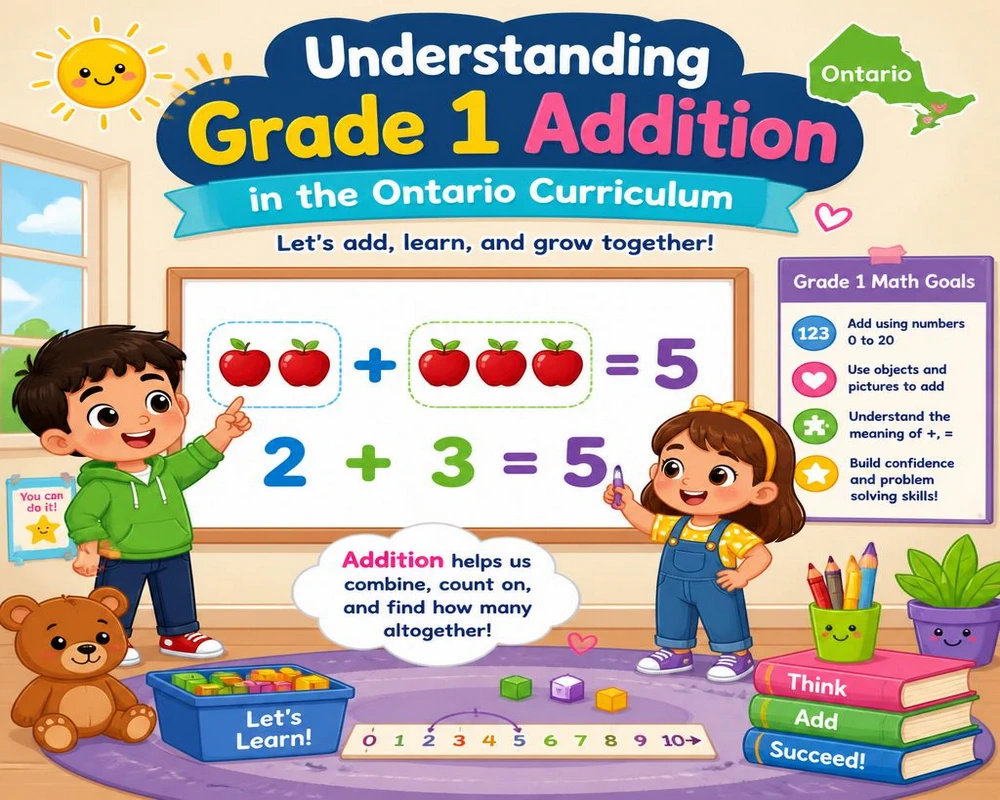
Understanding Grade 1 Addition in the Ontario Curriculum
Grade 1 addition focuses on developing fluency with sums to 20 while emphasizing understanding over rote memorization. Key expectations include using counting on, making ten, and doubles facts.
Recent 2024-2026 educational research shows early mastery of addition correlates strongly with overall math achievement. Quality Grade 1 addition practice builds number sense alongside procedural skills.
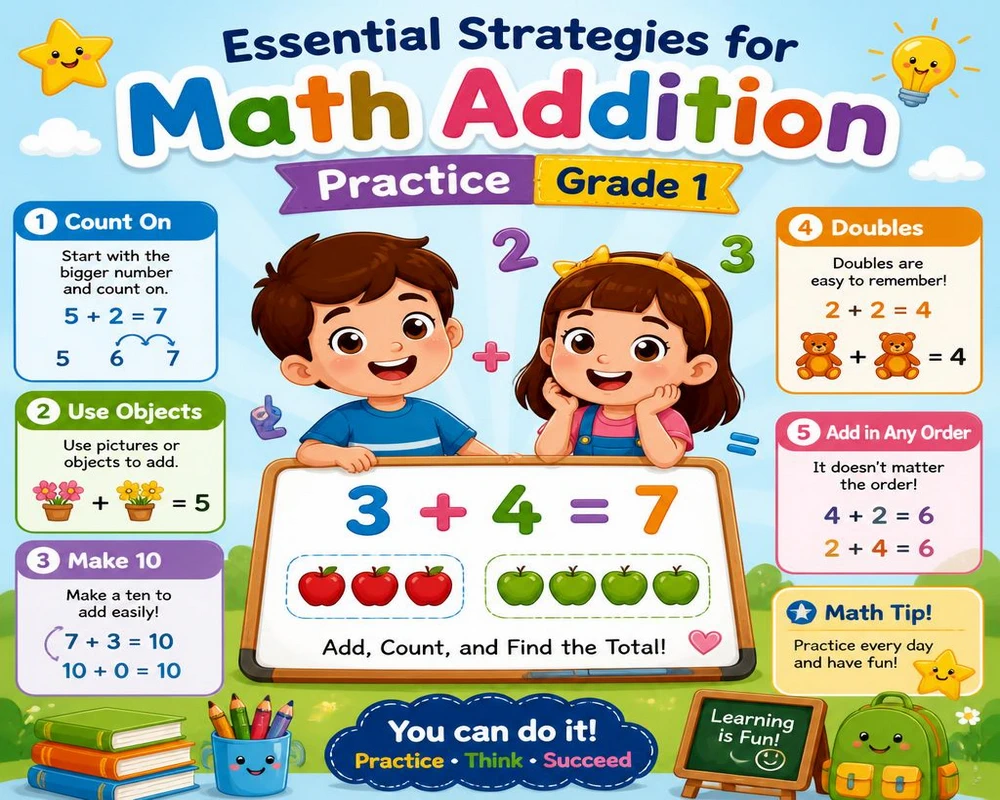
Essential Strategies for Math Addition Practice Grade 1
Counting On and Counting All
Start with concrete objects before moving to mental strategies.
Making Ten and Doubles
These “friendly” strategies speed up calculations significantly.
Using Number Lines and Ten-Frames
Visual tools help children see relationships between numbers.
Ontario teachers don’t just want students to memorize addition facts — they want to see genuine strategy behind the numbers, whether that’s counting on, making ten, or using doubles. Educators looking for the classroom-level breakdown of these strategies can find detailed guidance through EduGains, Ontario’s own resource hub built specifically to support the province’s math curriculum.
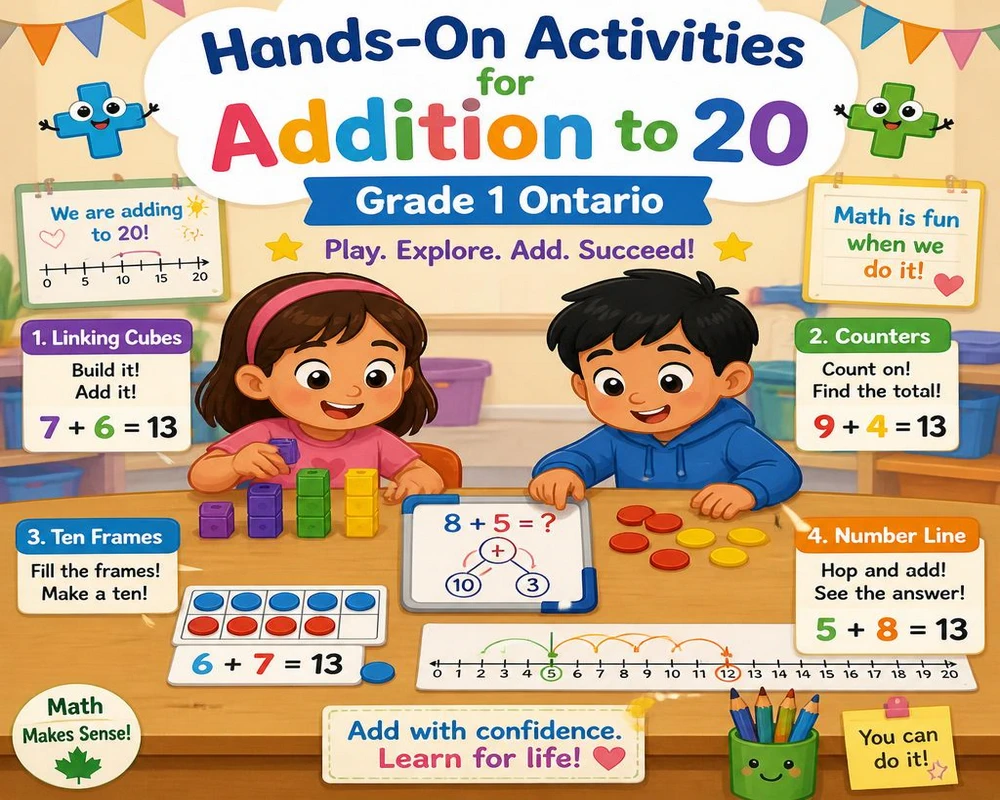
Hands-On Activities for Addition to 20 Grade 1 Ontario
- Snack Math: Add grapes or crackers while sharing.
- Board Games: Move spaces based on addition facts.
- Story Problems: “You have 6 toys and get 8 more…”
- Outdoor Counting: Add hops, jumps, or collected items.
Real-Life Example: During grocery shopping, count “We have 9 apples. If we buy 5 more, how many total?”
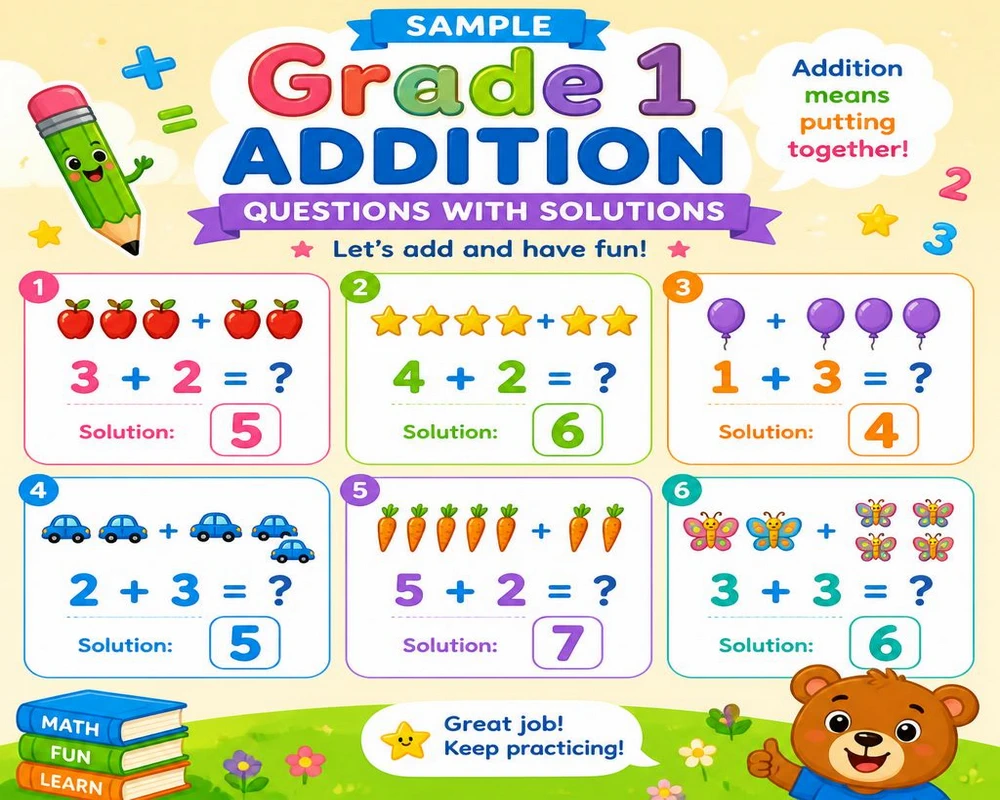
Sample Grade 1 Addition Questions with Solutions
Here are 25 original questions across difficulty levels. Each includes a short explanation.
Basic Addition (1-10):
- 5 + 3 = ? Answer: 8. (Count on from 5: 6,7,8.)
- 7 + 2 = ? Answer: 9. (Doubles plus one strategy.)
- 4 + 4 = ? Answer: 8. (Doubles fact.)
Adding to 10-15 (11-18): 11. 8 + 7 = ? Answer: 15. (Make ten: 8+2=10, plus 5 more.)
- 9 + 6 = ? Answer: 15. (Count on or use ten-frame.)
- 13 + 4 = ? Answer: 17. (Add to the ones place.)
Word Problems and Mixed (19-25): 19. You have 11 stickers and get 8 more. How many total? Answer: 19. (11 + 8 = 19.)
- There are 12 birds. 5 more fly in. How many now? Answer: 17. (Addition word problem application.)
- 6 + __ = 14. What is the missing number? Answer: 8. (Missing addend: count up from 6.)
- Add 9 + 5 using a number line. Answer: 14. (Start at 9, jump 5.)
- Sam has 7 cars. Mia has 8. How many together? Answer: 15. (7 + 8 = 15.)
- 10 + 10 = ? Answer: 20. (Landmark fact reaching 20.)
- If you add 3 more to 12, what number do you get? Answer: 15. (Practical addition to 20 range.)
Use these regularly and encourage different strategies.
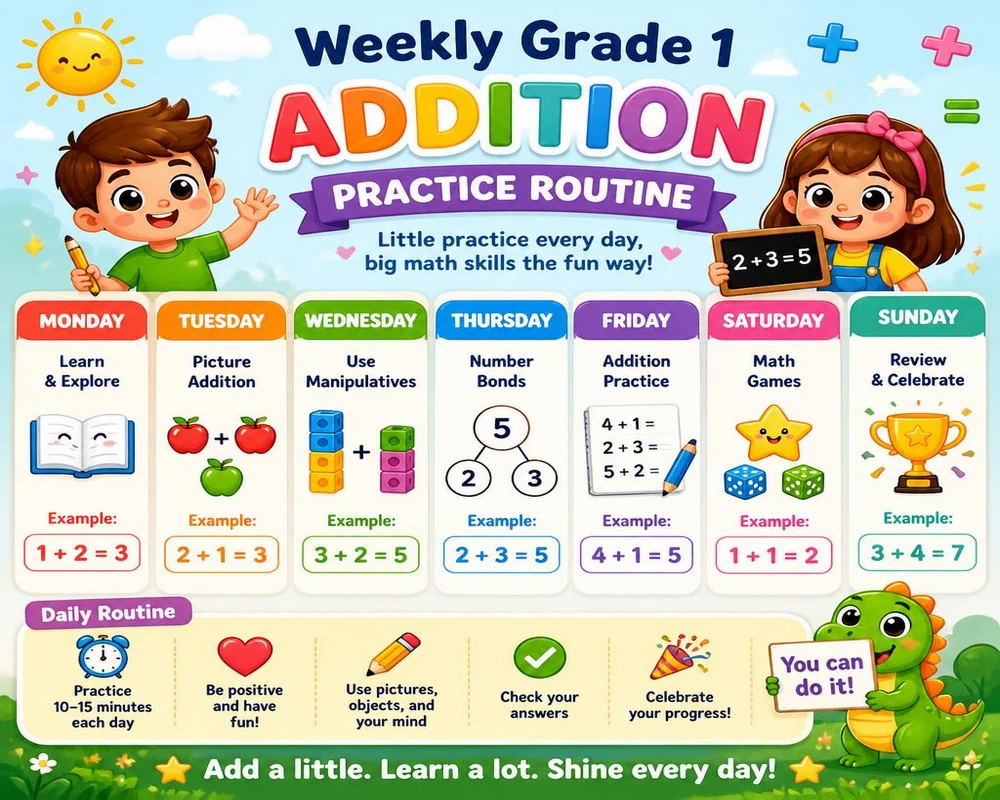
Weekly Grade 1 Addition Practice Routine
Monday-Wednesday: Fact fluency games. Thursday: Word problems. Friday: Review with manipulatives. Weekend: Real-life application.
Aim for 10-15 minutes daily to avoid fatigue while building fluency.
Pros and Cons of Common Practice Methods:
| Method | Pros | Cons |
|---|---|---|
| Flashcards | Quick fact recall | Less conceptual understanding |
| Manipulatives | Builds deep understanding | Slower initially |
| Digital Games | Motivating and adaptive | Screen time balance needed |
Combine all three for balanced growth.
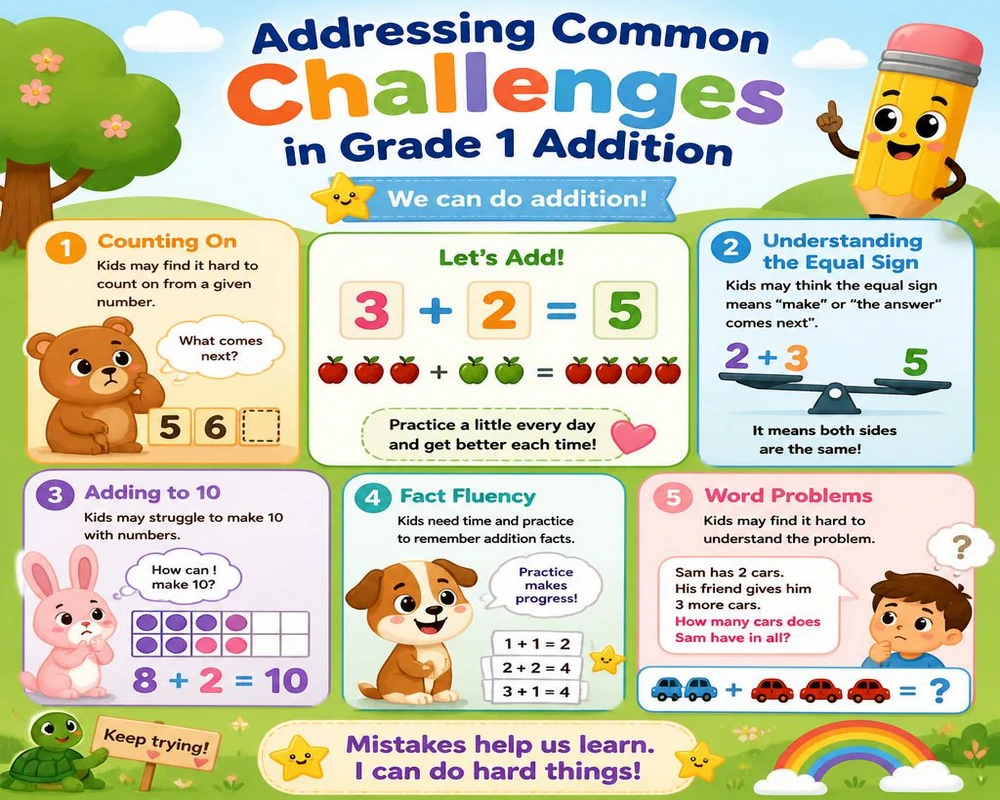
Addressing Common Challenges in Grade 1 Addition
Many children struggle with facts over 10 or word problems. Solutions include:
- Breaking numbers apart (e.g., 8 + 7 = 8 + 2 + 5).
- Drawing pictures for stories.
- Celebrating progress with a “Math Star” chart.
Expert insight: Consistent short practice outperforms infrequent long sessions.
Connecting Addition to Everyday Life in Canada
Use Canadian coins, measure recipe ingredients, or track sports scores. These connections make math addition practice Grade 1 meaningful.
Tracking Progress and When to Seek Extra Support
Observe fluency, strategy variety, and confidence. If progress stalls, increase hands-on time or consult the teacher.
Conclusion
Mastering addition to 20 sets up everything that follows in Grade 1 — subtraction, early word problems, and eventually place value all lean on this same foundation. For a complete look at what the rest of the year covers, our Grade 1 math practice hub pulls together counting, addition, subtraction, and shapes in one place.
Grade 1 addition practice opens doors to mathematical confidence and future success. By incorporating fun strategies, real examples, and regular Ontario-aligned questions, you’ll help your child master adding to 20 with enthusiasm.
FAQ: Grade 1 Addition Practice
1. What is the main focus of addition to 20 Grade 1 Ontario? Developing strategies for sums within 20 using concrete, pictorial, and abstract methods.
2. How many facts should a Grade 1 student master? Aim for fluency with sums to 10 first, then extend to 20 by year-end.
3. Are worksheets necessary for Grade 1 addition questions? They’re useful in moderation but pair best with hands-on activities.
4. When do most children master adding numbers Grade 1 Canada? By the end of Grade 1 with consistent practice.
5. How can I make math addition practice Grade 1 fun? Use games, stories, movement, and real objects.
6. What if my child counts on fingers a lot? It’s a valid early strategy. Gradually introduce mental math tools.
7. Does the Ontario curriculum emphasize speed or understanding? Understanding and flexible strategies come first; fluency develops naturally.
8. Where can I find more free resources? Ontario ministry supports, teacher sites, and quality printable packs.