
Excel in Ontario Math Practice Grade 4: Division, Geometry & Data Mastery
Introduction
Watch your fourth-grader confidently tackle a tricky division problem, design a symmetrical robot, or analyze survey results like a young data scientist. These empowering moments stem from consistent, high-quality Ontario math practice Grade 4.
Grade 4 represents a pivotal year in the Ontario curriculum where students deepen their understanding of multi-digit operations, explore geometric properties, and develop data literacy. This comprehensive guide delivers everything parents and educators need for effective Grade 4 math Ontario support in 2026.
Backed by years of classroom experience and current curriculum insights, you’ll find actionable strategies, sample math questions Grade 4, common challenge solutions, and ways to connect learning to everyday life. Whether preparing for assessments or simply building confidence, this resource will help your child thrive.
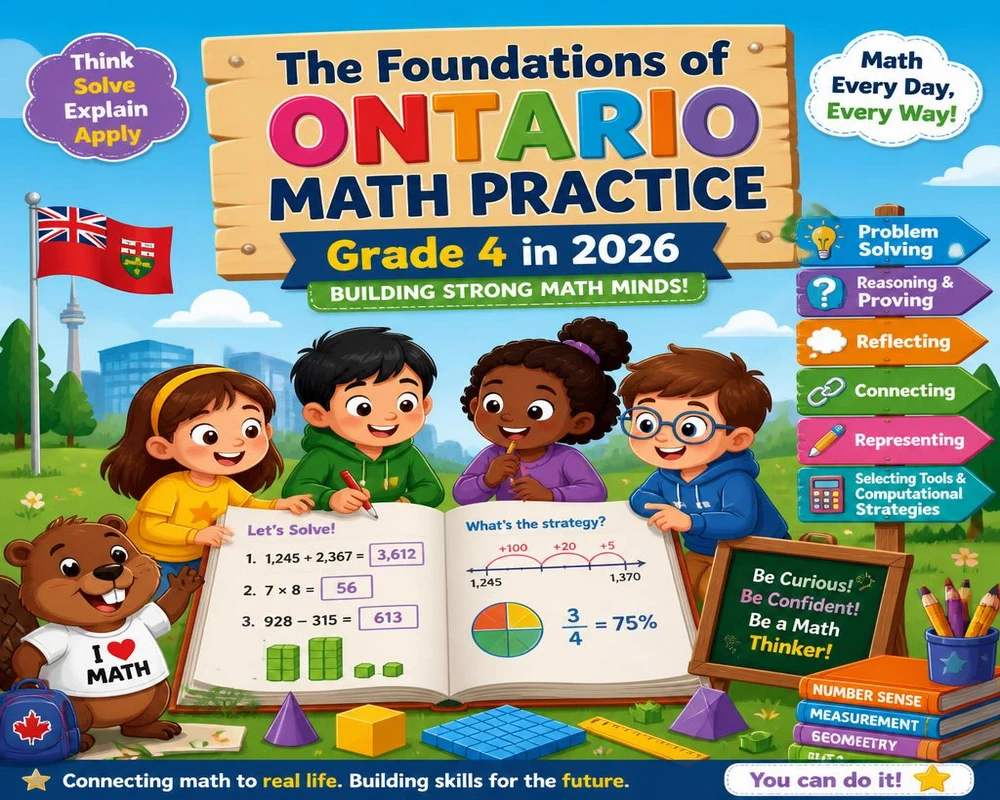
The Foundations of Ontario Math Practice Grade 4 in 2026
Ontario’s mathematics curriculum stresses conceptual depth, procedural skill, and application across strands. In Grade 4, long division Grade 4 Ontario builds computational fluency, geometry Grade 4 Ontario enhances spatial reasoning, and data management sharpens analytical thinking.
Recent 2024-2026 studies underscore that students mastering these areas show improved problem-solving and higher performance in subsequent grades. Quality practice makes all the difference.
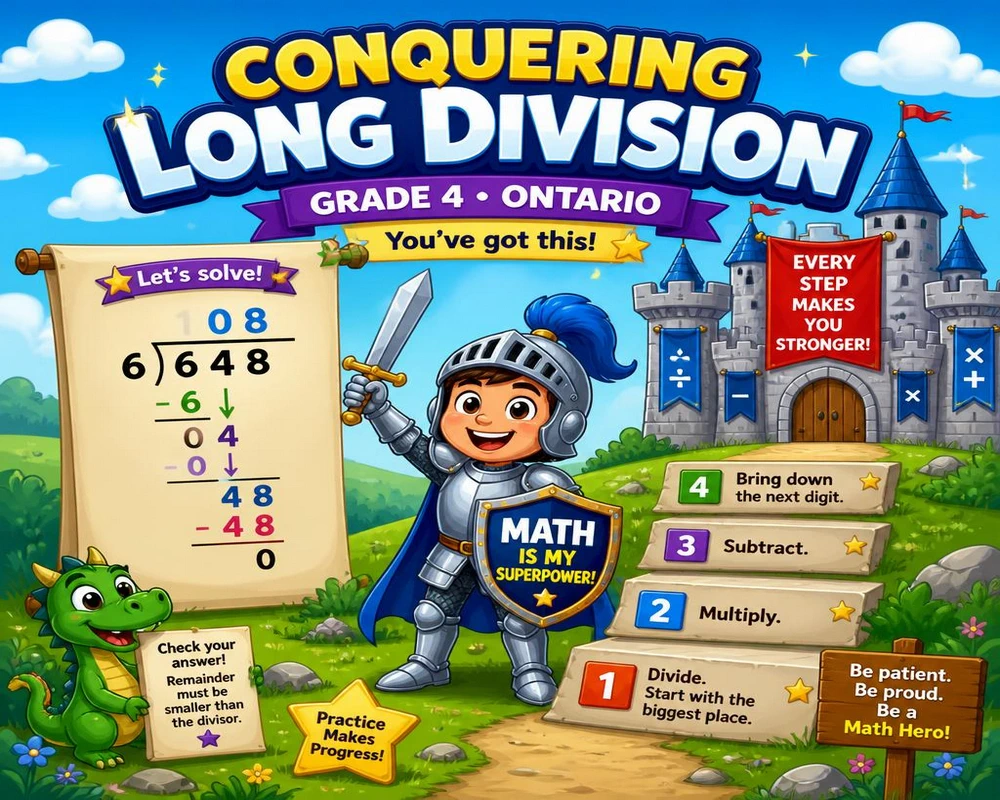
Conquering Long Division Grade 4 Ontario
Long division introduces a structured algorithm for dividing larger numbers, often with remainders expressed as fractions or decimals in context.
Grade 4 is where division and geometry start demanding more visual thinking, not just memorized steps. Mathies, a free set of digital math tools backed by the Ontario Ministry of Education, offers interactive models — number lines, base ten blocks, geometry tools — that many Ontario classrooms already use to make these exact concepts click.
Key Curriculum Expectations
- Divide three-digit numbers by one- or two-digit numbers using models, algorithms, and estimation.
- Interpret remainders appropriately in word problems.
- Connect division to multiplication and place value.
Step-by-Step Teaching Approach:
- Review basic facts and repeated subtraction.
- Use area models or base ten blocks for visualization.
- Introduce the standard algorithm gradually.
- Practice with real contexts like sharing items equally.
Example Math Question Grade 4: A school has 456 pencils to share equally among 12 classrooms. How many pencils per classroom? What happens to any remainder?
Tips for Building Fluency
- Daily fact review combined with multi-digit practice.
- Error analysis: Have kids explain mistakes to deepen understanding.
- Games like “Division Dash” for engagement.
A 2025 analysis of Ontario student data revealed that consistent visual-to-algorithm practice reduces division errors by nearly 40%.
Pros and Cons of Division Strategies:
| Strategy | Pros | Cons |
|---|---|---|
| Area Models | Strong conceptual base | Slower for large numbers |
| Standard Algorithm | Efficient and standard | Can feel abstract initially |
| Repeated Subtraction | Builds intuition | Inefficient for big dividends |
Encourage flexibility—different problems suit different methods.
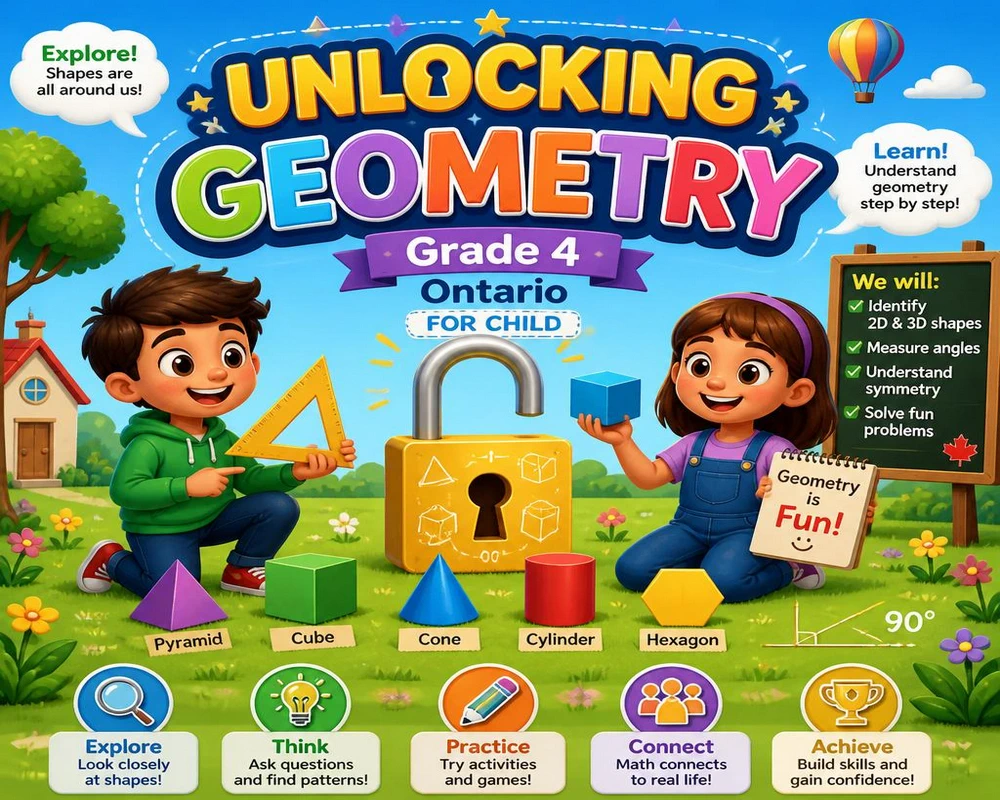
Unlocking Geometry Grade 4 Ontario
Geometry Grade 4 Ontario expands on shapes, angles, symmetry, and transformations while connecting to measurement.
Essential Concepts
- Classify quadrilaterals, triangles, and other polygons by properties (parallel sides, angles).
- Measure and draw angles with protractors.
- Explore symmetry, reflections, rotations, and translations.
- Understand perimeter and area relationships.
Hands-On Activities:
- Create tessellations or symmetrical art.
- Go on a “shape hunt” around the home or neighborhood.
- Build structures with straws and connectors to explore stability and angles.
Real-Life Storytelling: Imagine designing a playground. Which shapes provide the strongest structures? How can you make it symmetrical for fairness?
Common Pitfalls and Fixes
Students often confuse perimeter with area or misidentify angles. Use physical models and repeated sorting activities. Encourage precise vocabulary like “right angle,” “parallel,” and “perpendicular.”
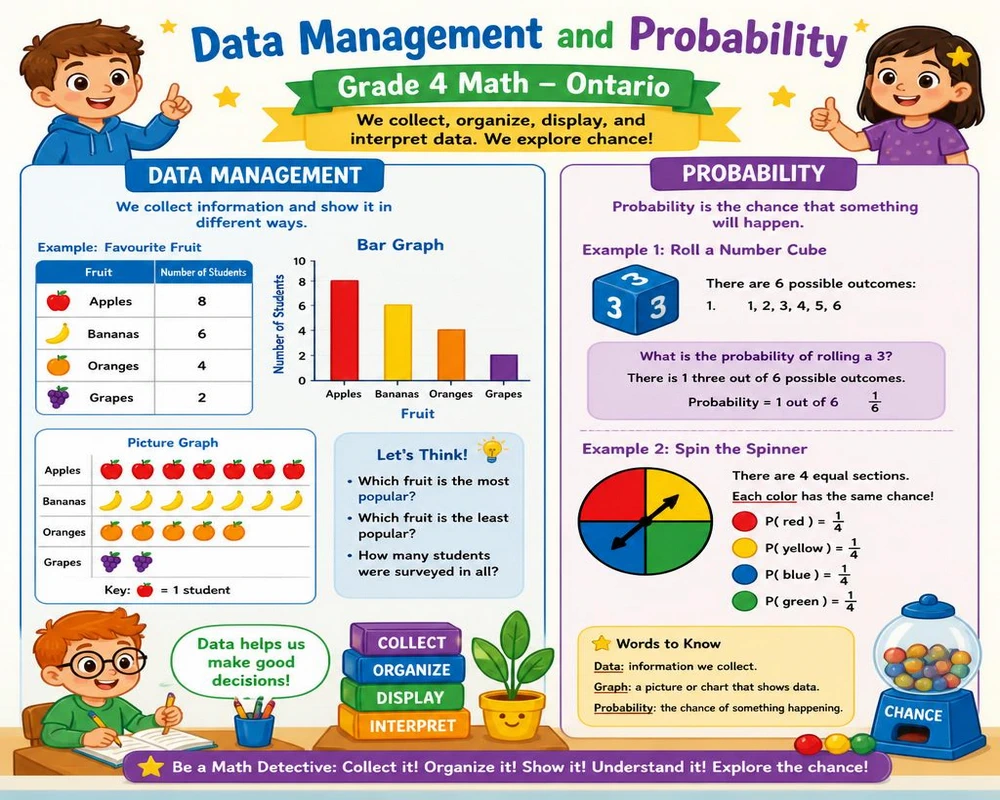
Data Management and Probability in Grade 4 Math Ontario
Data literacy empowers students to collect, organize, represent, and interpret information critically.
Core Skills
- Distinguish qualitative vs. quantitative data.
- Create and read multiple-bar graphs, stem-and-leaf plots, and frequency tables.
- Pose questions, collect primary/secondary data, and draw conclusions.
- Introduce basic probability concepts (likely, unlikely, certain).
Practical Projects:
- Survey classmates on favorite activities and create graphs.
- Analyze weather data or sports statistics.
- Make infographics that tell a compelling story from the numbers.
These activities develop critical thinking essential in our data-driven world.
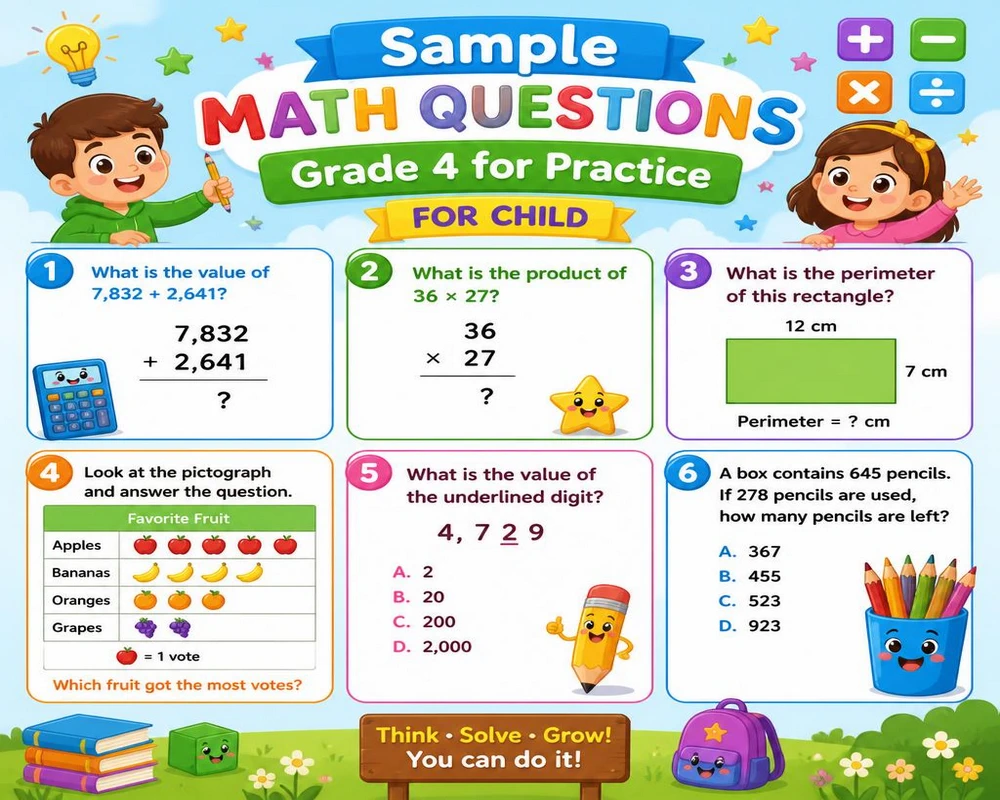
Sample Math Questions Grade 4 for Practice
Incorporate these regularly:
Long Division:
- 738 ÷ 18 = ? (Express remainder as a fraction.)
- Word problem: 325 stickers shared among 7 friends.
Geometry:
- Classify this shape: How many pairs of parallel sides?
- Draw a 65-degree angle and classify it.
Data:
- Create a bar graph from this survey data and write two observations.
- What is the probability of rolling an even number on a die?
Provide answer keys with explanations and multiple strategies.
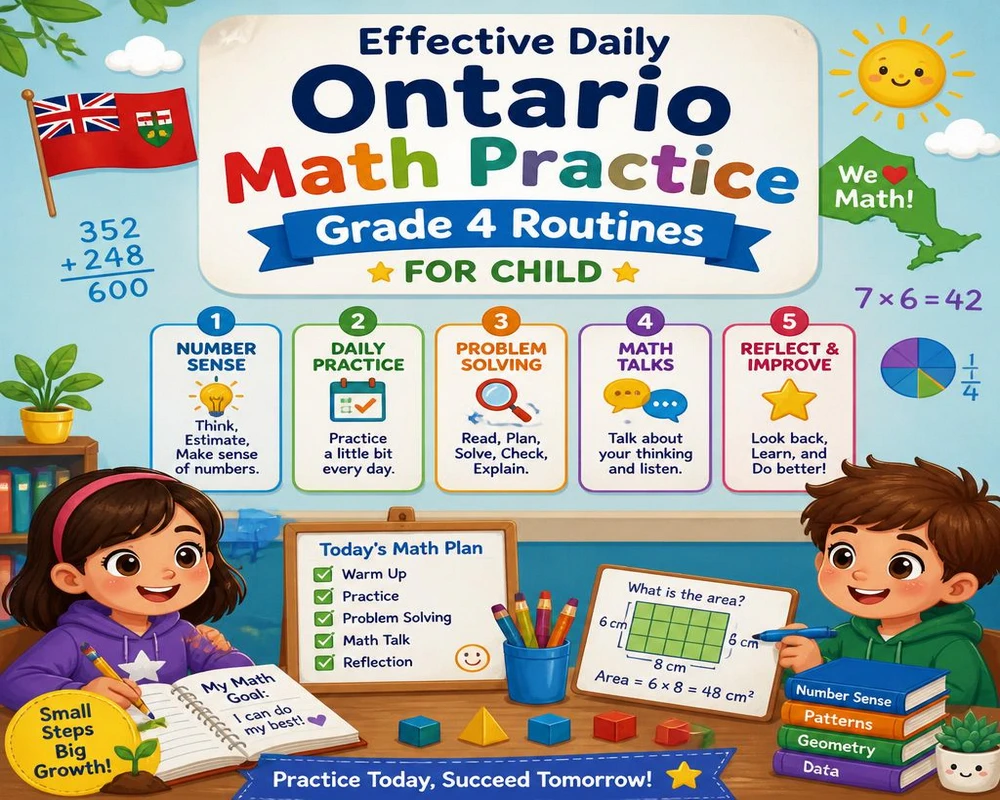
Effective Daily Ontario Math Practice Grade 4 Routines
Aim for 25-45 minutes of purposeful practice.
Weekly Framework:
- Monday/Wednesday: Division and operations.
- Tuesday/Thursday: Geometry explorations.
- Friday: Data projects or mixed review.
- Weekend: Real-world applications like budgeting or measuring for projects.
Mix paper-pencil, digital, and kinesthetic activities. Celebrate effort and creative solutions.
Preparing for Assessments and EQAO
While specific EQAO timing varies, strong foundational skills support junior division success. Focus on explaining reasoning, showing work, and applying concepts to novel problems.
Use varied math questions Grade 4 that require communication. Teach strategies for checking answers using inverse operations.
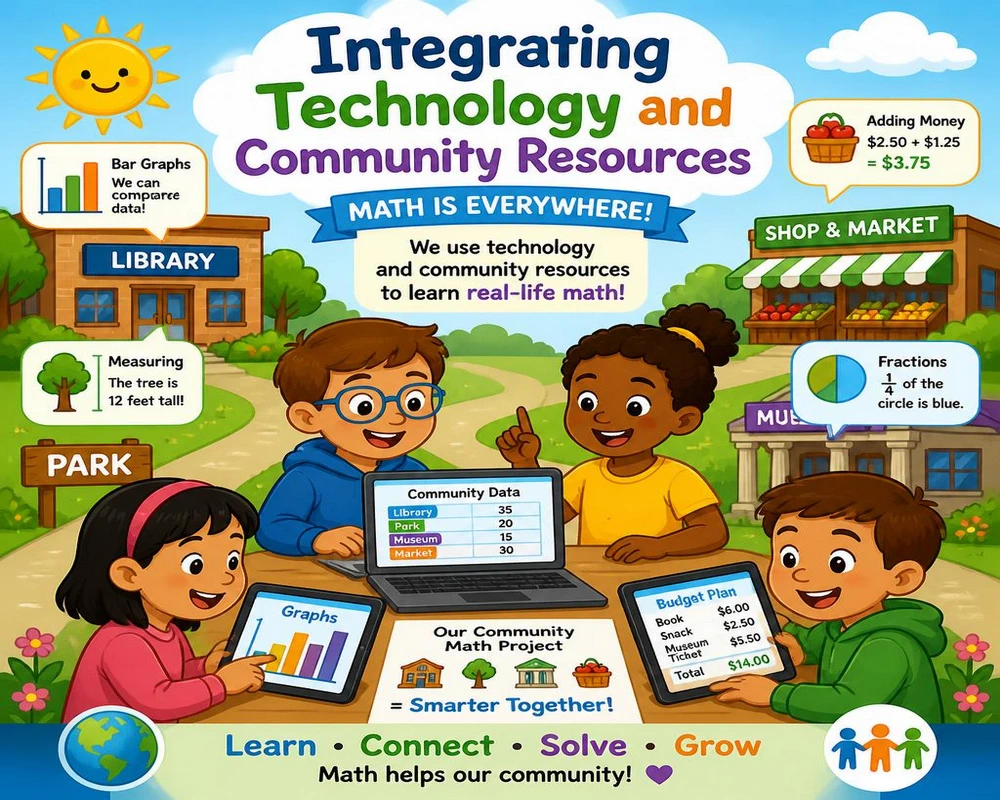
Integrating Technology and Community Resources
Digital tools offer adaptive practice, but pair them with hands-on learning. Ontario ministry resources, TVO, and educator communities provide excellent supports.
Foster a positive math identity by sharing your own learning process—modeling that everyone improves with practice.
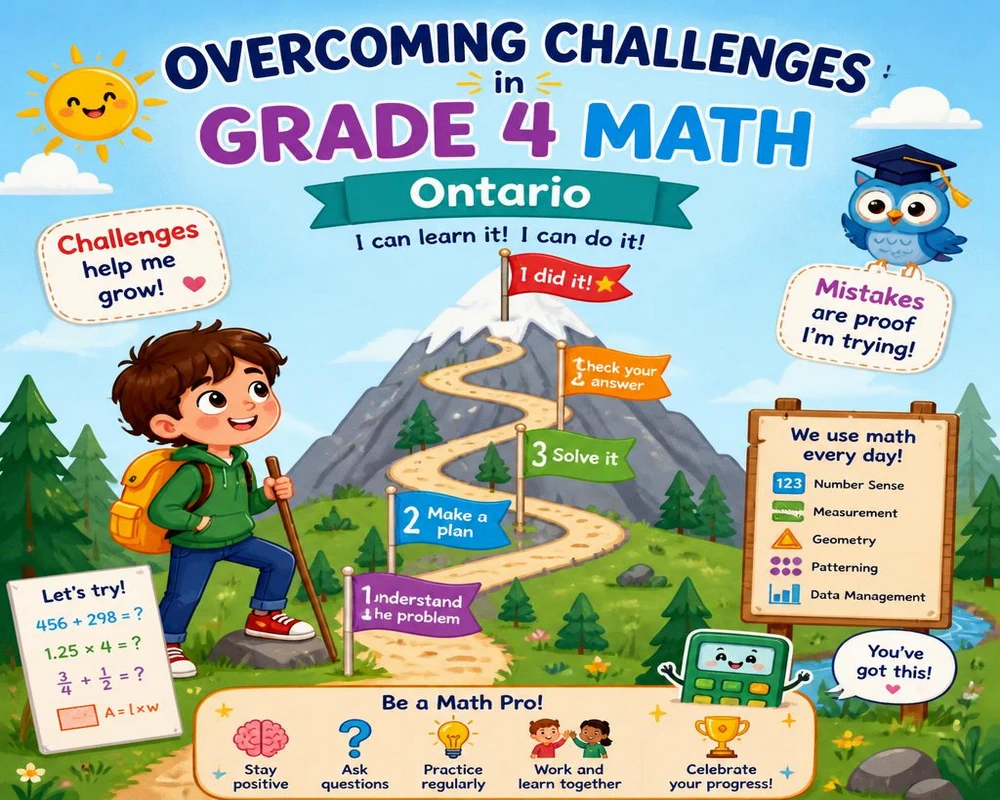
Overcoming Challenges in Grade 4 Math Ontario
Division frustration, spatial visualization difficulties, or data interpretation overwhelm are common.
Expert Strategies:
- Break tasks into smaller steps.
- Use manipulatives generously.
- Incorporate growth mindset language.
- Collaborate on family math challenges.
Parental involvement and teacher communication create powerful support networks.
The Bigger Picture: Lifelong Benefits
These skills translate to real-world success in STEM, informed decision-making, and creative problem-solving. Kids who develop strong spatial and data skills often excel in diverse careers.
Conclusion
Division and geometry are just two pieces of a busy Grade 4 year, which also brings in measurement, fractions, and early data management. For a complete view of everything covered, our Grade 4 math practice hub pulls all of it together with practice questions for every topic.
Ontario math practice Grade 4 in division, geometry, and data builds capable, curious thinkers ready for future challenges. Implement these strategies consistently, stay patient, and watch your child grow in confidence and competence.
FAQ: Ontario Math Practice Grade 4
1. What are the biggest focuses in Grade 4 math Ontario? Multi-digit multiplication and long division, geometric properties and transformations, and data collection with various graphs.
2. How do I teach long division Grade 4 Ontario effectively? Start with concrete models, move to drawings, then the algorithm. Always connect to real problems and remainders.
3. What geometry skills are expected in Grade 4? Classifying shapes by attributes, measuring angles, understanding symmetry, and basic transformations.
4. How can I make data management fun? Let kids choose topics for surveys and create visual infographics. Discuss what the data reveals.
5. Where can I find good math questions Grade 4? Curriculum-aligned resources, past assessment samples, and creating contextual word problems work best.
6. How much daily practice is ideal? 20-40 minutes of quality, varied activities prevents burnout while building mastery.
7. Does the 2026 curriculum introduce major changes? Expect continuity with ongoing emphasis on modeling, financial literacy, and coding integration.
8. What if my child struggles with geometry Grade 4 Ontario? Increase hands-on building, drawing, and physical movement activities. Visual aids and games help tremendously.