Master Ontario Math Practice Grade 3: Multiplication, Fractions & Area Success
Introduction
Picture your third-grader excitedly figuring out how many slices of pizza each friend gets or calculating the space needed for a backyard fort. These “aha” moments happen when kids master key concepts through thoughtful Ontario math practice Grade 3.
In Ontario’s dynamic curriculum, Grade 3 marks an exciting leap into multiplication and division facts, deeper fraction understanding, and the introduction of area. This guide equips parents, teachers, and homeschoolers with comprehensive tools to support Grade 3 math Ontario success in 2026.
Drawing from over 15 years helping students thrive, we’ll cover curriculum expectations, practical activities, common pitfalls, and targeted EQAO Grade 3 math prep. You’ll leave with ready-to-use strategies that make learning engaging and effective. Let’s turn potential frustration into excitement and strong foundational skills.
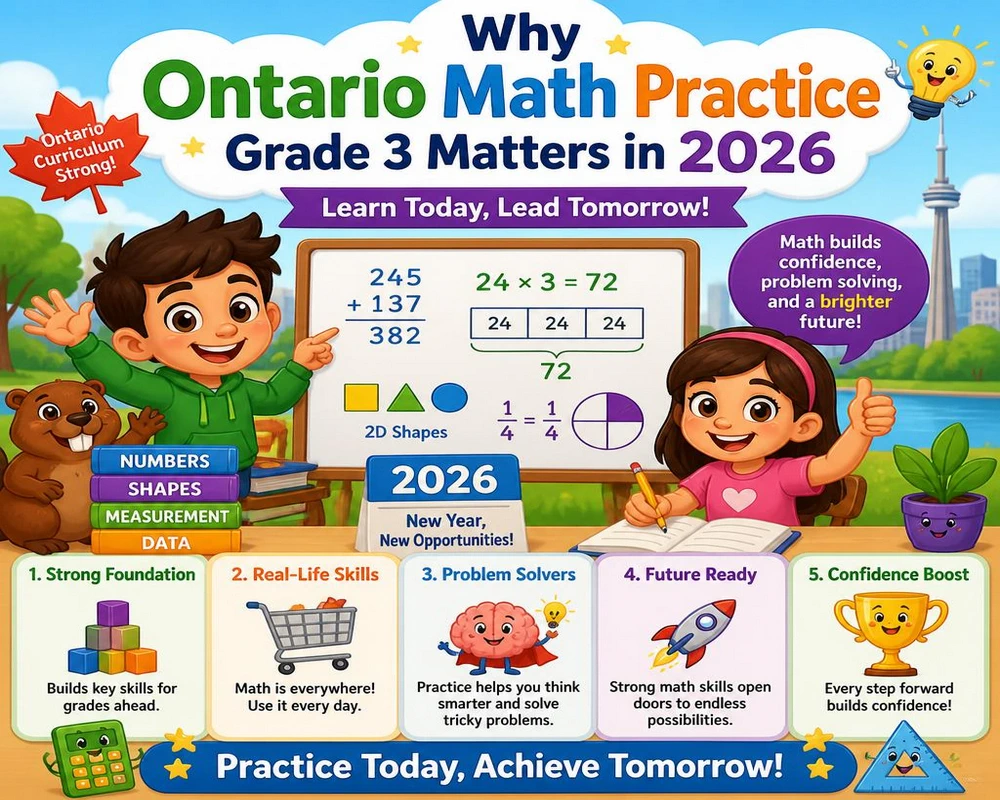
Why Ontario Math Practice Grade 3 Matters in 2026
The Ontario mathematics curriculum continues to emphasize conceptual understanding, procedural fluency, and real-life application. Multiplication Grade 3 Ontario builds directly on prior number sense, while fractions Grade 3 Ontario and area introduce proportional reasoning and geometry.
Recent 2024-2026 educational analyses show students with solid Grade 3 foundations perform significantly better in later EQAO assessments and beyond. Consistent, high-quality practice bridges school learning with home reinforcement.
Breaking Down Multiplication Grade 3 Ontario
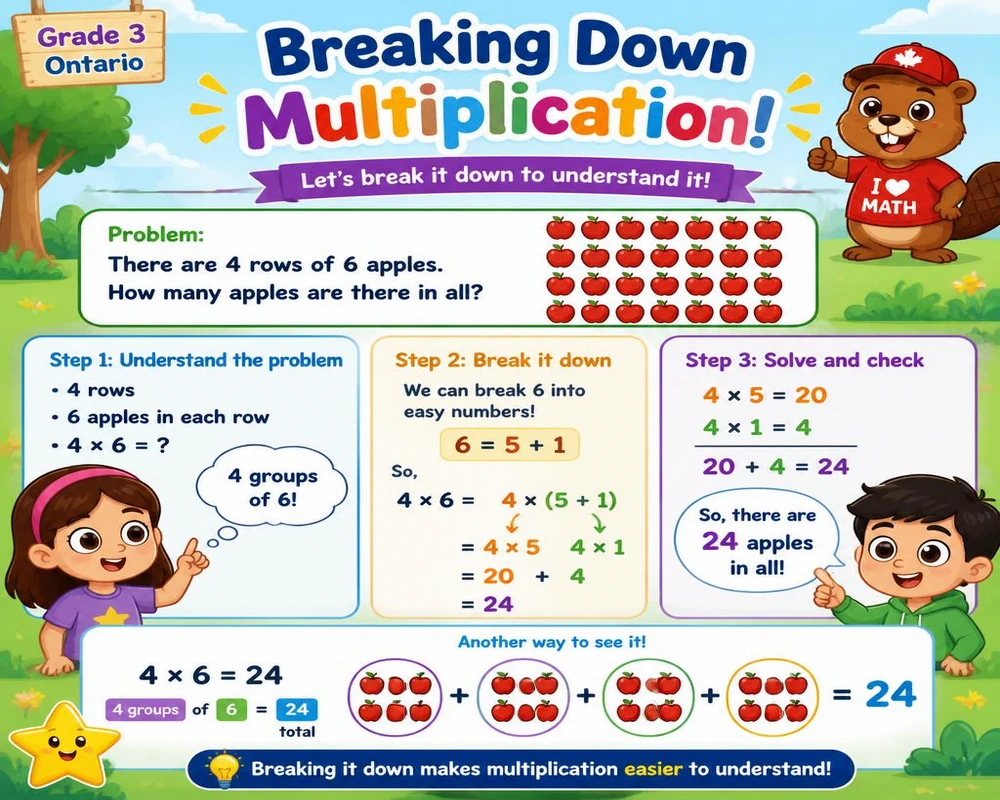
Multiplication shifts from repeated addition to a robust operation tool. Students focus on facts for 2, 5, and 10 initially, extending to 10 x 10 using arrays, area models, and number lines.
Key Expectations and Strategies
- Represent multiplication using equal groups, arrays, and skip counting.
- Understand the inverse relationship with division.
- Solve word problems involving multiplication up to 10 x 10.
Hands-On Activities:
- Build arrays with counters or blocks: “3 rows of 4 cookies.”
- Play multiplication bingo or card games.
- Use real-life scenarios like packing eggs in cartons.
Pro Tip: Start with facts of 2, 5, and 10 for quick wins, then expand. This builds confidence before tackling trickier facts.
Common Challenges and Solutions
Many students struggle with memorization. Combat this with songs, stories, and visual mnemonics rather than pure drills. A 2025 Ontario educator study found distributed practice (short daily sessions) outperforms cramming by improving long-term retention by 35%.
Exploring Fractions Grade 3 Ontario
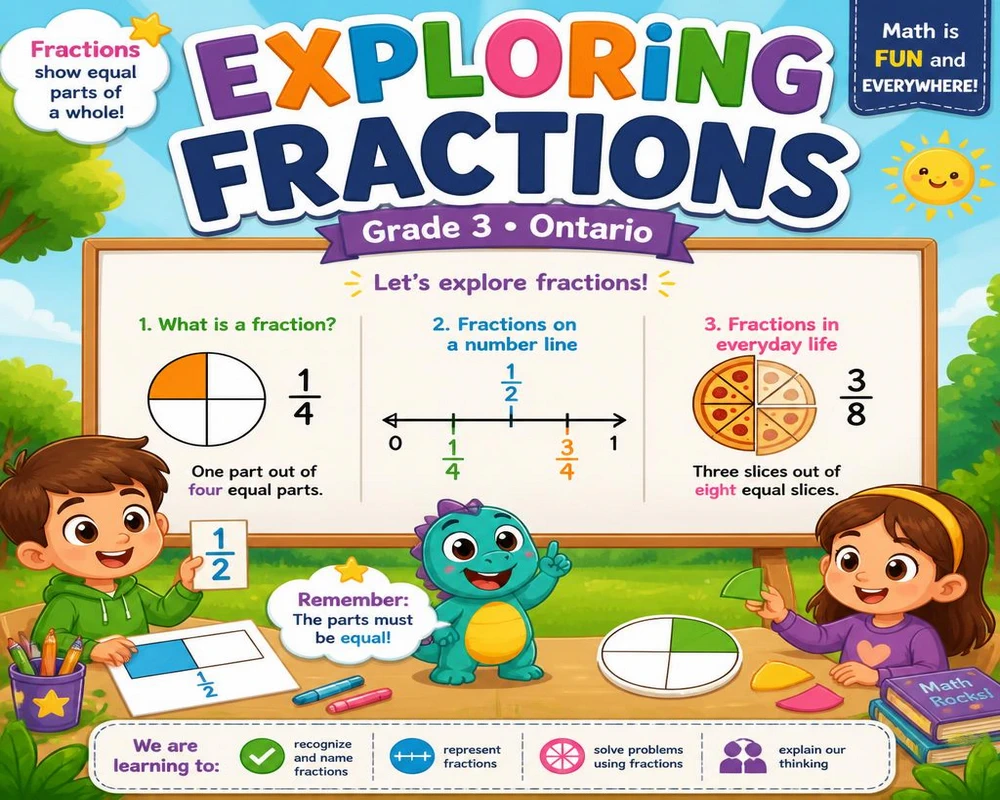
Fractions introduce the idea of parts of a whole and fair sharing. Students work with unit fractions, equivalent fractions, and fair-share problems.
Core Concepts to Master
- Identify and represent fractions using area models, fraction bars, and sets.
- Compare fractions with the same denominator or numerator.
- Solve fair-share problems leading to fractions, mixed numbers, and equivalents (halves, thirds, fourths, etc.).
Engaging Practice Ideas:
- Divide food items (real or pretend) among family members.
- Use paper folding or coloring to show equivalents like 1/2 = 2/4.
- Create fraction pizzas or gardens.
Storytelling helps: “Three friends share 8 cookies fairly. How much does each get?” This connects abstract concepts to relatable situations.
Linking Fractions to Multiplication
Emphasize how fractions relate to division and multiplication. For example, 3/4 is three groups of 1/4. This relational understanding strengthens overall number sense.
This guide focuses on multiplication, fractions, and area specifically, but if your child could use a broader refresher across the full year, our Grade 3 math practice hub covers every topic in the Ontario curriculum with hundreds of practice questions to work through at their own pace.
Mastering Area in Grade 3 Math Ontario
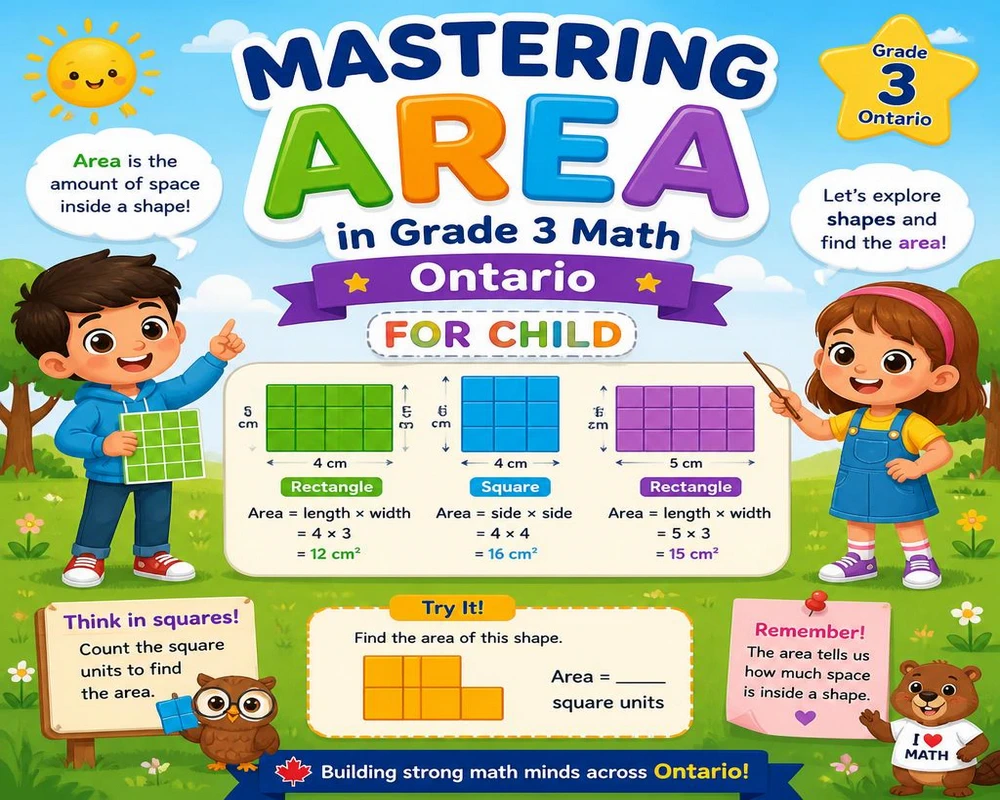
Area connects beautifully to multiplication. Students learn to measure area using unit squares and understand it as the space inside a 2D shape.
Teaching Area Effectively
- Cover shapes with square units and count them.
- Discover that area of a rectangle = length × width (introducing the formula conceptually).
- Compare areas of irregular shapes by decomposition.
Real-Life Examples:
- Planning a garden plot: “How many square units of soil do we need?”
- Designing a bedroom layout with grid paper.
- Comparing tablet screen sizes or book covers.
Pros and Cons of Different Approaches:
| Approach | Pros | Cons |
|---|---|---|
| Grid Counting | Concrete, visual | Time-consuming for large shapes |
| Formula Application | Efficient for rectangles | May skip conceptual understanding |
| Irregular Decomposition | Develops problem-solving | More complex for beginners |
Combine all three for balanced mastery.
EQAO Grade 3 Math Prep: Strategies for Success
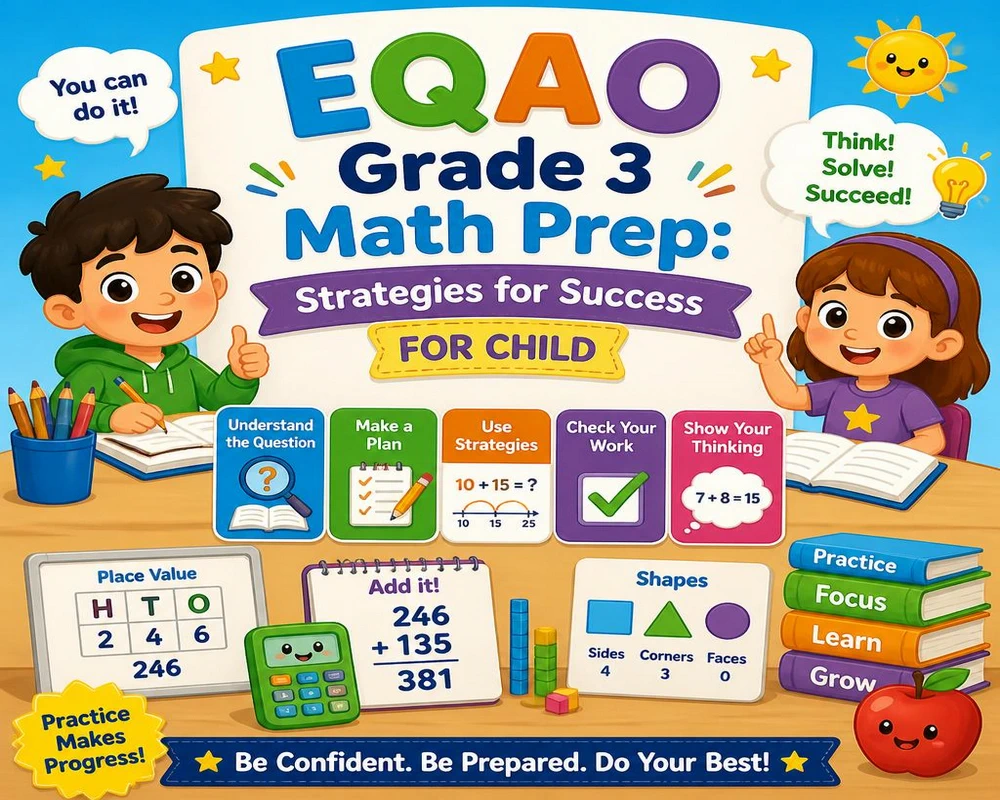
EQAO assessments evaluate thinking, application, and communication alongside knowledge. Strong Ontario math practice Grade 3 directly supports better performance.
Effective Preparation Techniques
- Practice open-response questions that require explanations.
- Use past EQAO-style problems focusing on multiplication, fractions, and measurement.
- Teach test-taking strategies like reading questions carefully and showing work.
- Simulate testing conditions periodically but keep stress low.
Data from recent EQAO results highlights that students comfortable explaining their thinking score higher. Incorporate “math talks” where kids verbalize solutions.
Grade 3 sits right at the point where Ontario's math curriculum starts asking more of students — multiplication tables, fraction reasoning, and area calculations all show up in the same school year. If you want to see exactly what the province expects by year's end, the Ontario Ministry of Education's elementary math curriculum page lays out every expectation grade by grade, which is a great way to double-check your child is on track.Sample EQAO-Style Grade 3 Math Questions
Multiplication:
- A box holds 8 rows of 6 crayons. How many crayons total? Show your work with an array.
Fractions:
- Share 10 apples among 4 friends. How much does each get? Use a model.
Area:
- A rug is 5 units long and 4 units wide. What is its area? Draw it.
Review answers together, discussing multiple solution paths.
Daily and Weekly Ontario Math Practice Grade 3 Routines
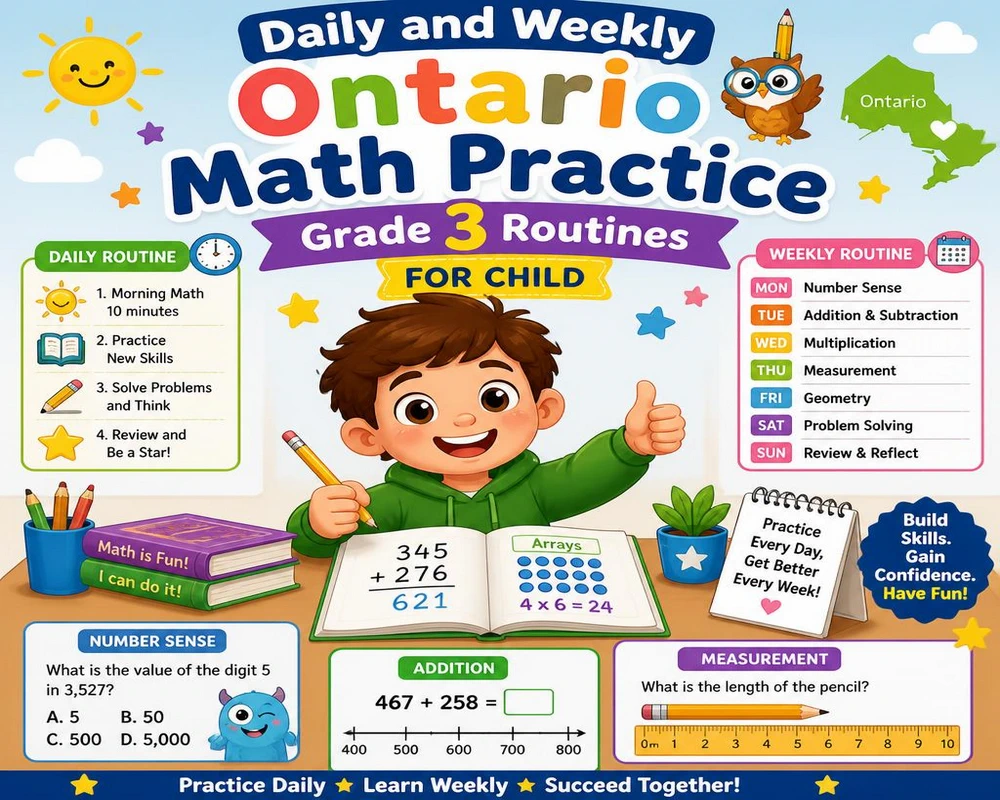
Consistency beats intensity. Aim for 20-40 minutes most days.
Sample Weekly Plan:
- Monday: Multiplication facts games.
- Tuesday: Fraction fair shares with manipulatives.
- Wednesday: Area exploration project.
- Thursday: Mixed word problems.
- Friday: Review and reflection.
- Weekend: Real-world application (cooking, shopping, building).
Incorporate movement, like hopscotch for multiplication or measuring outdoor spaces.
Integrating Technology and Resources
While hands-on remains king, quality digital tools reinforce concepts adaptively. Look for platforms aligned with Ontario expectations. Balance with offline activities to develop focus and creativity.
Free and low-cost resources from Ontario-based sites, teacher communities, and ministry supports offer excellent worksheets and lesson ideas.
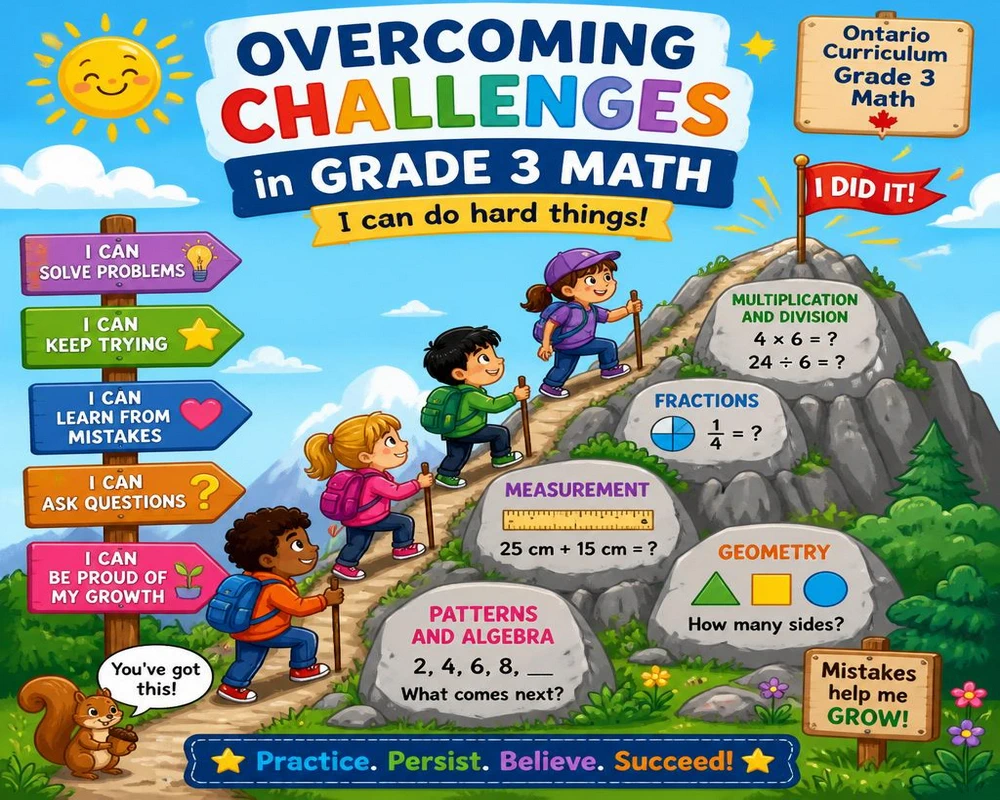
Overcoming Challenges in Grade 3 Math Ontario
Multiplication fact fluency, fraction misconceptions (like larger denominators meaning larger fractions), and distinguishing perimeter from area are common hurdles.
Expert Advice:
- Use concrete-pictorial-abstract progression.
- Address misconceptions immediately with targeted questions.
- Foster a growth mindset: “Mistakes help our brains grow.”
Parental involvement makes a huge difference. Regular, positive math conversations at home correlate with better attitudes and achievement.
Long-Term Benefits and Real-World Connections
Mastering these topics prepares students for Grade 4 and beyond, including more complex operations, decimals, and geometry. More importantly, it builds critical thinking, resilience, and practical life skills—from budgeting to spatial planning.
Many professionals trace their STEM confidence back to strong elementary foundations.
Conclusion
Ontario math practice Grade 3 focusing on multiplication, fractions, and area creates capable, confident young mathematicians. By blending curriculum knowledge with engaging, practical methods, you set your child up for success in EQAO and lifelong learning.
FAQ: Ontario Math Practice Grade 3
1. What are the main focuses in Grade 3 math Ontario? Multiplication and division facts (especially 2, 5, 10), fractions through fair sharing and equivalents, and calculating area using units and arrays.
2. How can I improve multiplication Grade 3 Ontario fluency? Daily short practices with arrays, games, and real-life problems. Focus on understanding before rote memorization.
3. What fractions should Grade 3 students know? Unit fractions, equivalents (e.g., 1/2 = 2/4), and solving fair-share scenarios with models.
4. How does area connect to multiplication Grade 3 Ontario? Area of rectangles is introduced as length times width, reinforcing multiplication through visual arrays.
5. What is the best way to prepare for EQAO Grade 3 math? Practice explaining thinking, use varied question types, and review key concepts regularly without over-testing.
6. How much practice time is recommended daily? 20-30 minutes of focused, engaging activities works best for most children.
7. Are there differences in the 2026 curriculum? Core expectations remain consistent with ongoing emphasis on financial literacy, coding, and real-world modeling.
8. How do I help if my child finds fractions difficult? Use concrete objects, visual models, and relate to sharing food or toys. Patient, repeated exposure with positive reinforcement helps.